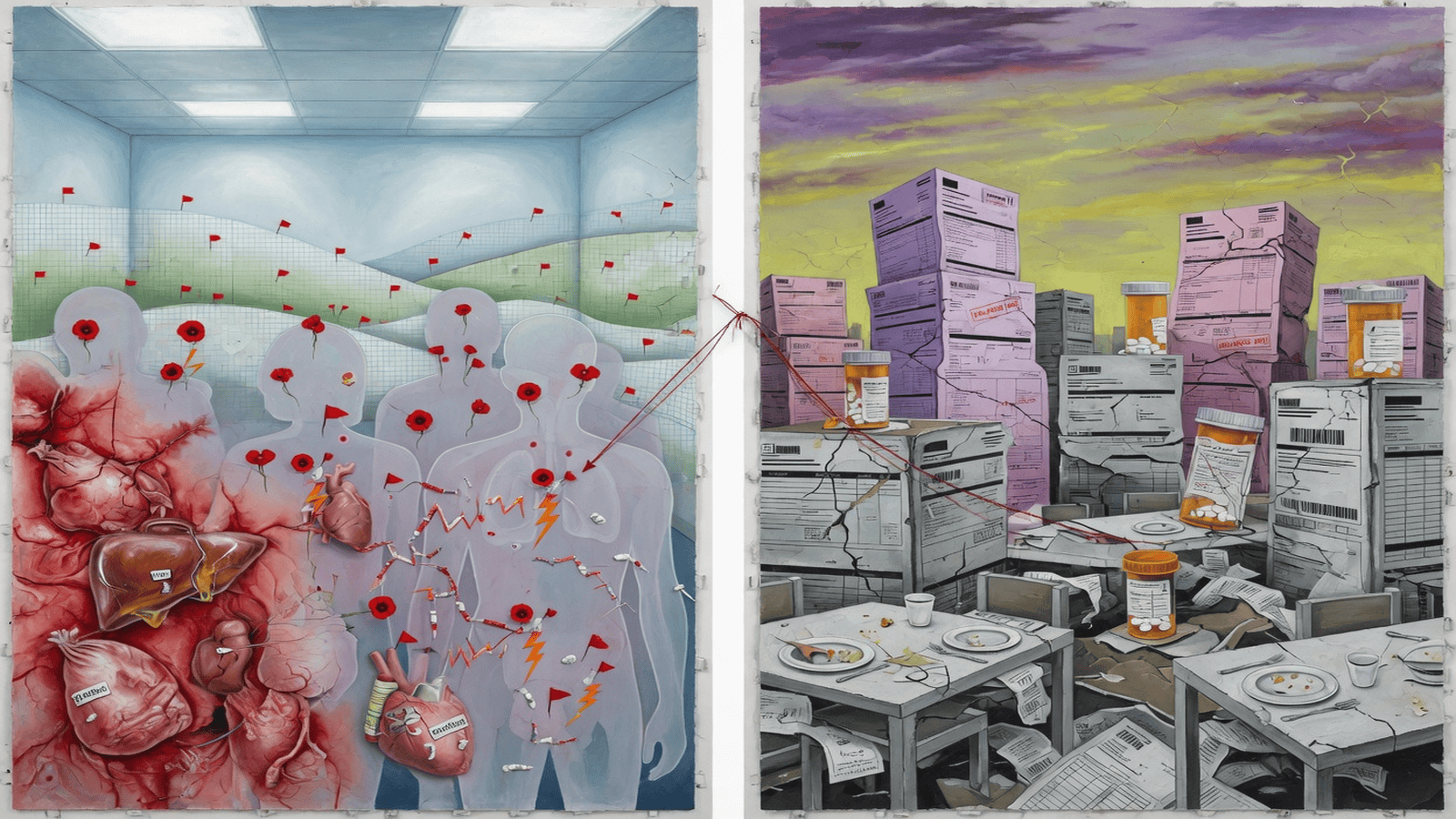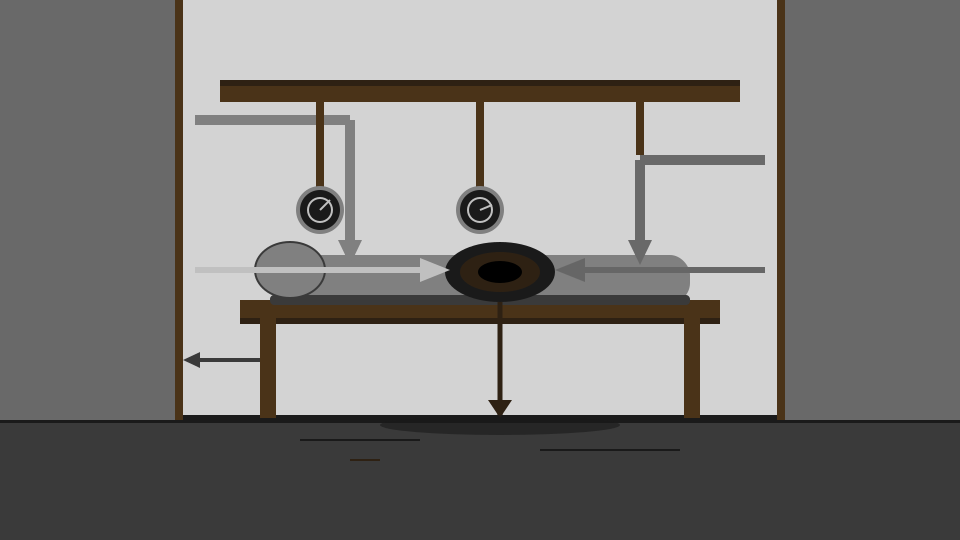
Ask a surgeon why the gallbladder came out, and the answer arrives fast, almost cheerful: you don’t really need it. That’s true in the narrow sense that a person can live, eat, and digest fat well enough without one. It’s also one of the most quietly revealing sentences in modern medicine. Cholecystectomy — removal of the gallbladder — is now among the most common abdominal operations performed in the country doing the most of them, and the organ is coming out almost always because of gallstones that track, closely, with obesity and insulin resistance. Nobody is treating a design flaw in the gallbladder. They are treating the downstream damage of a metabolic environment the organ was never built to survive, and calling the removal a fix rather than a receipt.
I. The Organ We Don’t Need
Randolph Nesse and George Williams gave this pattern a name three decades ago in Why We Get Sick: the body is not a machine with bugs, it is a bundle of trade-offs shaped by selection for reproduction, not for comfort in a world it never anticipated. The gallbladder concentrates bile for a diet of intermittent, hard-won fat. Feed it constant refined sugar and processed fat instead, and it will supersaturate, crystallize, and fail on schedule, the way any component fails when run continuously outside its design envelope. “You don’t need that organ” is true only after the sentence that should have come first: you didn’t need to break it either. Surgeons are not wrong to cut it out. They are just standing at the very end of a causal chain that started somewhere else entirely, and the language of the clinic — reassuring, procedural, mechanistic — has no natural way to say so.
II. One Ecological Shift, Many Diagnoses
The gallbladder is a small case of a much larger pattern. Obesity, insulin resistance, type 2 diabetes, fatty liver disease, chronic low-grade inflammation, and a rising share of common cancers keep arriving in medical literature as separate diagnoses with separate specialists, separate drugs, and separate patient-support pamphlets. Daniel Lieberman argues in The Story of the Human Body that this separation is mostly administrative rather than biological: these are downstream expressions of one shift in the food and movement environment, arriving in whichever organ happens to be weakest in a given body. Robert Lustig makes the mechanism more specific in Metabolical — chronic hyperinsulinemia, driven by a food supply engineered for shelf life and craving rather than metabolic tolerance, as the common thread running through conditions that look, on a chart, like a list of unrelated bad luck. Treating each diagnosis as its own siloed emergency is medically defensible and civilizationally misleading: it keeps the population from noticing that the emergencies are the same emergency, filed six different ways.
III. The Pseudoscience of Simplicity
The gap left by that misleading separation gets filled fast, usually by something worse than silence. Every metabolic condition on the list now has an ecosystem of miracle supplements, single-nutrient villains, and confident influencers offering the one root cause nobody else will tell you about. Susan Sontag diagnosed the underlying move in Illness as Metaphor: when a disease resists a clean causal story, culture supplies one anyway, usually moral rather than mechanistic — a failure of willpower, a betrayal of nature, a punishment for modern excess. That impulse is not confined to alternative medicine. Legitimate researchers built entire careers minimizing sugar’s role in cardiovascular disease while funded, quietly, by the sugar industry itself, a pattern of manufactured doubt that mirrors tobacco’s playbook more than it mirrors science. The honest description of chronic metabolic disease is genuinely complicated — diet, sleep, stress physiology, the built environment, drug side effects, and genetics all interacting over decades. Complicated does not sell supplements or clicks, so it keeps losing to whichever story is simple enough to fit in a caption.
IV. Medicine That Arrives Late
None of this indicts the acute-care system, which remains extraordinary at the thing it was built for: pulling someone back from a heart attack, resecting a tumor, replacing an organ that has already failed. The paradox is that this same system, so capable at the point of crisis, is structurally organized to arrive only at the point of crisis. Insurance reimburses procedures far more reliably than it reimburses the years of unglamorous maintenance — sleep, food quality, movement, stress — that would have kept the procedure from ever becoming necessary. A hospital that treats the complications of diabetes for twenty years is, by every financial metric available to it, a functioning business. A hospital that prevented the diabetes would show up nowhere on that ledger at all. Medicine keeps being simultaneously heroic and complicit: heroic at the bedside, complicit in a model that profits, however unintentionally, from the failure to arrive earlier.
V. The Financial Engine
That complicity has a price tag, and the price tag compounds. Elisabeth Rosenthal documents in An American Sickness how chronic disease management has become one of the most reliable growth sectors in the economy precisely because it is chronic — a condition that must be managed for forty years is worth more, to every actor paid per visit, per scan, per prescription, than a condition cured in one. Households carry it as medical debt and lost wages. Employers carry it as insurance premiums that outpace wage growth year after year. Public budgets carry it as the largest and fastest-growing line item most governments have, crowding out the very infrastructure and education spending that might have prevented the next generation’s version of the same disease. A body running low-grade metabolic damage for decades and a budget running low-grade fiscal damage for decades are not really two different stories. They are the same compounding-interest problem, expressed once in a liver biopsy and once in a bond rating.
VI. When Normal Becomes an Emergency
Somewhere between “public health problem” and “civilizational emergency” there is a threshold nobody has agreed to name, which may be exactly why it keeps getting crossed without a debate. A society that has quietly redefined chronic metabolic illness as the statistical default — not misfortune but background condition, the water everyone swims in — has changed what it means for a population to be well, without ever holding the vote that decision deserved. That redefinition is not a conspiracy and it does not require one; it only requires enough institutions finding it more convenient to manage the condition than to ask why so many bodies are arriving in the same condition at once. The gallbladder comes out, the chart gets a checkmark, and the causal chain that led there goes back to doing exactly what it was doing before, in the next body down the list.
A disclosure, as always: I’m not a doctor, just a programmer. Don’t take my word for it — ask your doctor if having your gallbladder out is good for you.
Further reading
- Randolph M. Nesse & George C. Williams — Why We Get Sick: The New Science of Darwinian Medicine (1994)
- Daniel E. Lieberman — The Story of the Human Body: Evolution, Health, and Disease (2013)
- Robert H. Lustig — Metabolical: The Lure and the Lies of Processed Food, Nutrition, and Modern Medicine (2021)
- Susan Sontag — Illness as Metaphor (1978)
- Elisabeth Rosenthal — An American Sickness: How Healthcare Became Big Business and How You Can Take It Back (2017)
- Cholecystectomy — Wikipedia