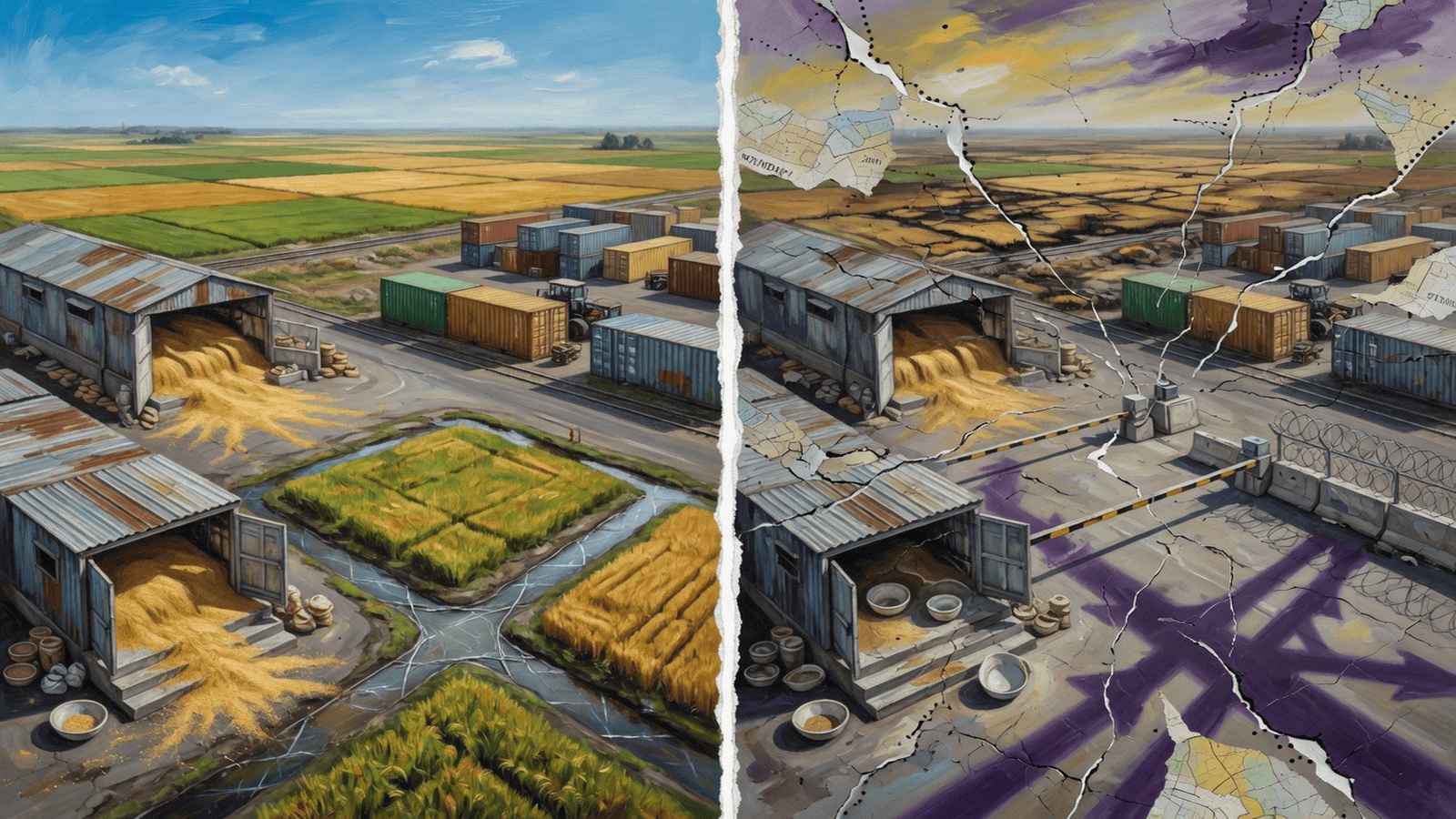
For most of history, scarcity was the honest explanation for suffering. There was not enough grain, not enough land, not enough medicine, so people starved and fought over what little existed. That explanation has been quietly running out of road for decades. The world produces enough calories to feed everyone alive today several times over, and still tens of millions go hungry every year while wars that serve no one’s stated interest grind on past the point of any rational return. The bottleneck was never only what we can produce. It is what we can agree to do with it.
I. The Abundance Paradox
Amartya Sen made the sharpest version of this case in Poverty and Famines, showing that famines rarely happen because food runs out; they happen because entitlement to food collapses for some group while supply keeps moving past them. Bengal in 1943 did not run short of rice. It ran short of a system that would let the poor buy any. That single reframing — from production to entitlement, from supply to access — generalizes far past famine. Modern hunger, modern displacement, modern war are usually not stories about insufficient stuff. They are stories about who gets cut out of the arrangement that distributes the stuff, and why the people doing the cutting can get away with it.
Once scarcity stops being the honest excuse, a harder question opens up. If the ceiling on human welfare is not resources, what is it? The uncomfortable answer is coordination: our capacity to build and sustain rules that let strangers share what abundance makes possible, without one group capturing it and everyone else defecting in response.
II. Convivence as a Civilizational Skill
Convivence is not the same thing as tolerance, and it asks for more than politeness. It is the practical, teachable competence of sharing institutions with people you did not choose and may not like, under real disagreement, without the arrangement collapsing into violence. That competence has recognizable parts: rules that people obey because they believe them legitimate rather than merely because they fear punishment, a habit of reciprocal restraint that survives the temptation of a one-time advantage, functioning channels for airing grievance before it hardens into vendetta, a willingness to trade a short-term win for a long-term equilibrium, and a sense of “we” wide enough to keep holding when the group is tested.
Elinor Ostrom spent a career documenting exactly this competence in the field, in Governing the Commons. Irrigation communities, forest cooperatives, and fisheries that by Garrett Hardin’s logic should have been strip-mined by their own members instead policed themselves for centuries, using locally designed rules, graduated sanctions, and cheap ways to monitor each other. Ostrom’s finding was not that people are naturally cooperative. It was that cooperation is an engineering problem with solvable designs — and that most large-scale failures trace back to institutions that never got engineered at all, not to some fixed fact about human nature. A society, in other words, can be materially rich and civically poor. Plenty on the shelf does not install any of the machinery above; it only raises the stakes of not having built it.
III. Why We Return to the Same Door
The cycle is recognizable enough that it barely needs footnoting. Prosperity expands what a society can do. Whoever is positioned to capture the new gains disproportionately does. Distrust hardens along the fault line the capture exposed, and identity calcifies around whichever grievance narrative explains the gap. Institutions that were supposed to referee the dispute lose the credibility to do it, usually because they were complicit in the capture. And once that credibility is gone, conflict stops being unthinkable.
The decisive move happens quietly, at the point where people stop choosing between peace and war in the abstract and start choosing between competing stories of who will keep them safe. Robert Putnam’s Bowling Alone traces a slower version of the same mechanism inside a single prosperous country: as associational life — the unglamorous machinery of clubs, unions, congregations, bowling leagues — thins out, so does the social capital that let strangers extend each other provisional trust. When formal institutions cannot supply that credible safety anymore, tribal narrative always can, and it is always cheaper to produce than the trust it displaces. That is the door. Every unresolved capture leads back to it.
IV. The Timescale Mismatch
Technological capacity compounds fast. Moral and institutional learning does not. Francis Fukuyama’s Trust makes the case that the social habits underwriting prosperity — the kind that let people extend credit, honor contracts, and cooperate with strangers on the promise of a shared norm rather than a signed guarantee — accumulate over generations and erode far faster than they build. Civilization keeps handing each generation tools invented for a future it hasn’t caught up to, alongside habits inherited from a past that no longer applies. That mismatch is why progress can feel simultaneously real and fragile: production problems get solved on the timescale of an engineering cycle, while relationship problems still run on the timescale of a generation, and the two clocks rarely agree to meet.
“Unfortunately, we tend to support basic values and traditions that reflect the past, without questioning their appropriateness to the present or the future.” — Jacque Fresco, The Best That Money Can’t Buy
Fresco’s own prescription was more radical than the case this essay is making — a full redesign of the system rather than an upgrade to its legitimacy — but the diagnosis travels on its own. Inherited values keep being applied past the date they stopped fitting the world they were built for, simply because nobody was forced to check the fit.
V. A More Demanding Question
The question worth asking is no longer whether there is enough. It is whether incentives can be built that reward cooperation more reliably than they reward extraction, whether coexistence can be taught with the same rigor a society already applies to literacy, whether institutions can earn trust faster than a demagogue can spend it down, and whether plural societies can hold disagreement without letting it slide into dehumanization. Steven Pinker’s The Better Angels of Our Nature argues, with a genuinely long lens, that the answer has trended positive for centuries — that the same institutional and normative machinery Ostrom found in a single valley has, however unevenly, been assembling at civilizational scale too. Pinker’s optimism is a useful counterweight, but it does not retire the question. Long-run decline in violence is compatible with sharp local reversals, and a society that stops maintaining the machinery can lose ground inside a single electoral cycle that took generations to gain.
If the machinery is not actively maintained, abundance does not neutralize conflict on its own. It just raises the amount worth fighting over.
VI. Why This Matters Now
None of this is an argument that production stopped mattering; it is an argument that it stopped being the binding constraint. We are very good, historically unprecedented good, at making more. We remain amateurs at deciding who the “more” belongs to once it exists, and at building institutions that survive the moment someone decides not to share. Convivence is the name for the missing curriculum — not a mood to cultivate, but a set of skills that can be designed, taught, and measured, the way Ostrom measured them in irrigation ditches and Putnam measured them in bowling leagues. Until it gets that treatment, plenty will keep behaving exactly like scarcity, because the shortage was never in the granary.
It happens that today is July 20 — Colombia’s independence day, the same week the United States marks two hundred and fifty years of its own. Independence? I don’t think so. We are still living on scarcity — not of grain, but of the convivence this essay has been arguing for — and a country that hasn’t solved that scarcity is neither free nor independent. It has only changed landlords.
Happy birthday to my eternal love and companion.
Further reading
- Amartya Sen — Poverty and Famines: An Essay on Entitlement and Deprivation (1981)
- Elinor Ostrom — Governing the Commons: The Evolution of Institutions for Collective Action (1990)
- Garrett Hardin — The Tragedy of the Commons, Science (1968)
- Robert D. Putnam — Bowling Alone: The Collapse and Revival of American Community (2000)
- Francis Fukuyama — Trust: The Social Virtues and the Creation of Prosperity (1995)
- Steven Pinker — The Better Angels of Our Nature: Why Violence Has Declined (2011)
- Jacque Fresco — The Best That Money Can’t Buy: Beyond Politics, Poverty, & War (2002)