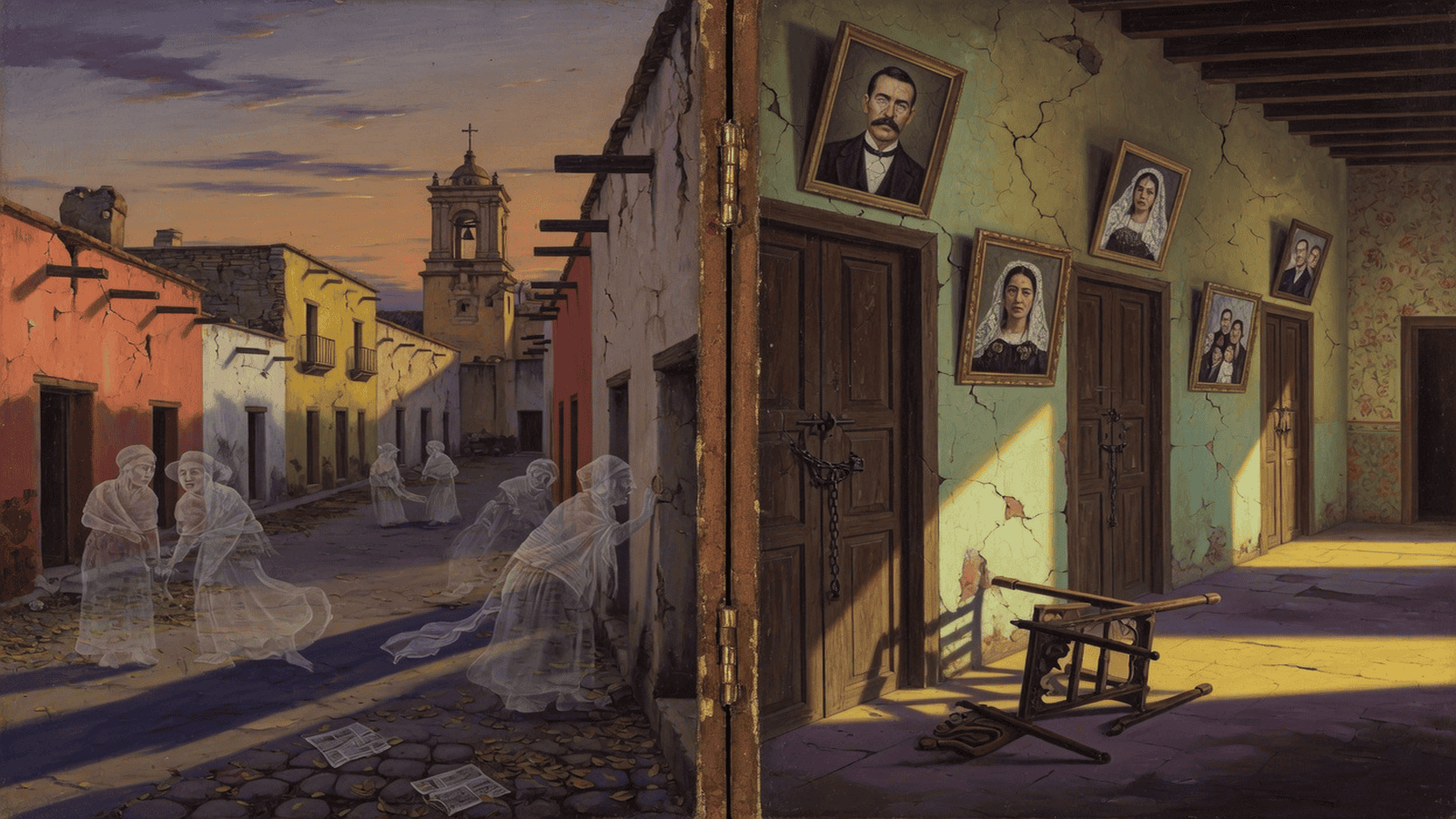
I read Pedro Páramo decades ago and thought I had understood it: a haunted town, the dead murmuring to each other across timelines, memory rendered as fog. Returning to it now, a second book sits underneath the first one. Juan Rulfo’s novel is not only a feat of atmosphere. It is a social diagnosis — abuse, incest, patriarchal impunity, and the mechanism by which private violence hardens into public order. The setting is unmistakably Mexican. The grammar it describes is not.
I. First Reading, Second Reading
On a first encounter, Pedro Páramo tends to work as an aesthetic shock: fragments, ghosts, a town that seems to breathe through its dead rather than its living. That was my reading at nineteen or twenty, and it wasn’t wrong — Rulfo built the book to land that way, voices bleeding into each other with no quotation marks to referee them, a chronology that refuses to hold still.
On a second encounter, decades later, the architecture looks different. The ghosts stop functioning as a device and start functioning as evidence. Comala’s dead aren’t there for atmosphere; they’re witnesses who never got to testify while alive, still repeating the one thing that mattered to them because nothing else was ever resolved. What haunts the town, on this reading, is not death. It is the long afterlife of domination — the way harm keeps circulating through a place long after the people who caused it and the people who suffered it are both gone.
Rodrigo Prieto’s 2024 Netflix adaptation is a useful marker of exactly where the first reading tends to stop. Shot by a cinematographer making his directorial debut, the film renders the haunted-town surface with real fidelity — the dust, the murmuring, the dead bleeding into the living — and critics praised precisely that atmosphere. It is a faithful adaptation of the book most first-time readers actually encounter. What it does not, and arguably cannot, easily render is the second book: the slow accumulation of who absolved whom, and why, that only becomes visible on a rereading unhurried by plot.
II. Comala as a Political Climate
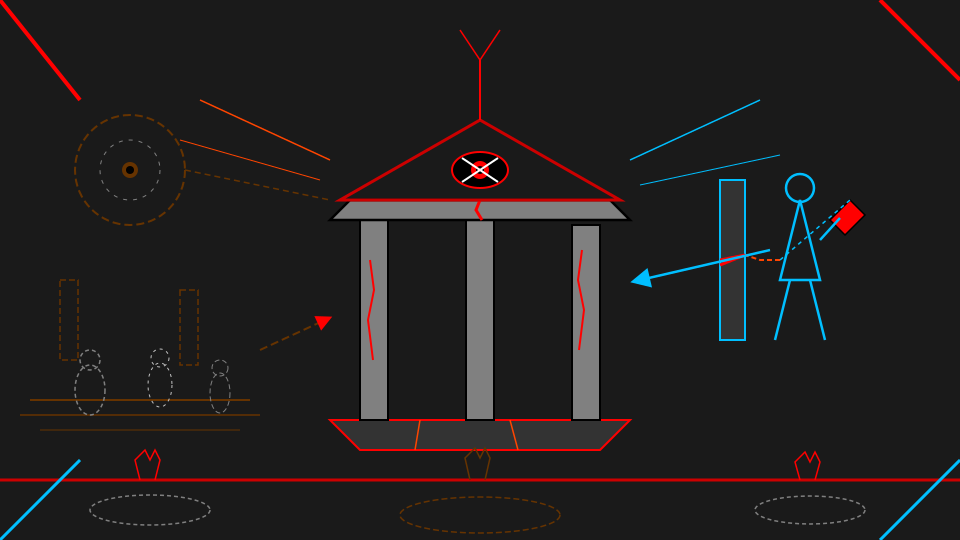
Read as a system rather than a mood, Comala maps cleanly onto a familiar set of mechanisms: land capture, patron-client dependence, religious mediation that launders instead of restrains, sexual coercion, and silence functioning as the only available survival strategy. Pedro Páramo himself is not merely one cruel man dropped into a village. He is a system wearing a face, and Rulfo’s trick is to make the man and the structure inseparable — you cannot tell where his personal cruelty ends and the town’s institutional arrangement begins, because by the time the novel opens they have fully merged. That merger is the actual subject. Through it, Rulfo shows how violence migrates out of the private sphere and into custom, until injustice stops registering as injustice and starts registering as weather — just the way things are in Comala, the way they’ve always been.
III. Abuse as Structure, Not Incident
Seen this way, the novel names forms of abuse that are usually narrated, when they’re narrated at all, as isolated tragedy rather than as pattern: gendered exploitation, coerced intimacy, the incestuous contamination of kinship boundaries, fear inherited across generations like property, and moral or religious language recruited to mask domination rather than interrupt it. The priest in Comala absolves what he should refuse to absolve, because refusing would cost him something the arrangement isn’t built to let him spend.
The force of the book is that it never sermonizes about any of this. It stages consequences instead of naming causes. Bodies carry what legal frameworks failed to interrupt; voices carry what moral frameworks failed to name; memory carries what the living generation was never allowed to say out loud. Rulfo trusts the reader to assemble the diagnosis from the wreckage rather than handing it over as thesis, which is exactly why the book survives being read as pure atmosphere for as long as it does — the social critique is load-bearing, but it doesn’t advertise itself.
IV. A Parallel with Marcela
A useful comparison sits, unexpectedly, in Don Quijote. Marcela’s episode — the shepherdess blamed for a suitor’s suicide, who steps forward to reject the accusation on its own terms — and Rulfo’s Comala come from different centuries, different registers, different literary ambitions entirely, and yet both interrupt an accepted social script at the exact point where the script asks to be accepted without examination.
Marcela refuses the premise that her beauty creates an obligation in anyone else; she names the logic and rejects it in the same breath, in public, in her own voice. Rulfo works from the opposite direction: he shows what happens when that same obligation — call it patriarchal entitlement — is imposed by force instead of argued for, and normalized by hierarchy instead of contested by a woman with an audience. Cervantes gives the refusal a speech. Rulfo gives the imposition a town. The shared thread underneath both is that patriarchy frames its violence as custom, as the natural order of things that doesn’t require justification — and literature, in both cases, is the machinery that breaks the frame and makes the custom visible as a choice.
V. Latin American Archetype, Global Pattern
Rulfo’s setting is unmistakably Latin American — the cadence, the post-revolution land regime, the specific weight of a rural patronage system built on top of unresolved agrarian reform. None of that is incidental or swappable; it’s what gives the novel its texture and its historical footing. But the grammar underneath the setting — impunity, familial secrecy, coercive masculinity, communal silence functioning as social glue — is not regional property. It recurs, with local vocabulary substituted in, across societies that share none of Comala’s history.
The claim, then, is double rather than either-or: Pedro Páramo is deeply local, and Pedro Páramo is painfully universal. The two claims aren’t in tension. The local texture is precisely what gives the universal pattern its credibility — a novel that tried to describe “patriarchal impunity” in the abstract would produce a pamphlet; a novel that renders it through one specific dead town produces literature that travels.
VI. Why This Rereading Matters
Rereading a book decades later isn’t only nostalgia, and it isn’t only the pleasure of noticing what a younger reader missed. It’s a change in ethical attention — the same sentences, read by someone whose sense of where power hides has shifted, surface a different book. What looked like symbolic darkness on the first pass reads, on the second, as social testimony: a way to think about how societies remember violence without ever fully naming it, and how the dead stay present, murmuring, precisely because justice never arrived to let them stop.
And as bad as it sounds, none of this surprises me. For all the happiness my country claims for itself, it is only a matter of time before the same pattern repeats. Pedro Páramo is already living in the United States, no visa required. Let’s hope evolution helps us survive his current incarnation, and that we don’t end up becoming Comala.
Further reading
- Juan Rulfo — Pedro Páramo (1955)
- Miguel de Cervantes — Don Quijote de la Mancha (1605/1615)
- Juan Rulfo — Wikipedia
- Pedro Páramo (2024 film), dir. Rodrigo Prieto — IMDb