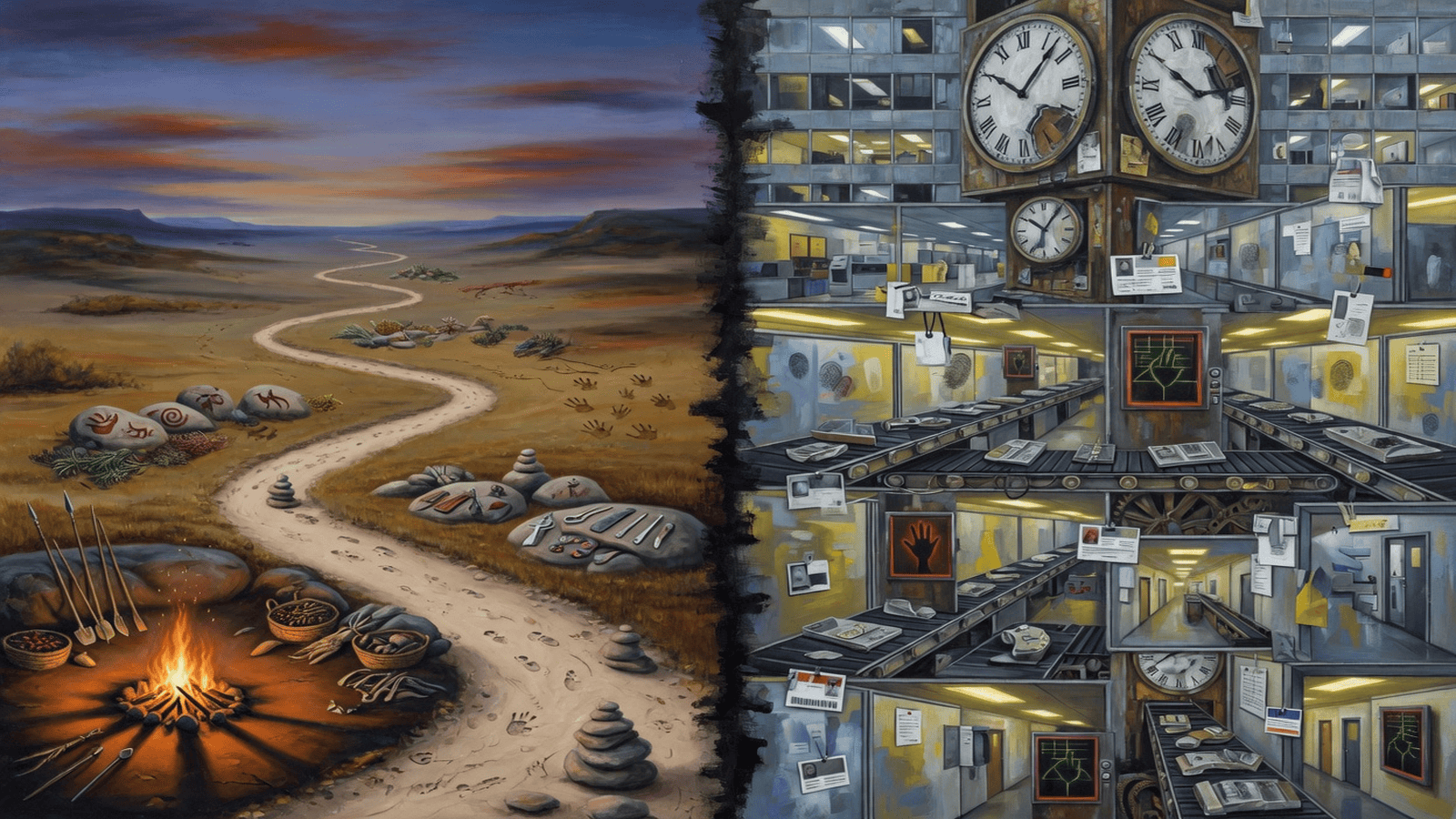
In 1966, at a symposium called “Man the Hunter,” the anthropologist Marshall Sahlins stood up with data other people had already collected — Richard Lee’s fieldwork among the Dobe Ju/‘hoansi of the Kalahari, the Arnhem Land studies from Australia — and said the quiet part out loud. Foragers routinely described as living at the ragged edge of subsistence were, in fact, meeting their needs on something like fifteen to twenty hours of work a week, and spending the rest of their waking hours resting, talking, and doing nothing in particular. Sahlins published the argument, expanded, in Stone Age Economics (1972) under a title designed to sting: “the original affluent society.” Not affluent because foragers had much, but affluent because they wanted little and got it without the compulsion the word “work” now implies. The finding embarrassed a whole civilizational story in which agriculture and industry had liberated humanity from want. They hadn’t. They had invented a new way of being busy, and then made the busyness feel like fate.
I. The Original Affluent Society
What Sahlins and, decades later, the anthropologist James Suzman in Work: A Deep History (2020) both describe is not laziness but a different relationship to time: task orientation. A hunt ends when the animal is down. Foraging ends when the basket is full. There is no fixed shift, no quota, no manager measuring output against a clock, because there is no clock organizing the day in the first place. Survival was met with irregular, modest effort, tuned to what the world actually offered that day. Nothing in this arrangement required a moral case for laboring past what was needed. The idea that a person should work a uniform number of hours regardless of what the work produced — that idea had not been invented yet.
II. Task Time Becomes Clock Time
It gets invented, according to the historian E.P. Thompson’s landmark essay “Time, Work-Discipline, and Industrial Capitalism” (Past & Present, 1967), somewhere between the standardization of the mechanical clock and the rise of the factory. Pre-industrial rural labor was still task-oriented — milking happens when the cows need milking, harvest happens when the grain ripens — but the factory cannot run on that logic; it needs bodies present and synchronized, all of them, at the same hour, whether or not there is a task ripe for doing. Thompson’s phrase for what results is exact: time is now currency, it is not passed but spent. Employers imposed the change with bells, fines, and time-sheets; but the durable trick was getting workers to police their own punctuality, to feel guilt at an idle hour the way their grandparents felt nothing at all. Discipline stopped being applied from outside and became a habit of the self.
III. The Sin of Idleness
Habit needed a justification, and Max Weber supplied its genealogy in The Protestant Ethic and the Spirit of Capitalism (1905). Calvinist doctrine left believers with no way to know whether they were among the predestined elect, and worldly diligence — methodical, frugal, tireless labor, with the profits reinvested rather than enjoyed — became the only available evidence, to oneself and to others, that one belonged to the saved. Work was no longer just what you did to live. It became what you did to prove you deserved to. Weber tracked how the religious scaffolding eventually fell away and left the compulsion standing on its own: hard work as character, idleness as near-sin, unemployment read as personal failure rather than as what it usually is, a structural outcome. The pivot the seed of this essay names — necessity hardening into narrative — has a fairly precise date of manufacture.
IV. The Body That Must Be Useful
Michel Foucault, in Discipline and Punish (1975), traced the same architecture across institutions that have nothing else in common: the school, the barracks, the hospital, the factory, the prison. Each organizes bodies with a timetable, a rank, a constant low-grade surveillance, an examination — and each produces what Foucault called docile bodies, useful and obedient in the same motion. Biopower, in his account, rarely says no. It says when, how, in what sequence, and for how long, and it says it so early and so thoroughly that by the time a person enters the labor market, the labor market barely needs to persuade them of anything. Eight-year-olds practice sitting still for bells years before any of them hold a job. The clock discipline Thompson found at the factory gate turns out to be a dialect of a much older grammar.
V. Naming the Commodity, and Refusing It
Karl Polanyi gave that grammar its economic name in The Great Transformation (1944): labor, along with land and money, is a “fictitious commodity” — something the market treats as a good produced for sale, when in fact none of the three was ever produced for that purpose. Labor, Polanyi wrote, is only another name for the activity of living; detach it from the person and sell it wholesale to market discipline, and the social dislocation that follows is not a side effect but the predictable result of pricing something that was never for sale. Six decades earlier, and from a French prison cell, Paul Lafargue — Marx’s son-in-law — had made the same diagnosis as a provocation rather than an analysis: The Right to Be Lazy (1880) mocked the working class for internalizing what he called the religion of work more devoutly than the bourgeoisie who profited from it, and demanded, against Jefferson’s pursuit of happiness, a plain right to idleness. Between Polanyi’s diagnosis and Lafargue’s demand sits the essay’s actual proposition: if labor was never a natural commodity to begin with, prying survival away from its sale isn’t utopian. It’s correcting an entry that was booked wrong from the start.
VI. Testing the Exit
The correction has been tried, imperfectly, in the world. Polanyi’s own case study of Speenhamland — the English parish relief system of 1795, which subsidized wages out of poor rates and collapsed under its own perverse incentives — is a warning about how not to do it, tying support to bread prices rather than decoupling it from labor at all. Better evidence comes from Mincome, the guaranteed-income experiment run in Dauphin, Manitoba from 1974 to 1979: the economist Evelyn Forget’s later analysis of the data found no meaningful drop in labor-force participation except among new mothers extending leave and teenagers finishing school instead of dropping out, alongside a measurable decline in hospitalizations. Kenya’s GiveDirectly cash-transfer trials found similar resilience decades later, on a different continent, under different conditions. Rutger Bregman gathers this evidence into an explicit policy case in Utopia for Realists (2017): what if the fifteen hours a week Sahlins found among the Ju/‘hoansi were still available to reclaim — not through foraging, but simply by removing the coercion that currently fills every hour beyond them.
None of this proves idleness is anyone’s natural state, or that everyone would keep showing up without the whip. What it complicates is an assumption buried deep enough to pass for common sense: that only the fear of starvation makes people productive at all. The Kalahari forager, the Manitoba welfare recipient, and the Frenchman writing from his prison cell are separated by roughly two hundred thousand years and a few hundred pages, and they seem to be filing the same report from different instruments — work does not vanish when the whip is lifted, it changes shape. The open question, the one this essay’s evidence cannot close, is what fills the vacated hours once nobody has to justify having them.
None of the systems tried so far actually settle it. Feudalism, capitalism, the socialist and communist corrections to capitalism, and now the techno-feudal hybrid Yanis Varoufakis describes in Technofeudalism (2023) — each rearranges who claims the surplus of someone else’s fifteen hours without answering the more basic question this essay opens: what those hours are for once the whip is gone. I don’t think there is a finished answer yet, only draft after draft of the same argument between survival and convivence — Ivan Illich’s word, in Tools for Conviviality (1973), for tools and institutions scaled to let people do things together rather than be done to — revised over centuries, mostly by trial and error, with no particular reason to think the current draft is anywhere near the last one.
Further reading
- Marshall Sahlins — Stone Age Economics (1972)
- James Suzman — Work: A Deep History, from the Stone Age to the Age of Robots (2020)
- E.P. Thompson — “Time, Work-Discipline, and Industrial Capitalism”, Past & Present (1967)
- Max Weber — The Protestant Ethic and the Spirit of Capitalism (1905)
- Michel Foucault — Discipline and Punish: The Birth of the Prison (1975)
- Karl Polanyi — The Great Transformation (1944)
- Paul Lafargue — The Right to Be Lazy (1880)
- Mincome guaranteed-income experiment — Wikipedia (1974–1979)
- Rutger Bregman — Utopia for Realists (2017)
- Yanis Varoufakis — Technofeudalism (2023)
- Ivan Illich — Tools for Conviviality (1973)