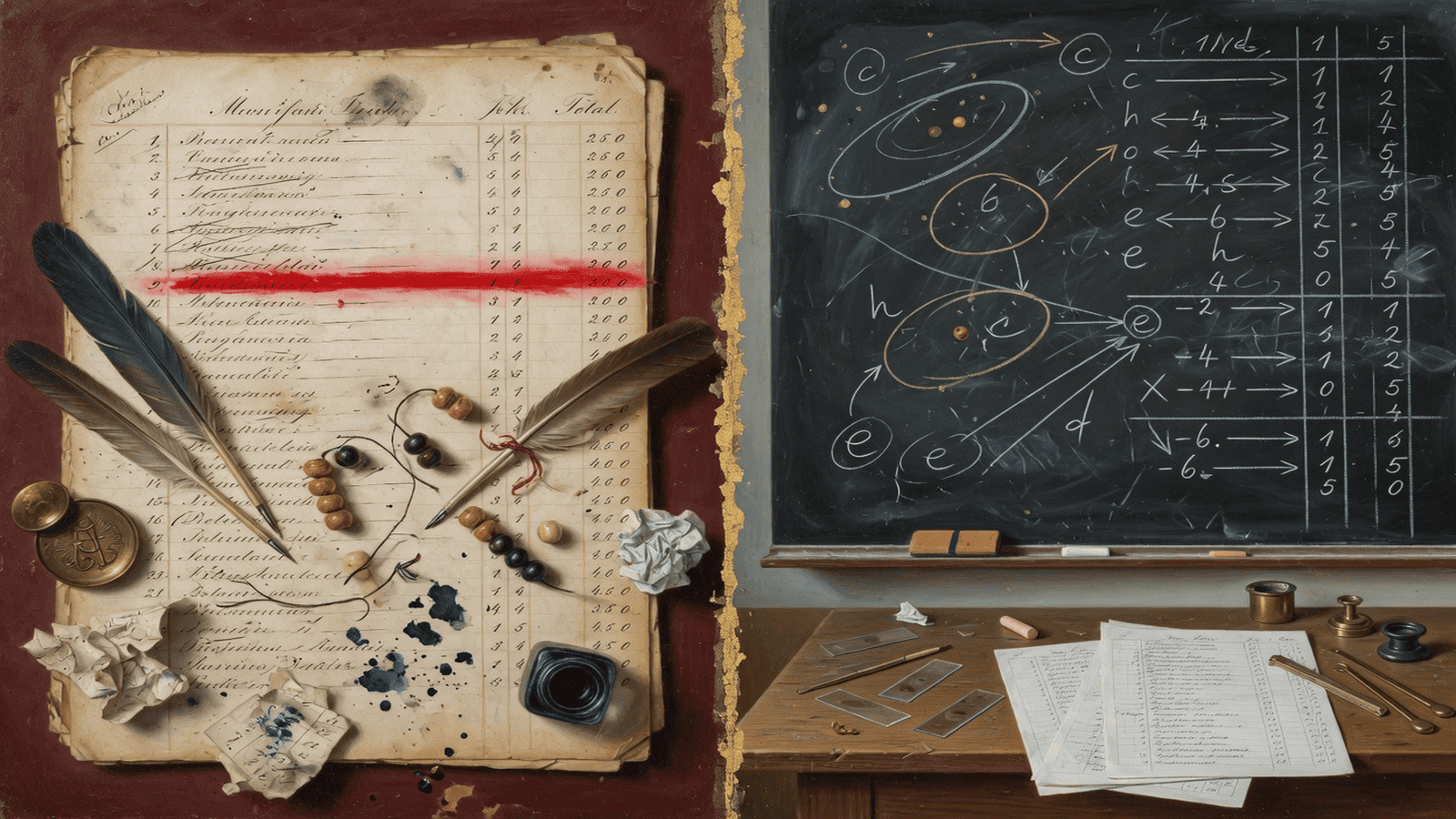
Luca Pacioli did not invent double-entry bookkeeping — Venetian merchants had been using it for at least a century before his 1494 treatise wrote the method down — but he did name the discipline’s real trick. Every transaction gets entered twice, once as a debit and once as a credit, and if the two columns ever fail to match, an error exists somewhere in the world the ledger describes. The genius of the system is not that it records money. It is that it manufactures a built-in alarm for reality not matching the record. Historians of science have mostly ignored this as a source of method, filing it under commerce rather than epistemology. But run the same trick on nature instead of a merchant’s warehouse, and a surprising amount of the history of discovery turns out to be exactly this: someone auditing a ledger, finding it would not close, and naming whatever was missing so it would.
I. The Chemist Who Weighed Everything
Antoine Lavoisier’s decisive move, in the 1770s and 80s, was not a new theory so much as a new instrument habit: he weighed things before and after burning them, in sealed vessels, and insisted the totals match. Prevailing chemistry held that combustion released “phlogiston,” a fire-substance that escaped into the air as a thing burned. Lavoisier’s scale disagreed. Metals gained weight when calcined, not lost it — the opposite of what phlogiston theory required, and the kind of discrepancy a ledger cannot simply write off. In Traité élémentaire de chimie (1789) he closed the account by naming the thing actually being added: a gas he called oxygen, absorbed from the air during burning. Conservation of mass — nothing lost, nothing created, only transformed — is Lavoisier’s ledger axiom stated as a law of nature. Chemistry’s founding act was literally an audit.
II. The Planet That Was There and the One That Wasn’t
By the 1840s, astronomers had a similar problem with Uranus: its observed orbit kept drifting from what Newtonian gravity predicted, a residual too small to ignore and too consistent to be measurement error. Urbain Le Verrier in Paris and John Couch Adams in Cambridge independently did the same arithmetic — calculated where an unseen mass would have to sit to pull Uranus into the orbit actually observed — and in September 1846, Johann Galle pointed a telescope at Le Verrier’s coordinates and found Neptune within a degree of the prediction. The ledger had demanded an entry, and the entry was sitting there, waiting to be seen.
Flush with that success, Le Verrier ran the same method again in 1859, this time on a stubborn 43 arcseconds per century of extra precession in Mercury’s orbit that Newtonian mechanics could not account for. He posited another interior planet, named it Vulcan, and half of French astronomy spent decades hunting for it. It was never there. The method that had found Neptune had, on Mercury, produced a plausible-looking phantom entry — proof that a ledger can demand a correction without telling you whether the correction is a new object or a mistake in the accounting system itself.
III. When the Whole Ledger Is Wrong
Two mismatches, a generation apart, turned out to need the same kind of fix: not a new line item, but new books. In 1887, Albert Michelson and Edward Morley built an instrument sensitive enough to detect Earth’s motion through the “luminiferous ether,” the medium light was assumed to need the way sound needs air. The experiment found nothing — no ether wind, in any direction, at any time of year. Physicists patched the account for years with contraction hypotheses and drag coefficients, entries that kept the ether solvent on paper. Albert Einstein closed it a different way in 1905: there was no ether to detect, because the speed of light is constant for every observer regardless of motion. Special relativity did not add a missing term. It rewrote the columns so the old missing term was never needed.
Ten years later Einstein audited Le Verrier’s phantom planet the same way. Mercury’s precession was real, Vulcan was not, and general relativity explained the 43 arcseconds as spacetime itself curving around the sun — a correction to the geometry, not an addition to the inventory of planets. Thomas Levenson’s The Hunt for Vulcan (2015) tells the fifty-six-year version of this story: an entire discipline hunting diligently, honestly, and wrongly for an object because nobody yet had the accounting system that made the object unnecessary.
IV. The Desperate Remedy
By 1930, physicists measuring beta decay had their own books not closing: electrons flew off nuclei with a continuous spread of energies, when conservation of energy demanded a single fixed value, the difference between two known nuclear states. Either energy conservation — physics’ oldest and most trusted axiom — was false, or something invisible was carrying the missing energy away, undetected. In an open letter to a Tübingen physics conference that December, addressed to “Dear Radioactive Ladies and Gentlemen,” Wolfgang Pauli proposed the second option and called it, in his own words, “a desperate remedy”: a neutral, near-massless particle emitted alongside the electron, carrying off exactly the energy the ledger was missing. Enrico Fermi named it the neutrino a few years later. Clyde Cowan and Frederick Reines detected it directly in 1956, twenty-six years after Pauli posited a particle purely because the accounting required one. Frank Close’s Neutrino (2010) is the full account of a particle discovered, in the strictest sense, on paper first.
V. The Ledger That Audits Itself
Double-entry bookkeeping catches an error after the fact: if debits and credits disagree, someone finds out, eventually, when the books are reconciled. It still assumes a bookkeeper you trust to keep an honest single copy. In 2005 the systems engineer Ian Grigg named the logical next step “triple-entry accounting”: have both parties to a transaction sign a shared, cryptographically verifiable receipt, so that the receipt itself — not either party’s private ledger — becomes the record neither side can quietly alter. Three years later, an anonymous author writing as Satoshi Nakamoto built exactly that receipt into a working system, described in a nine-page paper, “Bitcoin: A Peer-to-Peer Electronic Cash System” (2008): a blockchain in which every computer on the network keeps an identical ledger, additions are accepted only once a majority of the network agrees they are consistent with everything recorded before, and the specific fraud double-entry bookkeeping was built to catch after the fact — spending the same unit of value twice — becomes something the system refuses to accept in the first place. Bitcoin’s 2009 launch did not discover a hidden term the way Neptune or the neutrino did. It discovered, or perhaps only built, a ledger that no longer needs a trusted keeper to close, because closing is now a property of the network agreeing with itself in real time.
VI. The Account Still Open
Run this pattern forward and the ledger metaphor stops being decoration and starts being method: record the observation, compare it to the model, isolate what doesn’t close, and either name the missing term or rewrite the books that made it look missing. Oxygen, Neptune, and the neutrino are the entries that turned out to name something real. Vulcan and the ether are the entries that turned out to be errors in the accounting system itself, correctable only by Einstein throwing out the old books twice, a decade apart. Both outcomes come from the identical first move — refusing to let a discrepancy stand unexamined — and only hindsight tells you which kind of correction you are looking at.
Galaxy rotation curves today do not match the gravity of visible matter, and the universe’s expansion does not match the energy budget general relativity accounts for. Cosmologists have named the discrepancies dark matter and dark energy, in the full knowledge that the names might turn out to be Neptune or might turn out to be Vulcan. The ledger is open. Nobody yet knows which kind of correction closes it.
Every listicle promising to fix your life eventually gets around to the same four items: learn to cook, learn what your liver actually does, learn a language before you’re too old to be bothered, and — buried near the bottom, as if it were the least urgent of the four — learn accounting. It should be first. The other three tell you how to run a body, a kitchen, or a sentence. Accounting is the one that tells you when any of it has stopped adding up.
Further reading
- Antoine Lavoisier — Traité élémentaire de chimie (1789)
- Thomas Levenson — The Hunt for Vulcan: How Albert Einstein Destroyed a Planet and Deciphered the Universe (2015)
- Albert Einstein — Relativity: The Special and the General Theory (1916)
- Frank Close — Neutrino (2010)
- Michelson–Morley experiment — Wikipedia (1887)
- Discovery of Neptune — Wikipedia (1846)
- Ian Grigg — Triple-entry accounting (2005)
- Satoshi Nakamoto — Bitcoin: A Peer-to-Peer Electronic Cash System (2008)