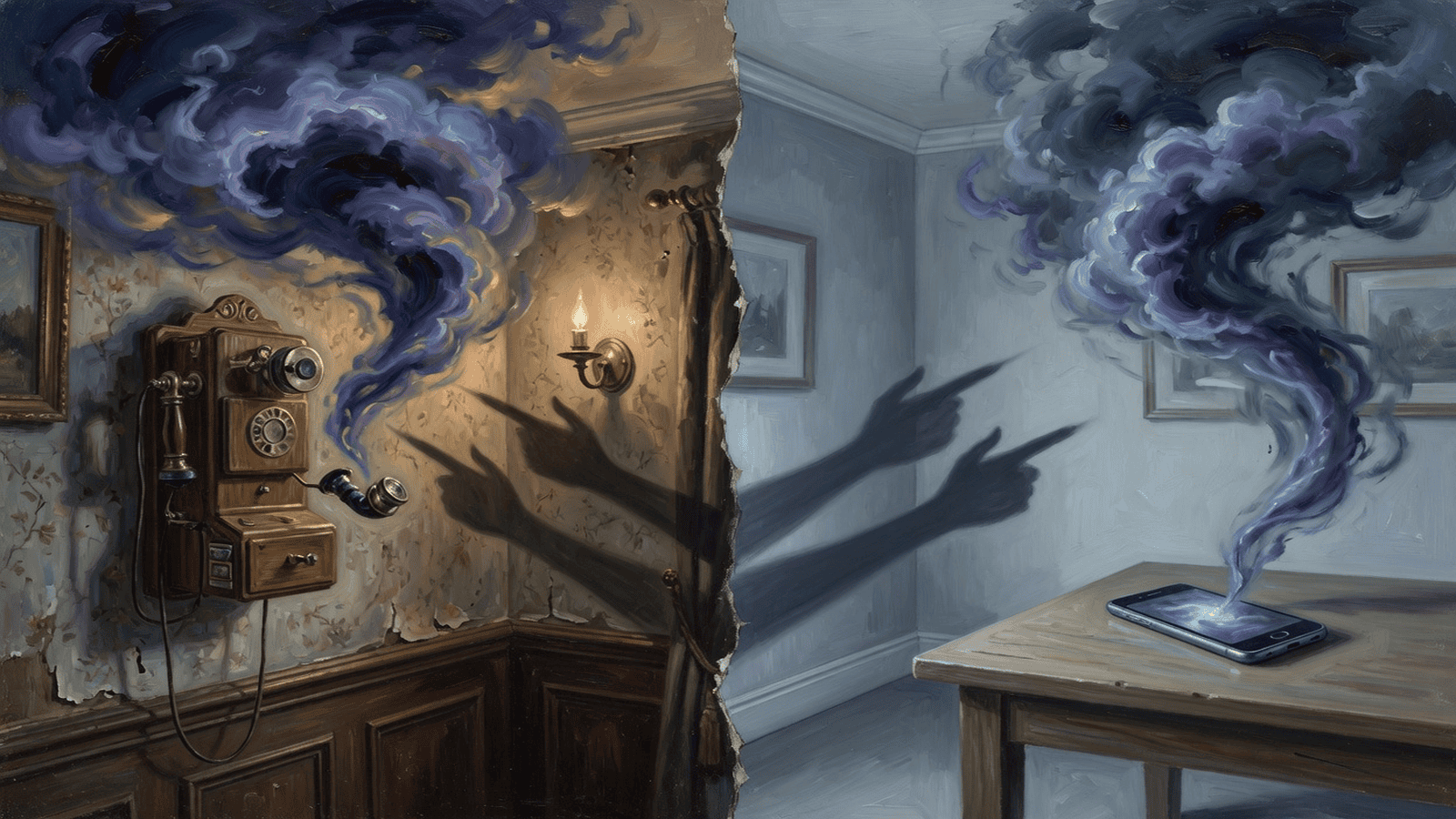
In 1926, fifty years after Bell’s patent, the Knights of Columbus Adult Education Committee circulated a set of discussion questions for its study groups. Two of them, verbatim: Does the telephone make men more active or more lazy? And: Does the telephone break up home life and the old practice of visiting friends?
Read them again and swap the noun. Half a century into the technology — not in its novelty phase, not in the first flush of alarm, but two generations deep, when every household that could afford one had one — serious adults were still convening to ask whether the device was making them lazy and dissolving the family. It is this decade’s discourse with the serial numbers filed off. The only thing that has changed in a hundred years is the object on the table.
An earlier post argued that the smartphone is not the disease but the latest anesthetic — that the device is only the syringe, and the addiction is to the avoidance it delivers. That post traced one constant: the appetite. This one traces the other: the accusation. Because if the device was never to blame, there is a real question in why every generation puts its device on trial — and why the indictment reads the same every time.
I. The rap sheet
The telephone’s charge sheet, assembled from its first fifty years, runs to four counts.
Count one: nervous exhaustion. George Miller Beard’s American Nervousness (1881) diagnosed a national epidemic of “neurasthenia” and blamed the overstimulation of modern life — his named culprits included the telegraph, the periodical press, steam power, and, revealingly, “the mental activity of women.” Note the date: the complaint that instant communication was frying the collective nervous system predates the telephone’s wide adoption. The phone did not generate the charge; it inherited it. Essayists of the era complained of the “tyranny of the bell” — the telephone was the first machine that could demand attention inside the home, at any hour, and people experienced the ring as a violation. They were not wrong. It was one.
Count two: idle talk. For roughly four decades, the phone companies themselves considered social conversation a misuse of their instrument. The telephone was marketed strictly for business and household management; industry literature fretted about women tying up party lines with gossip. It took until the 1920s for AT&T to surrender and begin selling sociability — the story Claude S. Fischer documents in America Calling: A Social History of the Telephone to 1940 (1992). Sit with that detail: the syringe manufacturer spent forty years disapproving of the drug. The dealer arrived reluctant, and the customers taught him what he was selling.
Count three: the collapse of the social order. In Britain especially, the telephone alarmed the upper classes because it bypassed the entire gatekeeping apparatus of the calling card and the servant at the door — anyone could ring directly into a gentleman’s drawing room. Add the hygiene scares, complete with campaigns to disinfect public mouthpieces, and the rural preachers denouncing party lines as instruments of eavesdropping.
Count four: laziness and the broken home — the Knights of Columbus counts, already read into the record.
Laziness, dissolved family life, corrupted women, nervous exhaustion, lost silence. Hold that list. It is about to become familiar.
II. The same op-ed, running for twenty-four centuries
Walk the charges backward. In Plato’s Phaedrus, King Thamus warns that writing will “create forgetfulness in the learners’ souls” — the memory-atrophy panic, leveled at literacy itself. In the 1540s, the naturalist Conrad Gessner warned that the printing press had unleashed a “confusing and harmful” flood of books the mind could not manage — the information-overload panic, four centuries before the inbox. Eighteenth-century Germany pathologized Lesesucht, reading-addiction, and blamed Werther for a wave of suicides — the harmful-content panic. In 1858, a New York Times editorial pronounced telegraphic news “superficial, sudden, unsifted, too fast for the truth” — a sentence that could run tomorrow above a column about the feed.
Now walk them forward. A 1936 letter to Gramophone complained that children divide their attention between homework and “the compelling excitement of the loudspeaker.” Fredric Wertham’s Seduction of the Innocent (1954) put comic books on trial for juvenile delinquency. Neil Postman’s Amusing Ourselves to Death (1985) did the same for television, with more style and a better argument. Vaughan Bell catalogued the whole procession in “Don’t Touch That Dial!” (Slate, 2010), and the Pessimists’ Archive has assembled the primary sources into a browsable museum of recurring alarm. Adam Gopnik, surveying the genre in “The Information” (The New Yorker, 2011), sorted every commentator on every new medium into three eternal factions: the never-betters, the better-nevers, and the ever-wasers. Douglas Adams got there first and funnier in The Salmon of Doubt: everything that exists when you are born is normal; everything invented before you turn thirty-five is exciting; everything invented after is against the natural order of things.
The nouns change. The grammar of the accusation does not.
III. The comfortable reading, and the other one
There is an obvious conclusion to draw from this history, and the genre that compiles it almost always draws it: every past panic looks quaint, so ours will too. The Knights of Columbus were wrong about the telephone; therefore the op-ed writers are wrong about the smartphone. Relax. We have been here before.
This reading is comfortable, and it is too easy. There is another one.
The panics were right about the mechanism and wrong only about the magnitude. Each device really did pave over some silence. The telephone really did end the unannounced quiet of the home — after the bell, no hour was safely one’s own, and everyone who has silenced a ringing phone knows the charge was accurate. The radio really did colonize the evening. Television really did absorb the family hour it was accused of absorbing. The panickers correctly identified what was being lost; what they could not imagine was how much further the curve would run. Their alarms were not false. They were early.
Proust understood this from inside the panic’s timeframe. In The Guermantes Way, the narrator hears his grandmother’s voice on the telephone for the first time — and the marvel turns immediately to dread, because a voice separated from its body is a rehearsal for its absence: he hears in the receiver, for the first time, exactly how he will one day remember her. The device’s earliest literary witness did not find it trivial. He found it a preview of grief. The panic, in its clumsy institutional language, was groping at something Proust caught precisely: the machine was changing what presence meant, and something real was being traded away.
On this reading, the dilution each device performs is structural, not moral — nobody chooses it, and moralizing does not reverse it — but it is real, and cumulative. And the smartphone panic is then not another false alarm in a long series of false alarms. It is the first alarm to go off at the asymptote, where the paving of silence is essentially complete.
IV. What the panic is wearing
There is a second pattern in the rap sheet, quieter than the first. Beard blamed the mental activity of women. The gossip panic was a gender panic wearing a technology costume. The British drawing-room panic was a class panic: what alarmed the gentleman was not the instrument but the stranger’s voice arriving unfiltered by a servant. The comic-book panic was a panic about parental authority; the Werther panic, about the reading habits of the young and the female. In every case the device stands trial for the era’s real anxiety, which cannot be prosecuted directly.
This suggests a diagnostic use for our own moment. If every panic encodes the anxieties of its hour more faithfully than the truth about its device, then the smartphone panic is a document worth reading — not for what it says about the phone, but for what it says about us. What is under the costume this time? Parental guilt, perhaps. Status anxiety about attention becoming the new wealth. The professional class’s fear of its own compulsions, projected onto its children’s screens. I do not intend to adjudicate. The question is better left open, because the moment a panic is decoded it stops being evidence.
V. The alibi
There is one more turn, and it leads back to Pascal’s room.
Every op-ed against the smartphone is written on one, and read on one, usually within arm’s reach of a bed. This is treated as an irony, when it is actually the diagnosis. Moralizing about the device is easier than sitting in the room the device rings in. The indictment, the trial, the discourse, the op-ed, the post you are reading now — all of it is one more place to put attention that is not the silence underneath. The panic is not the opposite of the addiction. It is the addiction’s alibi: a way of holding the syringe at arm’s length, examining it, denouncing it, and never once putting it down.
The Knights of Columbus asked whether the telephone breaks up home life. A century later the honest answer is: it did, some, and we would do it again, and we did — four or five devices ago. The trial reconvenes every generation because the verdict is never really in doubt and never really the point. The accused changes. The prosecutor is always us, and the crime is always ours.
Full disclosure, in the spirit of the alibi: I love my phone, and I am in no position to testify against it. I owe it too much — the “free” calls to friends and relatives an ocean away, at least a couple of jobs, and a respectable number of meetings I attended, in every sense that mattered, from wherever I happened to be standing. So I have made my peace with the arrangement. Every night I set it face-down on the nightstand and say: good night, phone — thank you for your services. It says nothing back, which is the longest stretch of silence either of us will get all day.
Further reading
- Blaise Pascal — Pensées (1670)
- Plato — Phaedrus (~370 BC)
- George Miller Beard — American Nervousness: Its Causes and Consequences (1881)
- Claude S. Fischer — America Calling: A Social History of the Telephone to 1940 (1992)
- Neil Postman — Amusing Ourselves to Death (1985)
- Fredric Wertham — Seduction of the Innocent (1954)
- Johann Wolfgang von Goethe — The Sorrows of Young Werther (1774)
- Marcel Proust — The Guermantes Way (1920)
- Adam Gopnik — “The Information: How the Internet Gets Inside Us” (The New Yorker, 2011)
- Vaughan Bell — “Don’t Touch That Dial!” (Slate, 2010)
- Douglas Adams — The Salmon of Doubt (2002)
- Pessimists’ Archive — primary-source clippings of technology panics