Two days ago, in The Photography That Disappeared, I traced what the smartphone did to the economics of the image—attention diluted, the photograph commodified, the decisive moment traded for burst mode. That essay stayed deliberately clinical, and it closed with a promissory note: at the risk of sounding Freudian, or Jungian, there is a second function of photography that has nothing to do with art, and I would come back for it. This is me coming back for it.
Full disclosure before we begin: my phone currently holds a couple hundred photographs of my cat, and the homes I have loved have carried their own dense constellations of frames. Whatever this essay uncovers, it uncovers in me first. I am not writing from above the phenomenon; I am writing from inside it, with the lights on.
I. The Wall as a Text
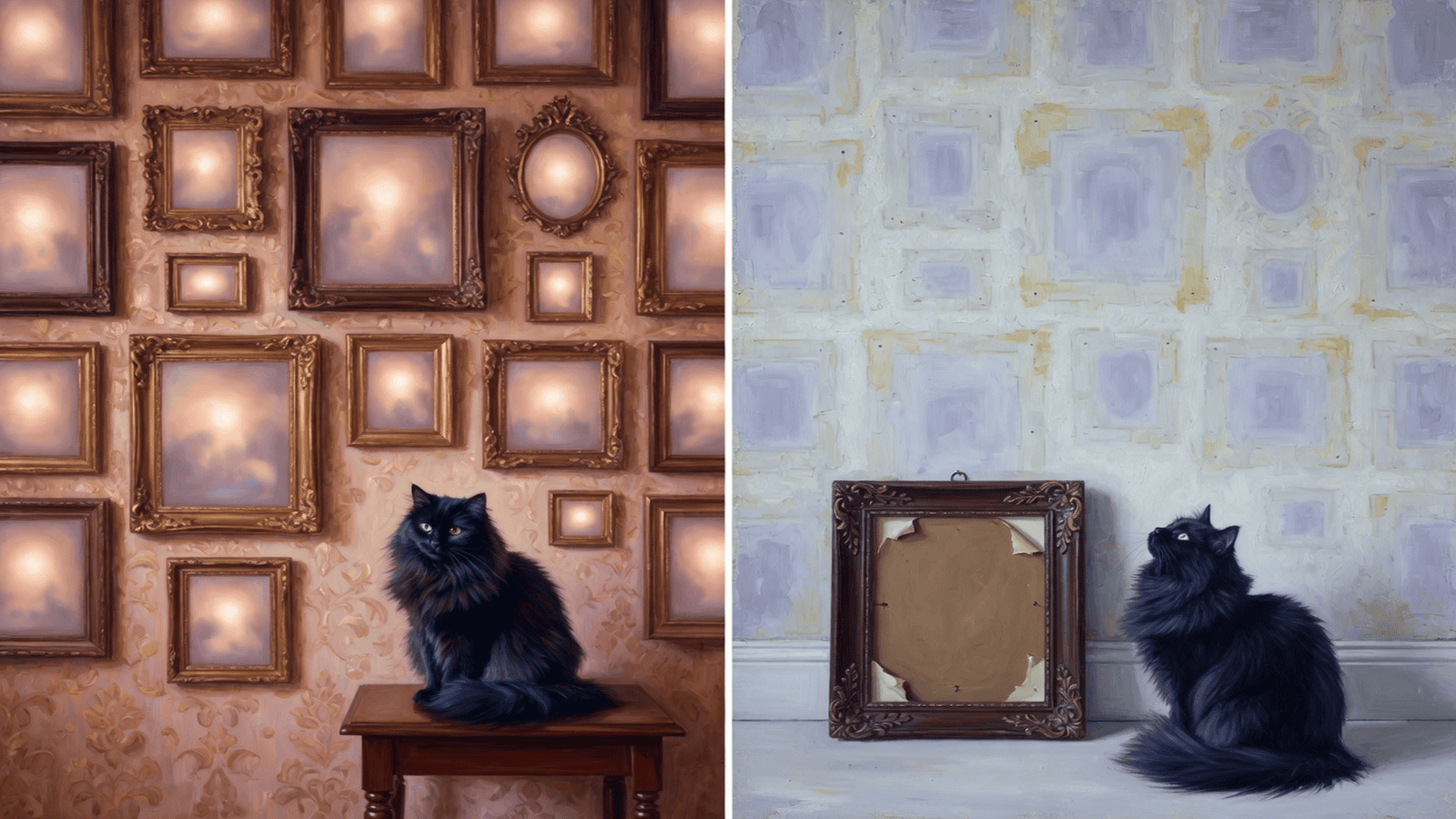
You are a guest in someone’s home. At some point in the evening the tour arrives at the wall—dozens, sometimes a hundred framed photographs: weddings, beaches, graduations, grandparents rendered in sepia, children rendered in triplicate. You are walked along it. Names are supplied. You nod.
Notice, first, that the wall is not an album. An album is private, sequential, and opened by choice; a wall is an exhibition—permanent, public, impossible to decline. Nobody frames a photograph for themselves alone. The frame is an address line: to whom it may concern. And what the wall says, once you read it as the text it is, is roughly this: these are my people; these are the places that admitted me; this life has been dense with love and motion; there is more of me than the person standing in front of you. The guest is not being shown pictures. The guest is being read a statement, and courtesy obliges them to sign it with a nod.
Erving Goffman gave us the vocabulary for this in The Presentation of Self in Everyday Life: the home divides into front regions, where the performance happens, and back regions, where the props are stored. The living-room wall is front stage by definition, and set design is never neutral. Nothing arrives on that wall by accident. The blurred years, the friendships that curdled, the ordinary Tuesdays—all edited out. What hangs is a highlight reel in matte frames, and like any text it has an author, an intended reading, and, most importantly, an intended reader.
II. The Fear Underneath
To ask what the wall is for is really to ask what it is against.
Susan Sontag observed in On Photography that photographs furnish evidence—that they certify experience. In the previous essay I called this the receipt of existence and treated it as a transaction aimed at others: look at me, I was there. But receipts imply an audit, and the more interesting question is who the auditor is. Push the receipt inward and the answer changes. The wall does not primarily reassure the guest. It reassures its owner: it happened, it was real, you were loved, the years were not lost. The display is aimed outward; the comfort runs the other way.
Ernest Becker argued in The Denial of Death that most of what we call character is a vital lie—an apparatus for not thinking about our own ending—and that we manage the terror by enrolling in immortality projects, works designed to outlast us. A wall of photographs is an immortality project at domestic scale. What it wards off is not death exactly but something adjacent and sharper: insignificance. The suspicion that a life needs evidence to be real. That unwitnessed, it might not have counted. Seen this way, the frames are less decoration than votive objects—candles lit against the dark, renewed every time a guest is walked down the row.
III. Persona and the Person
Carl Jung, in Two Essays on Analytical Psychology, described the persona as a mask designed to make a definite impression on others while concealing the true nature of the individual. He was careful not to call it a lie. The persona is an interface—a compromise between what society demands and what the individual can supply—and living without one is not honesty, it is exposure. The wall is persona in material form: the self we have negotiated for public view, hung at eye level.
Freud’s On Narcissism adds the mechanism. We each carry an ego ideal, the self we wish to be, and we spend our lives measuring the distance to it. What we cannot claim in speech—I am loved, I have lived well, I matter—we arrange to have said for us. The wall speaks so that we don’t have to; it is a ventriloquism of worth. There is nothing scandalous in this. Every culture builds such instruments.
The danger Jung actually warned about is identification—the moment the mask stops being worn and starts being lived. Translated to photography: the trip planned around the pictures it will yield, the dinner arranged for the image of the dinner, the moment experienced with one eye already on its future display. The persona swallows the person when experience becomes raw material for the announcement of experience—when we stop photographing what we live and start living what will photograph well. Most of us can name the exact vacation where we crossed that line. I can.
IV. “I Am Beautiful, and You Will Have to Endure It”
Here is the uncomfortable part. There is aggression folded inside display.
The announcement is not made for its audience; it is made at them. Nobody asked to be walked down the wall. The guest’s admiration is not requested but levied, the way a toll is levied. John Berger, in Ways of Seeing, wrote that men act and women appear—that women were trained to carry a surveyor inside, to watch themselves being watched. Whatever was true of that asymmetry in 1972, the camera roll has since universalized the condition: we all carry the internal spectator now, all compose ourselves for a gaze that never fully leaves the room.
What makes self-display so strange is its double charge. The wall pleads and imposes in the same gesture. It pleads: see me, confirm me, tell me it counted. And it imposes: you will look, you will nod, and you have no standing to refuse while under my roof. Vulnerability and hostility, fused. That is why the sentence I closed the last essay with has the shape it has—I am beautiful, and you will have to endure it. The confession lives in the first clause. The aggression lives in the second. And the second clause is the one we refuse to hear ourselves saying.
V. Not Vanity — Fear
The cheap diagnosis is narcissism, and it should be resisted—not out of politeness but because it is inaccurate. A wall of beloved faces is not a mirror; Freud himself distinguished the libido we invest in ourselves from the libido we invest in others, and a hundred frames of grandchildren are, on their face, an outward investment. Vanity is the wrong word for a fear.
Because that is the more precise reading: not look how splendid I am but please confirm this was real. Under the announcement sits a need with nothing pathological about it—the need to be witnessed. Humans do not merely want experiences; we want our experiences to have registered somewhere outside our own skull, in an eye that can vouch for them. The wall is a proxy for a sentence almost no one can say aloud: tell me my life counted. The trouble is not the need. The trouble is the ventriloquism—asking through frames what we cannot ask through speech, and then resenting the guest a little for answering only with a nod, which is all we left them room to say.
I am not proposing anyone take anything down. My own frames stay where they are, and the cat pictures are not going anywhere. But the next time you pass your wall—tonight, probably, since it stands between most rooms and the kitchen—try reading it as the text it is. Ask what it says. Ask who it addresses. And ask whether some part of what it is shouting might be said more quietly, to an actual person, in words, while they can still answer.
One last disclosure, since we are being honest with each other: none of the above applies to my cat. The analysis stops at her whiskers. I will go on announcing her to anyone who wanders within range of my phone—unprompted, unrepentant, at dinners, in elevators, during meetings that had nothing to do with her—because she is, objectively, the most beautiful feline ever assembled. Freud can call it what he likes. You will simply have to endure it.
Further reading
- On Narcissism: An Introduction — Sigmund Freud
- Two Essays on Analytical Psychology — Carl Jung
- The Presentation of Self in Everyday Life — Erving Goffman
- The Denial of Death — Ernest Becker
- Ways of Seeing — John Berger
- On Photography — Susan Sontag