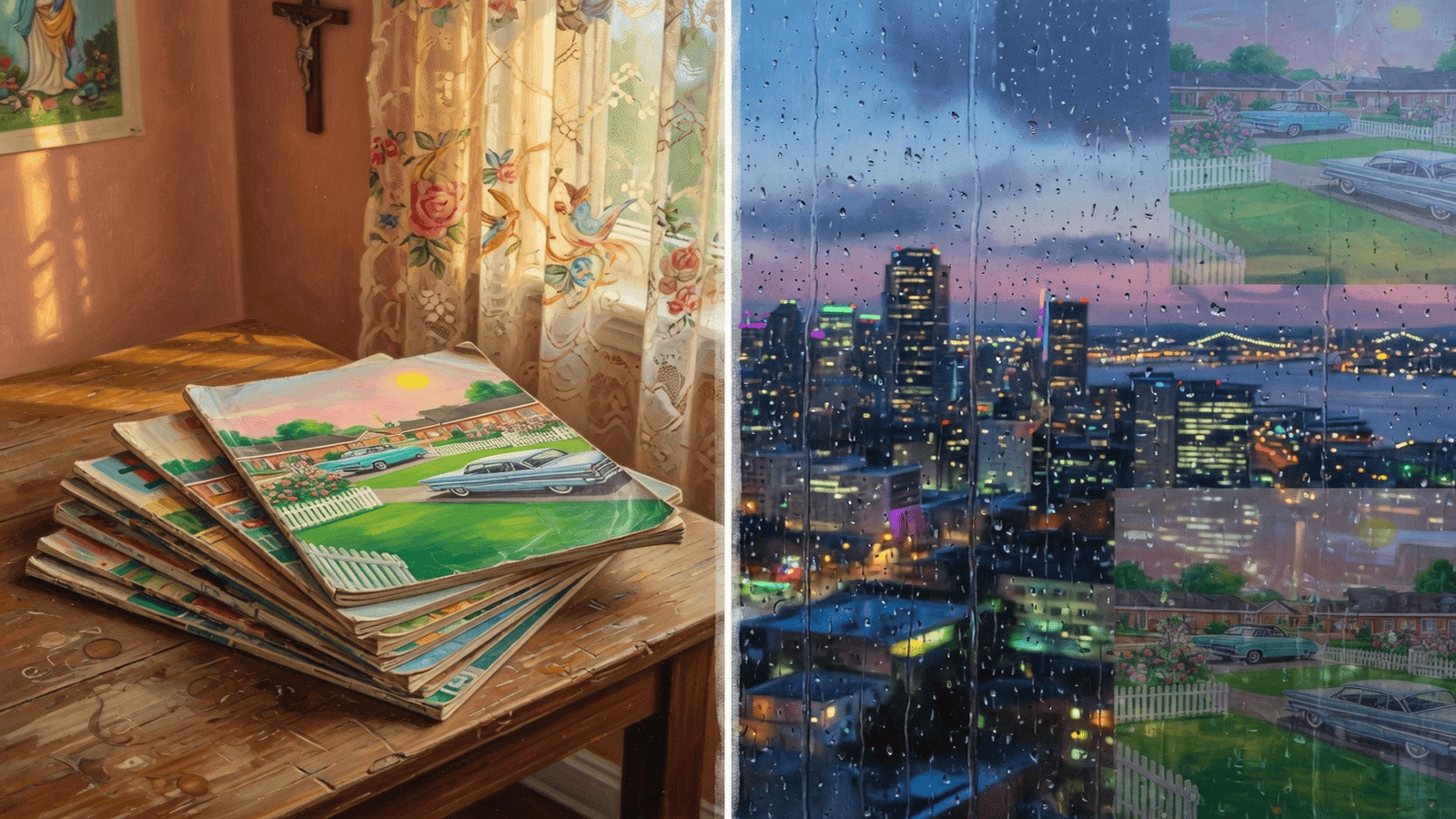
I still type it as “reader digest,” lowercase, the apostrophe and the capital letters missing. My fingers reveal what my memory conceals: I never studied this publication, I absorbed it. It arrived in Spanish, as Selecciones, and it sat on the tables of my childhood the way furniture does — unremarkable, permanent, load-bearing. Decades later I live in the country those pages described. I did not plan this in any way I could document. And yet I have come to believe the magazine was drawing a map the whole time, and that my body, eventually, walked to the place my mind had already been living.
I. The Magazine That Arrived Before I Did
Reader’s Digest was founded in 1922, and by the 1970s it was moving seventeen million copies a month across roughly twenty-one languages — arguably the most successful editorial product in history, and certainly the most quietly influential. The Spanish edition, Selecciones del Reader’s Digest, launched in Mexico in 1938 and spread through Latin America like a benevolent weather system. It was everywhere: dentists’ waiting rooms, grandmothers’ nightstands, the seat pockets of long-distance buses. Its sections were institutions in themselves — the vocabulary quizzes, the barracks humor, the anecdotes of ordinary life in the United States, the medical miracle condensed to eight pages with a happy ending.
The stories were simple, sometimes naive. I can see that now. A boy lost in the woods is found. A man rebuilds his life after an accident. A community raises money for a neighbor’s surgery. Problems existed in order to be solved, and they were solved with a product, a technique, or a positive attitude. What I could not see as a child is that the magazine was not describing how Americans lived. It was describing what Americans were trying to live toward — the aspiration, not the census. It exported the trying and omitted the failing.
And between the stories, the advertisements: green lawns, chrome appliances, families smiling around tables that never seemed to have a bill on them. If the articles sketched the moral architecture of a country, the ads painted its interiors.
II. Translation as World-Making
It matters that I received all of this in Spanish. Selecciones was not a translation in the narrow sense; it was a transposition. Editors chose which America crossed the border and in what clothing. Benedict Anderson argued in Imagined Communities that nations are built by print — that millions of strangers come to feel like compatriots because they read the same pages at the same time. Selecciones performed a stranger trick: it used print to build a nation in the minds of people who did not belong to it. Millions of Latin American readers were issued a shared, synchronized America — the same lawns, the same optimism, the same solvable world — without ever holding a visa.
Edward Said gave a name to the way texts construct places before travelers reach them: imaginative geography. He was writing in Orientalism about how the West invented an East to suit its purposes, but the mechanism runs in every direction. The South also received an invented North, and received it gladly. What got left out of the translation is exactly what you would guess: the loneliness, the debt, the fine print. Not out of conspiracy — condensation is the founding gesture of the Digest, and every condensation is an editorial theory of what deserves to survive.
III. The Advertisement as Architect
Here is what I find most interesting in retrospect: the journalism aged, but the advertising built the durable structure. I remember almost none of the articles. I remember the lawns perfectly.
Umberto Eco, wandering through wax museums and theme parks in Travels in Hyperreality, noticed that America excels at producing copies more vivid than their originals. Jean Baudrillard, crossing the same country at speed in America, concluded that the copy had quietly replaced the original altogether. Neither of them needed to leave my childhood living room. The America of the Selecciones advertisements was already a hyperreality — cleaner, kinder, and more coherent than any acre of the actual country has ever been. A commercial does something journalism cannot: it presents a world with no remainder, no loose threads, no section B. Literature complicates; news contradicts itself weekly; but an ad is a finished cosmos, and a child cannot argue with a finished cosmos.
This is how a commercial narrative outbuilds every other kind. It doesn’t inform you about a country. It furnishes one inside you.
IV. The Body Ends Up Where the Mind Was Living
Alfred Korzybski warned that the map is not the territory. True — but he said less about the map’s patience. A map laid down in childhood does not expire. It waits.
I did not come to the United States chasing the lawns. I came for work, as an adult, along a chain of decisions that each looked purely practical: this job, this project, this opportunity, this flight. No single link had anything to do with a magazine. And yet the chain, viewed whole, bends unmistakably toward a country I had been reading about since before I could evaluate it. Somewhere under the practical reasoning sat a settled, wordless premise: that is a place where life works out. Nobody installed it by argument, so no argument ever dislodged it.
I don’t think this is destiny, and I don’t think it is coincidence. I think it is something humbler: orientation. The mind builds its geography from whatever fragments arrive — stories, ads, photographs, a tone of voice — and years later, at every fork where the options otherwise weigh the same, the body tips toward the territory that feels pre-mapped. Calvino’s Invisible Cities is usually read as a book about memory, but it is also a book about this: every city we reach was built in us before arrival, and what we find there is partly what we brought.
V. The Privilege of the Prepared Map
I want to be precise about what kind of immigrant story this is, because the word “immigrant” covers lives that should not be forced to share a sentence. I never came to the United States to study. I did not marry here. I have no school friends here, no college nostalgia, no family network. My America has been employment authorization and tax season, professional work and the ordinary survival logistics of any working adult. When I say the arrival disoriented me, I mean exactly that and nothing more. I did not flee anything. I am, by every measure that matters, privileged — and a reader of Selecciones was already privileged before leaving: literate, urban, subscribed, pre-loaded with the destination’s language of aspiration.
Eva Hoffman, in Lost in Translation, describes emigration as being split between the language a life was lived in and the language it must continue in. My split is a gentler cousin of hers, but it is real, and it has a particular shape: the gap between the country I had read and the country that bills me. The imagined America was clean, orderly, and solvable. The lived America is expensive, bureaucratic, and frequently lonely. The strange part is that the imagined one did not dissolve on contact. It persists, layered under the real one like a first coat of paint — which is why certain suburban streets at dusk can make me feel, absurdly, that I am inside an advertisement I read forty years ago.
Was arriving a loss or a growth? Both, and neither cancels the other. The naive map got me here; the territory then taught me to read. Seventeen million copies a month, in twenty-one languages, for most of a century — I doubt my case is rare. Whole generations, on several continents, grew up with an America folded into their laps in their own language. Some of us eventually bought the ticket. The body ends up where the mind was already living. The only variable is whether you notice.
Further reading
- Imagined Communities — Benedict Anderson
- Orientalism — Edward Said
- Travels in Hyperreality — Umberto Eco
- America — Jean Baudrillard
- Invisible Cities — Italo Calvino
- Lost in Translation: A Life in a New Language — Eva Hoffman
- Map–territory relation — Alfred Korzybski
- Reader’s Digest — Wikipedia
- Selecciones del Reader’s Digest — Wikipedia