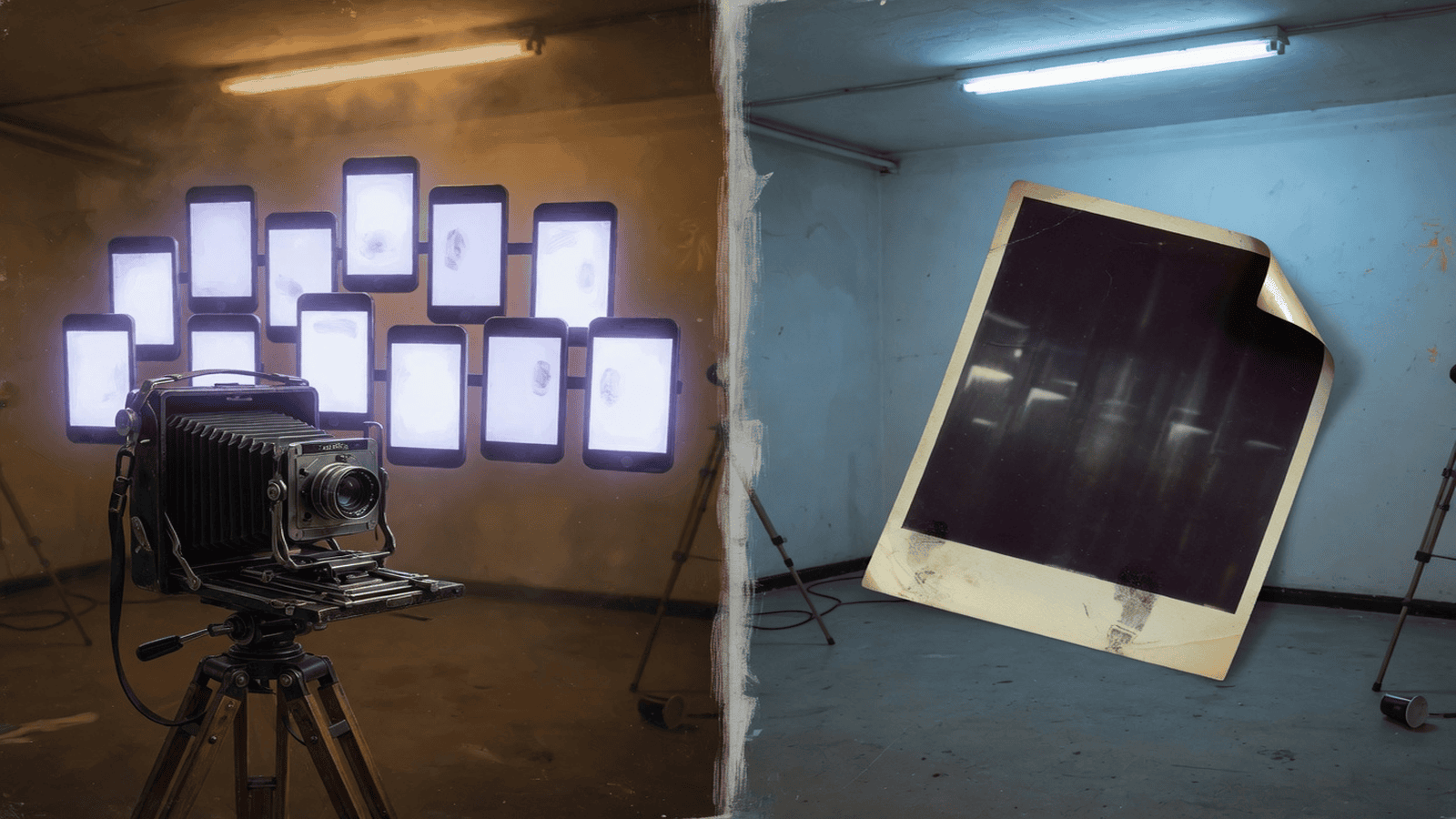
At a private event not long ago, I lined up what felt like the perfect shot. The light was doing something rare, the composition had assembled itself, and the moment was about to peak. Then, in the same instant, a dozen smartphones rose in front of me. Not out of malice—out of reflex. A wall of glowing rectangles, each capturing the same scene from nearly the same angle, each producing an image that would be indistinguishable from its neighbors. The photograph I was about to take became redundant before it existed.
It would be easy to file this under etiquette, a small complaint about modern manners. But the scene deserves a closer reading, because it contains, in miniature, everything that has happened to photography in the last two decades. The person holding the phone is not the problem. The problem is that we have all become the same person, holding the same camera, pointing at the same world, producing the same image. And when everyone is a photographer, the photograph ceases to mean anything.
I. The Friction That Made the Miracle
Value has always been entangled with difficulty. For most of its history, photography demanded friction: expensive equipment, a working knowledge of chemistry, patience for light, and the compositional judgment to know where to stand and when to press. Because the craft was hard, the result felt like a small miracle—a trophy extracted from time.
The smartphone removed every layer of that friction, and with it, the visibility of mastery. When anyone can produce a technically flawless image with one tap, the effort disappears from view, and with the effort goes the perceived value of the output. We never valued photographs merely because they were sharp; we valued them because someone had seen something and gone through difficulty to keep it. Strip out the difficulty and the seeing becomes invisible too.
This is not nostalgia for darkrooms. Film photography had its gatekeeping, its priesthood, its expensive club. The democratization of the camera genuinely expanded who could participate in image-making, and that expansion was good. But there was an unadvertised price: when the barrier to entry dropped to zero, the barrier to attention rose toward infinity. Walter Benjamin saw the first half of this trade in The Work of Art in the Age of Mechanical Reproduction—reproduction dissolves the aura of the singular object. He did not live to see the second half: what happens when the reproduction itself becomes infinite.
II. From Looking to Scanning
Susan Sontag warned in On Photography that to collect photographs is to collect the world—and that the collection changes our relationship to what is collected. She wrote that in 1977, when a heavy consumer of images might see a few hundred a day. We now see thousands, and the brain has responded the way brains respond to any overload: it built a filter.
A photograph used to be a destination. You walked to it on a wall, opened it in a book, held it in your hand. Now it is a transaction—something scrolled past in half a second, its value measured in the twitch of a thumb. The shift is not from good images to bad ones; the average technical quality of photographs has never been higher. The shift is from looking to scanning. Looking is an act of attention that lets an image work on you. Scanning is triage. And no photograph, however extraordinary, can move a person who is triaging.
This is the same adaptive mechanism that lets us tune out traffic noise or the hum of a refrigerator. Visual saturation has made the photograph inaudible. The image did not lose its power; our attention was diluted across a million competitors, and the dilution is structural, not moral. Nobody chose it. It is simply what happens when an entire species starts photographing its lunch.
III. The Receipt of Existence
The deeper shift is in what photographs are for. Photography began as an art of seeing: look at how this light falls, look at what this face holds, look at what I noticed that you would have walked past. Most photographs taken today serve a different function: they prove that the photographer was there. Not “look at this”—“look at me, here.”
That is the shift from expression to proof, from poetry to inventory. A photograph as evidence of presence is a receipt, and receipts are the most disposable documents we produce. Vilém Flusser, in Towards a Philosophy of Photography, argued that the camera programs its user—that we increasingly photograph what the apparatus and its distribution channels make photographable. Social media completed his prophecy. “Good” photography was redefined as photography that performs well online, and the feedback loop homogenized the output: the same presets, the same angles, the same poses, the same sunset that looks identical in Bali and in Sicily because both were processed through the same vibe.
The result is not a democracy of styles but a monoculture of the image. A commodity, in the strict economic sense, is a good whose units are interchangeable. That is precisely what the photograph has become: interchangeable. The wall of phones at my event was not producing memories; it was producing inventory that no one will ever look at twice.
IV. The Death of the Decisive Moment
Henri Cartier-Bresson built his life’s work on what he called the decisive moment—the fraction of a second when life, light, and geometry align, described in the book known in English as The Decisive Moment. The concept assumed scarcity: one frame, one chance, an irreversible choice. The tension of the single irreplaceable exposure was not incidental to the art; it was the art. The photographer’s entire discipline—anticipation, position, patience—existed because the moment would not come back.
Burst mode killed the tension. Wide-angle lenses that see everything, AI enhancement that repairs everything, and the ability to take fifty frames and choose one later have replaced the decisive moment with the safety of endless takes. The photograph stopped being captured and started being manufactured. Something honest went out of it—not because editing is cheating, but because a frame that can always be retaken carries no risk, and an image without risk carries no charge. Roland Barthes, in Camera Lucida, located the power of a photograph in its punctum—the accidental detail that wounds the viewer. Punctum is precisely what optimization removes.
V. What to Do With the Discomfort
So where did the attractiveness of photography go? Nowhere. The photograph is as capable of meaning as it ever was. What changed is the economy around it: we traded depth for volume, and volume won so completely that a single image now has to fight through thousands of interchangeable ones to reach a scanning, saturated eye.
Which brings me back to the private event and the wall of phones. My first reaction was irritation, and I have come to think the irritation was the most interesting data in the room. Annoyance at the redundant image is evidence that the non-redundant image still matters to you—that some part of you still distinguishes between taking a picture and making a statement. The people raising their phones were not doing anything wrong. They were doing what the apparatus programs everyone to do. The discomfort belongs only to those who still expect a photograph to be an act of seeing.
No one can put the genie back in the lens, and this essay proposes no return to analog purity. The only lever left is intentionality: fewer frames, chosen harder; images made as statements rather than secreted as reflexes. If you are the one still bothered by the phones rising in unison, the question is not how to make them go away. The question is what you are going to do with that discomfort.
At the risk of sounding Freudian—or Jungian—there is another angle here, one I intend to explore in the future. Leave photography as an art form alone for a moment, and a second function comes into view: the egotistic one, the “look at me, I was there,” the fear we refuse to recognize when we cover our walls with hundreds of pictures of our beloved places and people. Perhaps we never meant to take a picture at all. Perhaps we meant to show the world something entirely utilitarian—almost an announcement: I am beautiful, and you will have to endure it.
Further reading
- The Decisive Moment — Henri Cartier-Bresson
- On Photography — Susan Sontag
- The Work of Art in the Age of Mechanical Reproduction — Walter Benjamin
- Towards a Philosophy of Photography — Vilém Flusser
- Camera Lucida — Roland Barthes