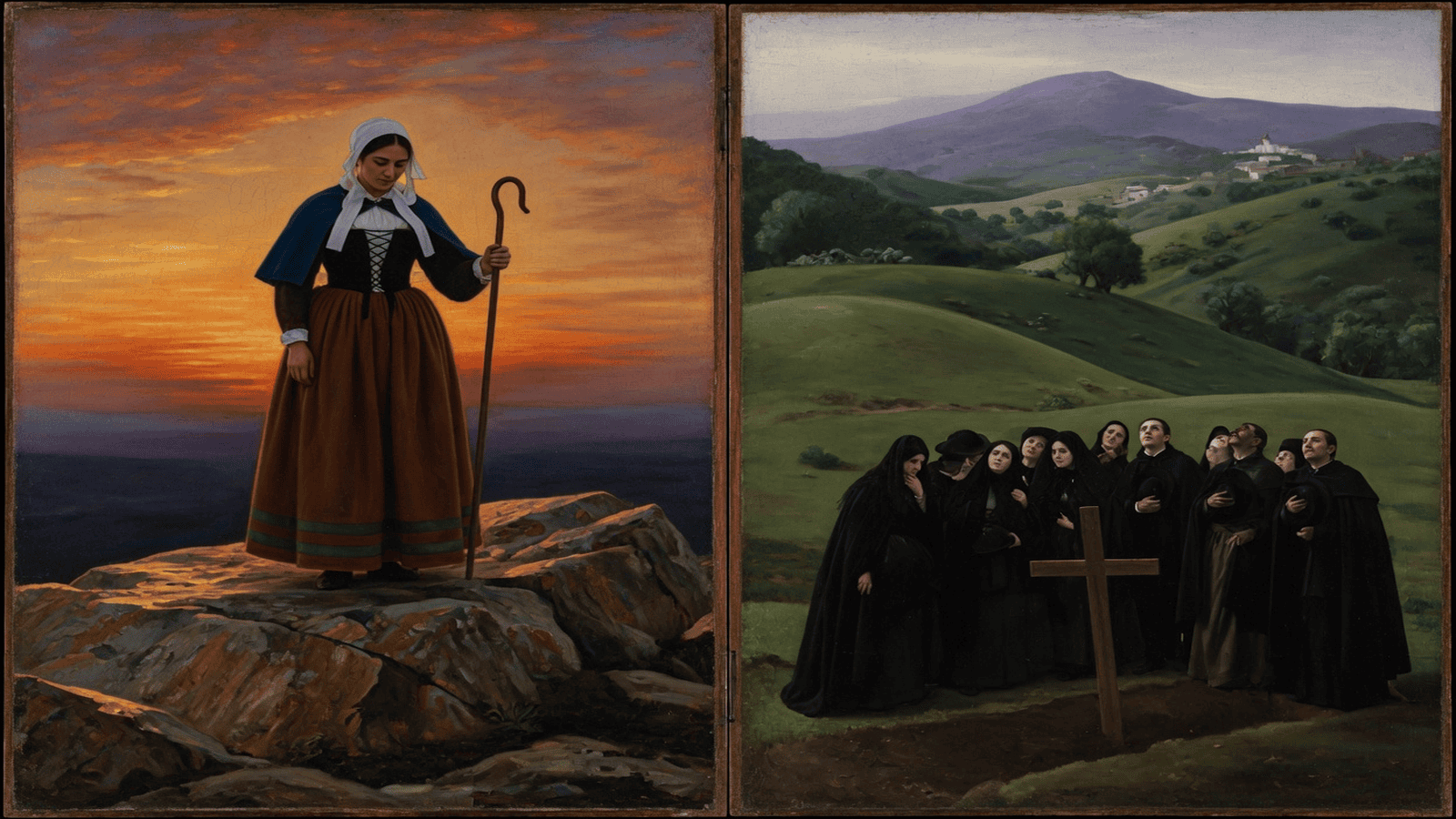
Cervantes wrote about women’s rights in the sixteenth century with an angle so sharp it cuts through four hundred years. A beautiful woman, financially independent, who dares to say no—and a man who feels so entitled to her love that his suicide becomes her crime. The most appalling part? His friends, and society, agree.
The story comes from Don Quijote, Part I, Chapters 12–14. A young woman named Marcela, orphaned and wealthy, decides to live as a shepherdess in the wilderness rather than marry any of the countless men who pursue her. She is free, self-sufficient, answerable to no one. One of her suitors, Grisóstomo—a brilliant, educated man—becomes consumed by his unrequited love. He follows her into the shepherd’s life, writes melancholic verses, and eventually dies, apparently by his own hand.
At his funeral, the mourners blame Marcela. They call her cruel, heartless, a cold beauty who drove a good man to his death. They are ready to make her pay.
And then she appears. Marcela climbs the rock above the grave and delivers one of the most astonishing speeches in all of literature—not just for its time, but for any time.
I. The Defense
Marcela’s speech is brief and surgical. She says, in essence, that her beauty does not obligate her to love anyone. She never promised anything. She never deceived. She never encouraged. She chose a free, solitary life—not to hurt anyone, but to live according to her own will. His despair is his. His death is his. She is not its cause. Why should she be blamed for his inability to accept her rejection?
The genius of Cervantes’ setup lies in what he chose not to give Marcela. He could have made her a victim—poor, desperate, morally compromised. Instead, he gave her every conceivable advantage: beauty, wealth, independence, an spotless reputation. She is not arguing from weakness. She is a woman who has everything and still has to defend her right to say no.
Grisóstomo, by contrast, is an immature man who feels entitled to her love. He constructs a narrative of tragic devotion. His suicide is immediately weaponized by his friends to blame the woman who rejected him. And society—embodied by the mourners, by Grisóstomo’s entire circle, by the pastoral romance tradition itself—agrees: she is responsible. She is liable. A man died because of her. What did she expect, being so beautiful and so unattainable?
Four hundred years later, we are still having this conversation. The script has not changed. “She led him on.” “She should have known.” “If she had just given him a chance…” Femicide, victim-blaming, the insistence that a woman’s rejection is a kind of violence that justifies violence in return.
Cervantes saw it. He named it. He wrote Marcela’s defense, and then—in a masterstroke of narrative ambiguity—he let her walk away, back into the wilderness, without a fairy-tale resolution. She doesn’t marry anyone. She doesn’t apologize. She doesn’t compromise. She simply refuses to be the story that others have written for her.
II. The Radicalism of Refusal
The most dangerous part of Marcela’s speech is its fundamental claim: that rejection does not require justification. Her “no” is complete. She does not need to explain why she doesn’t love Grisóstomo. She does not need to provide a list of his flaws or her superior expectations. She does not need to soften the blow with false hope or kindness. She simply refuses.
This is still a radical position. In most narratives—literary, social, romantic—a woman’s refusal must be cushioned. It must be apologetic. It must offer an explanation, a reason, a pathway back. The refusal itself is treated as incomplete without justification. Marcela inverts this entirely. Her refusal is the complete statement. It requires nothing else.
Compare Marcela with virtually every other narrative of her period—and many since. The heroine who marries for duty. The heroine who sacrifices for love. The heroine who suffers nobly. The heroine who dies. Marcela is one of the earliest examples in Western literature of a female character who is right, who wins the argument, and who does not get punished, converted, married off, or killed for her independence. She walks away, intact.
The pastoral romance tradition that Cervantes is inverting had a very different plot. The beautiful shepherdess is a prize to be won. Her beauty is the entire premise of the conflict—it attracts the suitors, it fuels the entitlement, it becomes the “cause” of the tragedy. Cervantes subtly rewrites the genre: the shepherdess is not a prize. She is a person. Her beauty does not make her public property. It does not obligate her to perform gratitude to those who desire her.
III. The Weaponization of Despair
The most chilling part of the episode is not Grisóstomo’s death but what happens immediately after. The mourners do not grieve. They do not blame Grisóstomo for his entitlement or his inability to accept rejection. They blame Marcela. They transform her act of refusal into an act of cruelty. They weaponize Grisóstomo’s despair against her.
This is the mechanism that Cervantes exposes: how a man’s emotional distress can be used to coerce, control, and punish a woman who simply exercised her autonomy. Grisóstomo did not die because Marcela refused him. He died because he felt entitled to her love and could not tolerate rejection. But by dying—or rather, by the narrative that surrounds his death—he casts Marcela as the villain of his story. His friends complete the move. Society agrees.
The parallel to contemporary discourse is not subtle. A man’s emotional suffering becomes a woman’s moral responsibility. His inability to accept her boundaries becomes evidence of her cruelty. The narrative framework shifts: she is not a person exercising autonomy; she is an instrument of his harm. And once that shift occurs, her refusal becomes an act of violence. The logic that follows is that some form of punishment is justified—social ostracism, physical harm, or worse.
Cervantes understood this four centuries ago. He wrote it into his novel with such precision that it cuts through every century in between.
IV. The Absent Resolution
The episode ends with Marcela walking back into the mountains. The narrative lets her go. This is almost unheard of in literature of the period—a character who is right, who is sympathetic, who is central to the episode, and who simply leaves without a conventional resolution. The world does not change for her. She does not reintegrate into society. She does not marry, does not die, does not apologize, does not compromise.
That absence of resolution is itself a statement. It suggests that the world is not yet ready for her. It suggests that her freedom requires distance from a society that would constrain her. It suggests that some stories do not have endings because the contradictions they expose cannot be resolved within the existing social order.
The question Cervantes leaves us with is not rhetorical: Why should a woman have to choose between her freedom and her safety? Why is the alternative to marriage and domesticity exile? And if a woman of beauty, wealth, and virtue cannot claim her right to refusal without being blamed for a man’s death, what does that tell us about the world?
One cannot help but wonder: in Cervantes’ century, was even a #MeToo movement conceivable? How did he manage to speak up about women’s rights when even today the violence is so pervasive that we must introduce new terminology—femicide in contrast to homicide—to name what is happening? And we are still waiting for the full truth about cases like Epstein to reach public reckoning. Cervantes saw the problem with such clarity four centuries ago that his words read like a diagnosis of today. The fact that they are still necessary, still urgent, still unresolved, is perhaps the most damning evidence of all: we have not progressed. We have only found new language for the same old violence.
Further reading
- Don Quijote de la Mancha — Miguel de Cervantes (Part I, Chapters 12–14)
- Beyond Fiction: The Recovery of the Feminine in the Novels of Cervantes — Ruth El Saffar
- Cervantes in Algiers: A Captive’s Tale — María Antonia Garcés
- Feminism and the Early Modern Spanish Canon — Anne J. Cruz