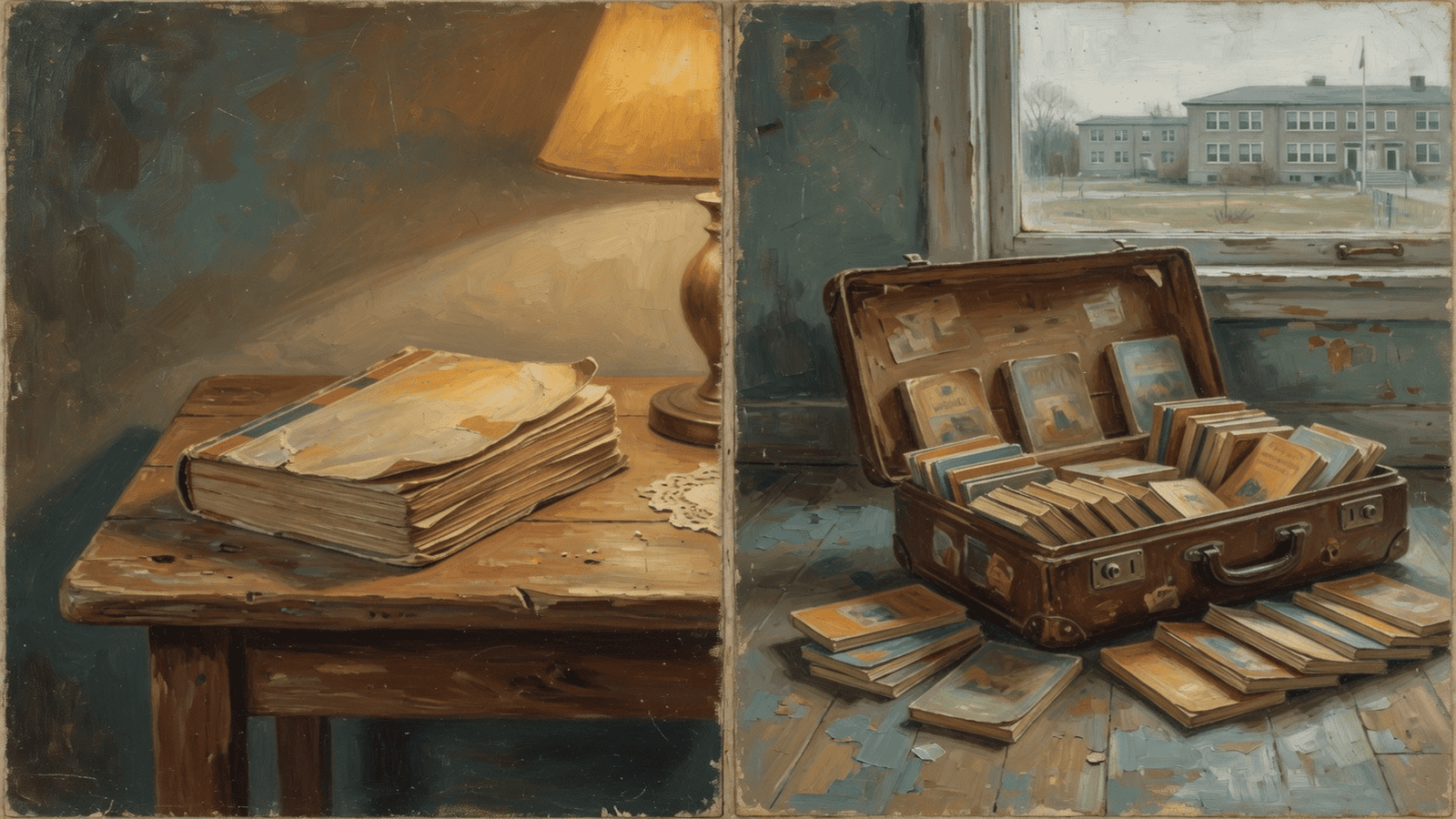
My father’s suitcase did not contain what suitcases are supposed to contain. Among the shirts and the papers there were books — small ones, the size of an open hand, with yellowed pages and covers that each promised an entire world: Buddhism. Secret societies. Nuclear energy. The series was called En 25.000 palabras, published by Editorial Bruguera of Barcelona in the early seventies, and its subtitle was not a marketing line but a philosophy: para el hombre que tiene prisa. For the man in a hurry.
The man in a hurry was my father. The child who went through the luggage was me. And what came out of that suitcase was not information — I understood a fraction of what I read — but a suspicion that never left: the world was wider than anyone at school was willing to admit.
I. For the Man in a Hurry
Bruguera was no temple of high culture. It was the great pulp factory of the Spanish-speaking world — the house of Corín Tellado’s romances, of dime-store westerns, of comic books sold at every kiosk from Barcelona to Buenos Aires. Its genius was industrial: print small, price low, distribute everywhere. The bolsilibro — the pocket book — was its unit of production, and for decades it moved through the Hispanic world the way transistor radios moved through it, cheap and ubiquitous and slightly disreputable.
En 25.000 palabras applied that industrial logic to knowledge itself. The premise was an editorial wager of remarkable nerve: every subject, no matter how vast, has a heart that fits in a pocket. Twenty-five thousand words on the atom. Twenty-five thousand on the Freemasons, on yoga, on the drug trade, on Tibetan Buddhism. Not a summary of a book — a compression of a field, executed to a fixed budget, bound in cheap paper, and sold for the price of a coffee to a reader assumed to have no credentials, no leisure, and no need to apologize for either.
That assumption is the whole story. The series did not ask who you were before telling you how the world worked.
II. Unpacking My Father’s Library
Walter Benjamin, boxing and unboxing his books across a life of moves, wrote in Unpacking My Library that a collection is a form of memory — that ownership is the most intimate relationship one can have with objects. My father’s suitcase was a collection in exactly that sense and in no other. It was not curated. There was no plan, no syllabus, no intended reader. The books were there because he was curious, and the luggage simply recorded, title by title, the shape of that curiosity.
Pierre Bourdieu gave a cold name to what happens next: cultural capital, the knowledge and dispositions that families transmit and that schools pretend to distribute. In his account the transmission is usually invisible — dinner-table vocabulary, the assumption that one goes to museums. In our house it was literal. The capital sat in a suitcase, portable as the name implies, and it was transferred not by instruction but by trespass: a child opening luggage he had no business opening, reading books no one had assigned.
Nobody taught me those subjects. What I inherited was not the content but the appetite — the disposition to believe that Buddhism and nuclear physics and secret societies were things an ordinary person in an ordinary house was entitled to know about. That entitlement is the rarest thing a school can grant, and the one it most reliably withholds.
III. The Curriculum and the Contraband
I do not want to romanticize the contrast, but I do want to state it plainly. School had a curriculum, and the curriculum had a purpose: to produce someone who could function — read the forms, pass the exams, hold the job, repeat the narratives his society needed repeated. Ivan Illich, in Deschooling Society, called this the confusion of teaching with learning and of grade advancement with education: the institution certifies process and calls it knowledge. None of it is malicious. Survival skills are genuinely useful; someone must teach the forms. But no curriculum committee on earth would have put Buddhism, the Freemasons, and the atom into the hands of a nine-year-old, because none of those serve the function. They are width, not survival.
The suitcase was the contraband channel. It ran parallel to the school, unregulated and unexamined, and it carried exactly what the official channel filtered out: the news that the world was stranger, older, and more plural than the syllabus implied. The most formative knowledge I received as a child was knowledge nobody knew I was receiving — least of all me. There was no exam, so there was no floor and no ceiling. There was just the next small book, and the next.
IV. Compression as Democracy
The gesture was not uniquely Spanish. Allen Lane’s Penguin paperbacks had made the same bet in 1935 — serious books at the price of a pack of cigarettes, sold in train stations to people the hardcover trade had never considered readers. France institutionalized the idea in the Que sais-je? collection: an entire field, 128 pages, one confident expert. The mid-century paperback revolution was, before the phrase existed, open access — the radical proposition that the price of knowledge should approach zero and its distribution should look like the distribution of groceries.
Compression was the cost of admission, and it is fashionable to count only what compression loses: nuance, apparatus, the scholarly hedge. But 25,000 words has a property that infinite scroll does not — it ends. A bolsilibro was finite, and its finitude was an argument: this is the shape of the subject, here are its edges, and beyond those edges there is more, which you must now go and find. The ending pointed outward. Today’s man in a hurry has Wikipedia, which is bottomless, and the feed, which is endless, and neither ever delivers the small click of a back cover closing — the moment when a subject becomes a thing you have a purchase on rather than a stream you are standing in. The old format was poorer in every measurable way and richer in exactly one: it let you finish, and finishing is where the appetite for more is manufactured.
V. The Width of the World
The point was never mastery. Nobody became a physicist from 25,000 words on the atom, and Bruguera never pretended otherwise. The point was width — the early, durable knowledge that the map handed to you at school was a province, not the world. A child who has held twenty subjects in his hands, even badly, even half-understood, has learned the one meta-lesson that survives when every fact fades: the catalogue is bigger than anyone tells you, and it is open.
My father, I think, never knew what the suitcase did. He was just a man in a hurry who wanted the world in his pocket. But that is how the widest inheritances travel — not handed over, but left where a curious child will find them.
Further reading
- Walter Benjamin, Illuminations — contains “Unpacking My Library,” on collections as memory
- Ivan Illich, Deschooling Society — the classic argument against confusing schooling with education
- Pierre Bourdieu, cultural capital — Wikipedia — on how families transmit knowledge and disposition
- Editorial Bruguera — Wikipedia — the Barcelona house behind the bolsilibros
- Penguin Books — Wikipedia — Allen Lane’s 1935 paperback revolution
- Que sais-je? — Wikipedia — the French collection that compressed every field into 128 pages