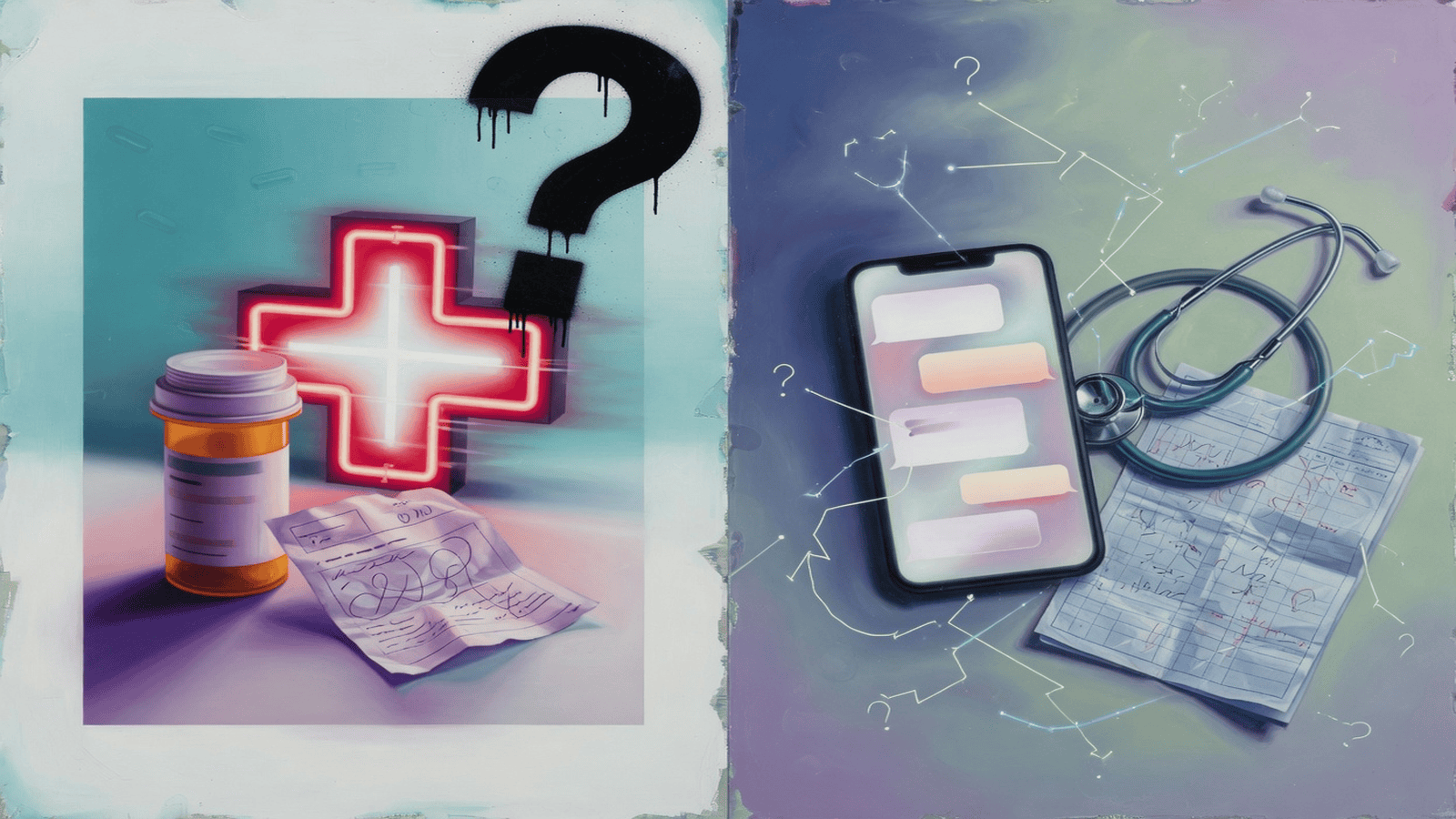
“Ask your doctor if it’s right for you.” Anyone who has watched American television knows the sentence by heart. It sounds like caution, but read it slowly and it’s a script: here is a feeling you may not have noticed, here is a product that addresses it, and here is a professional whose role in the transaction is to ratify or veto a decision you have already half-made. The ad doesn’t sell a drug. It sells a diagnosis and rents a doctor’s authority to close the deal.
Which makes the next sentence, the one no ad has dared print yet, almost inevitable: ask your LLM what your problem might be. The unsettling part is not that a chatbot might one day pretend to be a doctor. It’s that the sentence sounds so natural — because we already live in a world where diagnosis, persuasion, and convenience are blended so thoroughly that the model is a lateral move, not a rupture.
I. The Ad Was Already a Diagnosis
Direct-to-consumer prescription drug advertising is legal in exactly two countries, the United States and New Zealand, and it took a 1997 FDA relaxation of broadcast rules to unleash the version everyone now recognizes. The format that emerged has a precise division of labor. The ad manufactures salience — it teaches you to notice a tiredness, a sadness, a restlessness in your legs. You perform the self-diagnosis in your living room. The doctor is positioned downstream, as the compliance step: the professional who validates or rejects a commercial suggestion that arrived before you did. And the product is sold as if this whole sequence were neutral.
Seen this way, the drug ad is a user interface for the body. It tells you what to notice, how to feel about it, and who is authorized to dispense the fix. Paul Starr’s The Social Transformation of American Medicine traces how the profession spent a century accumulating what he calls cultural authority — the power to define what counts as illness in the first place. The ad’s genius was to borrow that authority without buying it: “ask your doctor” launders commercial intent through professional legitimacy, four words at a time.
The model doesn’t break this machine. It slots into it, one step earlier and one interface closer.
II. Rebote de Bilis
This essay started with a translation request. I asked a model for the English equivalent of rebote de bilis — a phrase any Latin American grandmother can use in a sentence, describing the stomach revolt that follows a swallowed rage. There is no clean English word for it, and the model knew that. It gave me the literal rendering, then the folk etiology, then the nearest biomedical neighbors — somatized anger, stress dyspepsia — then a note on how the concept lives in a different map of the body than the one Anglophone medicine draws. It translated the culture, not just the term.
No dictionary does that. Frankly, few doctors would take the time. And I noticed what the answer produced in me, because it’s the same thing the drug ad is engineered to produce: not verified knowledge, but the feeling of being understood. The problem had become nameable. That is the demand the model meets better than any instrument before it — people rarely want a diagnostic workflow; they want one sentence that gives the problem a shape. The question is what kind of thing supplied it.
III. Tool, Knowledge, Pattern, Profession
Our vocabulary offers four categories for a thing like that. A tool does something for you. A knowledge gives you information. A pattern engine recognizes recurring structure. A profession carries social authorization, responsibility, and liability. The LLM sits awkwardly across all four: you prompt it like a tool, query it like an encyclopedia, and it is, literally and by construction, a pattern engine. And it is increasingly treated as the fourth thing, because people want it to behave like an expert without paying expert prices.
But a profession is not a body of knowledge with a diploma stapled to it. It is a monopoly on judgment under conditions of uncertainty — and a social contract that makes the monopoly tolerable. The physician is licensed, regulated, insured, suable, and strippable of the right to practice. Ivan Illich, medicine’s fiercest critic, argued in Medical Nemesis that the profession had expropriated health itself, turning citizens into lifelong patients; but even his indictment presupposes the contract, since expropriation is only possible where authority is real. The model inherits the appearance of that authority — the calm register, the structured differential, the bedside syntax — while bearing almost none of its obligations. A tool is something you can abandon. A profession is something that can abandon you, and be made to answer for it. The model is the first artifact that feels like the second while remaining, legally and morally, the first.
IV. The Ethics of Plausibility
Harry Frankfurt’s On Bullshit drew a famous line: the liar tracks the truth in order to negate it, while the bullshitter is simply indifferent to it. A language model is structurally indifferent — not deceptive, not honest, optimized for the continuation that fits. It doesn’t need to be right to be useful. It needs to be plausible enough to keep you inside the conversation. Frankfurt at least had a person to blame; here the indifference has no author, which makes it harder to see and easier to forgive.
So consider the scene that is already ordinary. A person notices a symptom — perhaps an ad taught them to notice it. They do not call a doctor first. They ask the model, and the model answers calmly: likely causes, red flags, sensible next steps. The person feels less alone, more informed, and perhaps less inclined to seek care right away. Nothing in that scene is obviously evil. Nothing in it is obviously innocent either. Whether it was triage, reassurance, education, or marketing depends entirely on facts outside the conversation — who built the system, what it optimizes for, what it discloses, and who answers for the miss. The ethics doesn’t live in the output. It lives in the plumbing.
V. Who Bears the Cost
The lazy binary — AI good, AI bad — misses where the problem actually sits. Medicine, advertising, and machine-generated advice now share a common surface: the confident sentence about your body, delivered in the register of care. The honest question is not whether the sentence is allowed, but who pays when the surface is mistaken for substance.
The old system had an answer, and it was the ad’s four words. “Ask your doctor” was cynical, but it named a fuse: a licensed human wired between suggestion and consequence, who could be wrong and be held to it. “Ask your LLM” keeps the current and removes the fuse. If the model’s medically plausible answer causes harm and no one is accountable for it, then what was supplied was never advice — it was plausibility, wholesale, with the liability left as an exercise for the patient. Until someone signs for the answer, that is the only honest name for the product.
The Greeks had already ranked the instruments. First the word, then the plant, last the knife, runs the old aphorism attributed to Asclepius — cutting was what remained when everything gentler had failed. García Márquez handed the same verdict to a physician of his own invention: Dr. Juvenal Urbino, in Love in the Time of Cholera, holds that the scalpel is the greatest proof of the failure of medicine. Notice where that hierarchy places the model. It is an engine of the first remedy — the word, the oldest and gentlest instrument medicine ever had, and the only one that never required a license. Twenty-five centuries later we have built a machine that dispenses the word at planetary scale, and we still haven’t decided who answers for the prescription.
Further reading
- Paul Starr, The Social Transformation of American Medicine — on how the medical profession built its cultural authority
- Ivan Illich, Medical Nemesis — the classic indictment of medicine’s expropriation of health
- Harry Frankfurt, On Bullshit — on indifference to truth as a distinct category from lying
- Gabriel García Márquez, Love in the Time of Cholera — where Dr. Juvenal Urbino delivers the verdict on the scalpel
- Asclepius — Wikipedia — the healing tradition behind “first the word, then the plant, last the knife”
- Direct-to-consumer advertising — Wikipedia — on the regulatory history of pharmaceutical ads