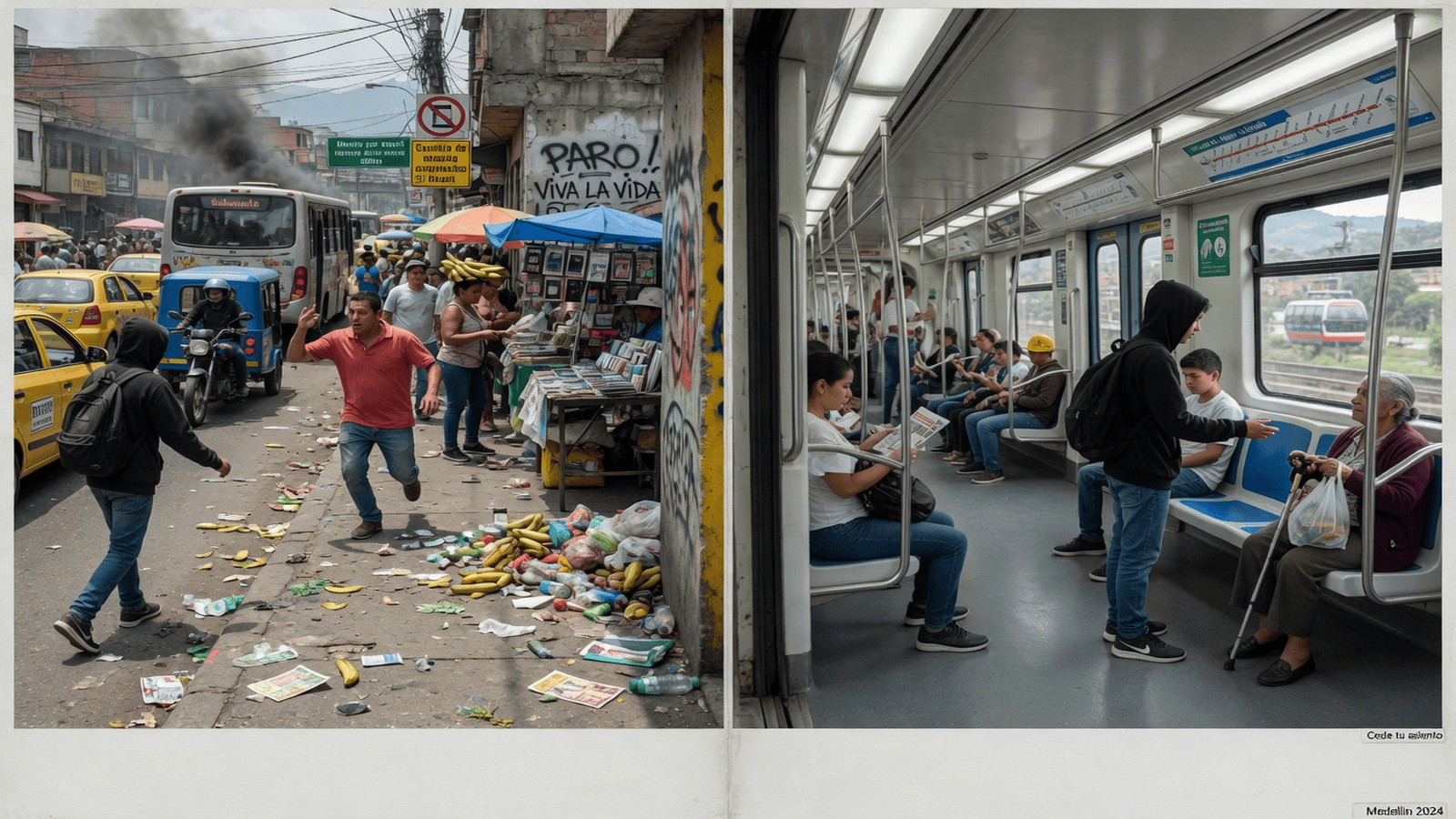
Step onto a sidewalk in Medellín and you might see someone cut across four lanes of traffic, drop a wrapper without looking down, elbow past a line. Watch that same person descend into the Metro three minutes later and they queue. They fall silent. They offer their seat to a stranger who is older than they are. They treat a rolling steel box like a place of worship.
Nothing about their character changed in the time it took to walk down the stairs. What changed was the story they were standing inside.
I. The Puzzle of the Model Citizen
The common explanation for Medellín’s famously orderly metro is education — decades of civic messaging finally sinking in. It’s a tidy answer and it’s too thin, because it can’t explain the split-screen. If education were doing the work, the well-behaved rider on the platform would also be the well-behaved pedestrian on the street outside it. They are not two different people. They are one person operating under two different sets of instructions, and only one of those instruction sets came with a story attached.
This is the more interesting claim buried in the puzzle: behavior is not a fixed trait you carry around inside you. It is a response to context, and narrative is the tool that builds context. Change the story a space tells about itself, and you change what the same person does inside it, without touching anything about who they are.
II. The Story Came Before the Trains
What’s easy to miss about Medellín is the sequencing. The civic campaign — Cultura Metro — began years before the first train ran in 1995, in a city that was, at the time, one of the most violent in the world. The narrative wasn’t advertising bolted onto a finished product. It was laid down as foundation, the way you pour concrete before you frame a wall.
This inverts how most infrastructure gets built. The usual order is: construct the thing, then hire a communications team to explain it to people. Medellín’s order was: teach people what the thing means to them, then hand them the keys. By the time the doors opened, riders weren’t being introduced to a subway. They were stepping into a story they already knew the ending of — a story where they were the custodians, not the guests.
Charles Duhigg’s research on keystone habits, laid out in The Power of Habit, makes a related point about individuals: certain small, symbolic behaviors reorganize everything around them once they’re established. Medellín ran the same logic at civic scale, and ran it before the concrete was even poured.
III. This Is Yours
The actual mechanism sits in three words. Slogans like Este es su metro — this is your metro — aren’t slogans in the advertising sense. They’re identity claims. And the specific claim matters enormously: not this is for you, a gift dispensed by an abstract government, but this is yours, a possession that implicates you in its condition.
“For you” is passive. It describes a relationship where someone else did something and you’re the recipient — the same relationship you have with a public bathroom you’ll never clean. “Yours” is active. It assigns custody. If the train is yours, its floor being clean is your business in a way that a stranger’s floor never is.
Benedict Anderson’s Imagined Communities argues that nations are held together not by physical proximity but by citizens agreeing to imagine themselves as a group with shared stakes. Medellín did this at the scale of a subway line — manufactured a small imagined community bounded by turnstiles, and populated it with people who behave like members rather than tourists.
IV. Two Roads to the Same Order
Medellín isn’t the only city that engineered orderly behavior out of a disorderly population — it just did it through story instead of through the street itself. New York’s transit authority, working from the broken-windows theory that James Q. Wilson and George Kelling laid out in 1982, took the opposite route: fix the physical signals of neglect — graffiti, broken windows, uncollected fare evasion — and the disorderly behavior those signals invite will follow the neglect out the door. No slogan campaign, no possessive pronoun. Just the environment itself, edited until it stopped inviting disorder.
Both approaches produced real, measurable order. But they built it out of different materials. Broken windows theory changes behavior by editing what people see. Medellín’s campaign changed behavior by editing what people believe about themselves in relation to the space. One is architecture of signal; the other is architecture of identity. The fact that both work is itself the finding — order can be built from the outside in or the inside out, and a narrative, when it’s sustained and specific enough, is structural in exactly the way a repaired window is.
Remove either one, and you’d expect the effect to erode. Which raises the harder question for Medellín specifically: the campaign is three decades old now. Is it still being renewed for each new generation of riders, or has “this is yours” become self-sustaining culture, inherited without anyone quite remembering it was ever a campaign at all?
V. The Dark Mirror
The mechanism that makes a stranger protect a subway car is the same mechanism that has, elsewhere, made strangers march. “This is yours” is a phrase with no built-in ethics. It scales up into national identity and down into cult recruitment with equal ease; it is the load-bearing sentence behind both a well-tended commons and every propaganda campaign that has ever asked ordinary people to police, sacrifice, or die for something they were told belonged to them.
The tool is neutral. What separates Medellín’s use of it from its uglier applications isn’t the mechanism — it’s that the thing being claimed was, in fact, given back. Citizens were told the metro was theirs, and then they got to ride it, govern its cleanliness, watch it stay theirs for thirty years. Propaganda tells you something is yours and then takes it. Civic narrative, done honestly, tells you something is yours and means it.
That difference is invisible from inside the mechanism. It only shows up over decades, in whether the promise was kept.
Further reading
- Charles Duhigg, The Power of Habit — on keystone habits and how small symbolic behaviors reorganize the systems around them
- Benedict Anderson, Imagined Communities — on how shared narrative manufactures belonging at scale
- James Q. Wilson & George L. Kelling, Broken Windows — The Atlantic, 1982 — on how physical signals of neglect invite disorder