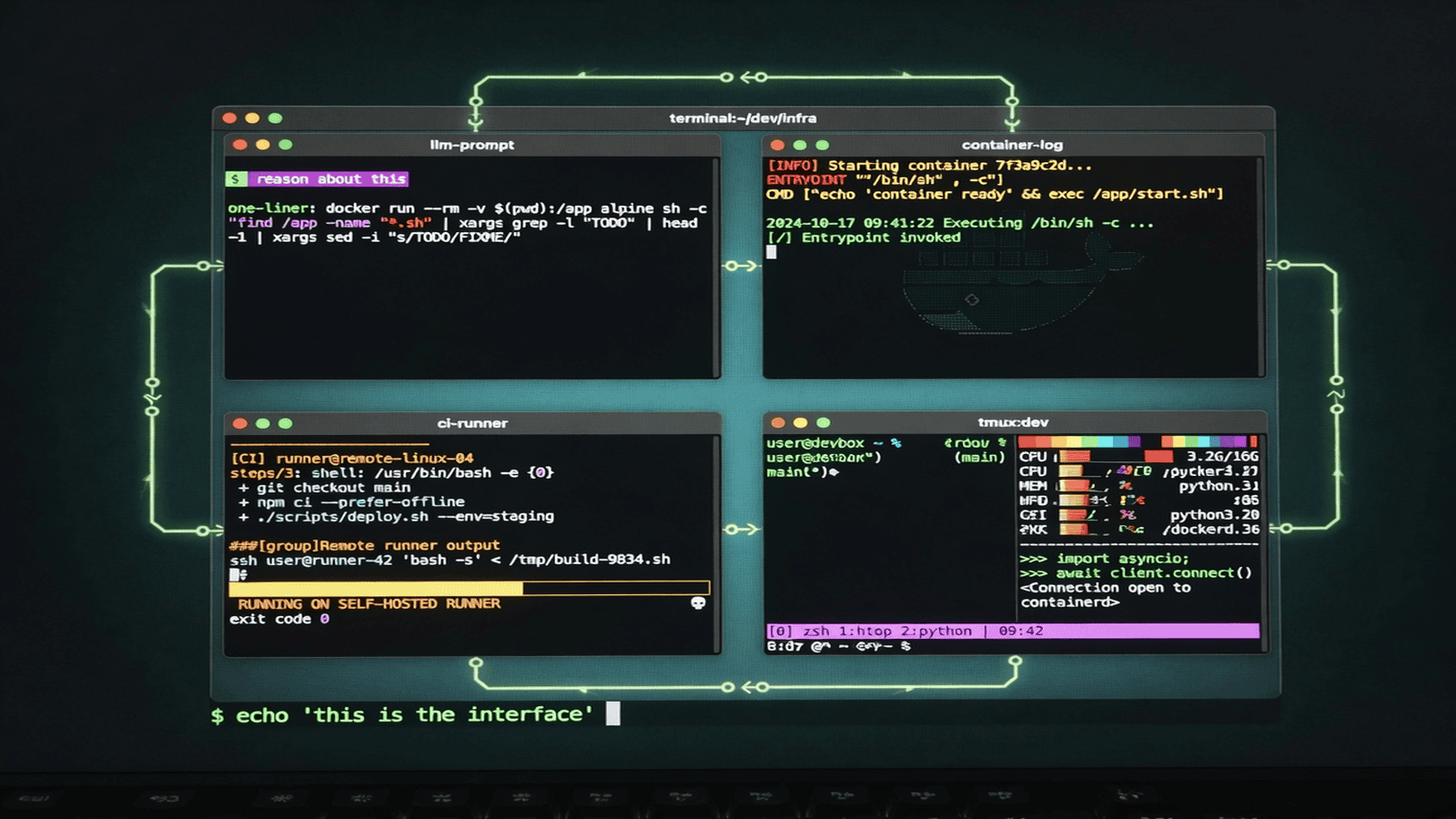
The Unix shell is not the best tool for every job. But it is the most portable standard we have. When an LLM is asked to reason, it writes bash. When a container starts, it runs a shell script. When a CI pipeline executes, it runs shell commands. When a server boots, init runs a shell. The shell is not elegant—it is ubiquitous. And ubiquity, in systems engineering, is a kind of elegance.
Learning the shell means learning to operate the vast majority of computing devices in their native language. It means inheriting a tool ecosystem that has been battle-tested for decades. It means you can read what a machine is doing—whether that machine is human or artificial—and when it goes wrong, you can fix it.
I. The Universal Interface
The Unix shell is the lowest common denominator of computation. This was not an accident. The shell is the oldest, most widely adopted interface between human intent and machine execution. It predates almost every other abstraction we use—and unlike those abstractions, it has not been replaced. It has been absorbed.
Every Android device runs a Linux kernel. Every Mac runs Darwin, with BSD tools in the terminal. Every cloud VM runs Linux. Every Raspberry Pi, router, NAS, and edge compute node speaks Unix. The shell is the protocol that connects to all of them. If you cannot operate a Unix shell, you are locked out of most of the computing infrastructure that exists.
This is not an argument for purism or Unix evangelism. It is an argument for pragmatism: the shell works on your Mac, your Linux box, your Docker container, your cloud VM, and the WSL environment on your Windows machine. It is the one interface that does not care what platform you are using.
II. You Inherit the Tool Ecosystem
Learning the shell is not really about learning bash syntax. It is about learning to think in the Unix philosophy: do one thing well, compose via pipes, treat everything as a file.
When you learn bash, you implicitly learn grep, awk, sed, find, xargs, cut, sort, uniq, tee, diff, patch, tar, ssh, scp, rsync, curl, jq, and hundreds more. These tools are not language-specific. They are not version-dependent the way npm packages or pip libraries are. They have been stable, documented, and composable for decades. They do not go obsolete because a startup ran out of funding or a new framework took over.
This tool ecosystem is the intellectual foundation of modern software engineering. Learning the shell is learning that philosophy by immersion, not lecture.
III. LLMs Are the New Shell Users
There is a strange loop happening now. Humans are asking LLMs to reason and solve problems by writing shell commands. And the LLMs are doing it—they generate bash scripts, Python one-liners with command-line tools, Docker invocations, and CI pipeline configurations.
If you cannot read and understand what an LLM wrote for you, you are at the mercy of its judgment. If it generates a destructive command, you will not catch it. If it writes inefficient code, you will not know. If it misses a security implication, you will not see it. Learning the shell means you can verify what the machine did—and when it goes wrong, you can fix it yourself.
This is not a temporary phase. As LLMs become more capable at reasoning about infrastructure and systems, the shell is becoming the lingua franca through which they communicate solutions.
IV. You Don’t Have to Abandon Your Platform
This is the practical insight that dissolves the false choice. You do not have to pick between “I use Windows” and “I learn Unix.” All three major desktop platforms now offer seamless ways to run Unix processes:
- Windows: WSL2 gives you a real Linux kernel running inside Windows, with full filesystem integration. Docker Desktop runs Linux containers.
- macOS: The terminal is BSD userland natively. Docker, Podman, Colima, and Lima provide Linux container runtimes.
- Cross-platform: Docker and Podman run on all three and give you a Linux environment regardless of the host.
The Unix shell is not a platform switch. It is a platform addition. You keep your tools, your GUI, your workflow. You add the ability to speak the universal language.
V. The Standard That Won by Invisibility
The Unix shell did not win through marketing or by being objectively the best tool. It won by being the default for so long that it became invisible. No one chose it. Everyone inherited it. That is the strongest kind of standard—the kind you do not notice until you try to work without it.
This is why it has survived every abstraction that promised to replace it: graphical file managers, visual programming environments, no-code platforms, configuration management tools, infrastructure-as-code frameworks. None of them replaced the shell. They all sat on top of it, calling it when they needed something done.
The shell is not a technology. It is a protocol—a thin layer between your intentions and the machine’s capabilities. And protocols do not become obsolete.
In The Matrix Revolutions, Agent Smith has replicated himself so thoroughly that even the One—Neo, the most powerful being in the Matrix—cannot refuse him. Smith tells Neo: “There is no escape.” The *nix shell is like Smith: it has replicated itself across every machine, every platform, every abstraction layer. You cannot refuse it. Even the most powerful developers, the ones who could theoretically build their own interface, eventually return to it. The shell is not trying to take over. It already has. It is ubiquitous by replication, not by design. And the lesson is not that the spoon bends, or that the spoon does not exist. The lesson is that there is a shell, and you might as well learn to use it.
Further reading
- The Unix Programming Environment — Brian W. Kernighan & Rob Pike
- POSIX Shell Command Language — The Open Group
- The Fish Shell Documentation — A gentler alternative
- WSL Documentation — Running Linux on Windows
- Docker Documentation — Containers as the universal runtime
- The Matrix Revolutions — Wachowski Directors — On Agent Smith and inevitable replication