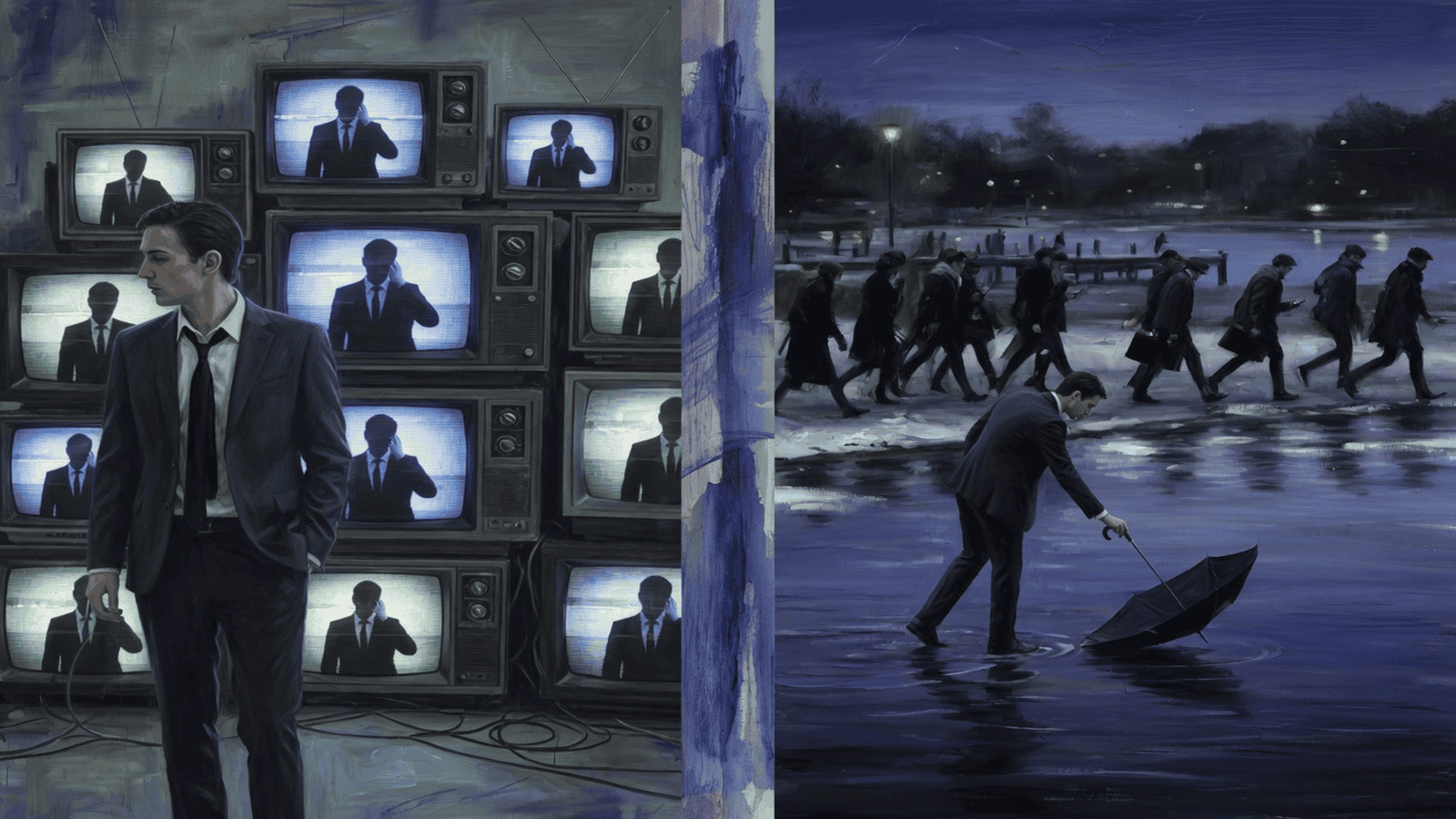
The last two minutes of Ashby’s Being There contain the movie’s thesis—and most viewers miss them. The credits roll while the audience is already exiting, already calculating parking logistics, already unwinding from what they thought was a light social satire about a simpleton let loose in the corridors of power. But those final seconds are where the film stops being funny and becomes something darker: a perfect distillation of how narrative, not truth, becomes the ultimate organizing force of human belief.
I. The Unintended Messenger
Chauncey Gardener is a blank slate. He has lived his entire life inside a television set, absorbing the cadence and imagery of broadcast media without learning how to embed them into anything resembling a coherent worldview or even ordinary human experience. When he is thrust into high society—the dying millionaire Benjamin Rand’s estate—Chauncey speaks in aphorisms about gardening, television, seasons, and simple cycles. He has no agenda. He barely has a self.
And yet, almost instantly, he becomes essential. The dying Rand sees in him a oracle. Political operatives see a political asset. The media sees a story. Each person projects their own narrative architecture onto his blankness. A comment about “seasons for change” becomes a metaphor for political renewal. A reflection on tending to roots becomes wisdom about economic fundamentals. The void doesn’t resist interpretation; it invites it.
This is not a defect in how people read Chauncey. It is the design of narrative itself. When a messenger carries no signal of his own, he becomes a perfect mirror. The watcher fills in the meaning because meaning is what the watcher needs.
II. Narrative as Inevitability
The film moves through political machinations, broadcast moments, and quiet domestic scenes with the lightness of farce. But there is something systematic happening underneath. No one is lying about Chauncey. No one is plotting his rise deliberately. The “magic” works not through conspiracy but through the basic fact that in a narrative-saturated world, a sufficiently vacant figure becomes irresistible. People will construct meaning around him because they must construct meaning—it is how human attention works.
What Ashby captures is not a conspiracy of manipulation. It is something more fundamental: the discovery that narrative power flows automatically toward those who do not resist it. Chauncey’s innocence is not a shield; it is an invitation. His blankness is not a vulnerability; it is the ideal surface for projection.
By the film’s final act, Chauncey has become essential to the dying Rand, indispensable to his political circle, and a media phenomenon. Again: no grand plan. Just the inexorable accumulation of narrative weight, each observer adding their layer of meaning, building a structure that has nothing to do with who Chauncey actually is and everything to do with what people need him to be.
III. The Final Seconds
Then comes the ending. Chauncey leaves the estate and arrives at a public park. He descends to the water’s edge. The movie shows him walking across the surface of the lake—walking on water—his umbrella descending to touch the surface as if testing its solidity. Behind him, barely visible, a crowd packs up their belongings and leaves, too occupied with their own exits to notice the impossible thing happening in front of them.
What is happening in those final seconds? Is Chauncey ascending? Has the narrative become so powerful that it has transcended its carrier entirely? Has the meaning that everyone projected onto him become so thick that it has folded back into reality itself?
Or—and this is the film’s most unsettling possibility—is the camera simply showing us that no one is watching anymore? That the miracle, if there is one, is irrelevant because the audience has already moved on, already extracted the narrative they needed and left.
The movie does not answer. But it suggests something: that narrative has a life independent of truth. That what people believe, what they need to believe, what they will invest their attention and energy into believing, matters far more than what is actually happening. Chauncey may or may not be walking on water. It does not matter. The narrative has already escaped him.
IV. The Agenda Behind the Magic
This is where Being There becomes genuinely dangerous as a text. Because Chauncey’s innocence—his absolute lack of agenda—is precisely what makes him useful to everyone with an agenda. The dying Rand’s advisors, the political operatives, the media figures who will make Chauncey into a phenomenon: they all have plans. They all benefit from the narrative.
Chauncey does not. He is untouched by his own apotheosis.
But that is not true of everyone else. Someone gains from the mystification. Someone benefits when the narrative escapes the carrier. The movie suggests that the system—the machinery of power, wealth, and media that surrounds Rand and his circle—is what thrives when meaning becomes untethered from truth. When what is believed matters more than what is real, the people with the most resources to shape belief win.
Chauncey’s blankness is not wisdom. It is an absence. And into that absence, agendas pour freely.
V. What We Miss
Most viewers do not catch the final shot. They miss it because they are already leaving, already shifting into the headspace of the parking lot and the next appointment. The film’s deepest insight is credits-adjacent, barely part of the official text. It is the moment the movie trusts least—the moment it offers to viewers who will not receive it.
This may itself be the point. In a narrative-saturated world, the most important moments are the ones we rush past. The ones that do not fit the expected arc. The ones that arrive when we are already packing up to leave.
Being There was released in 1979, before the internet, before social media, before the algorithms that would come to govern attention at the scale of billions. And yet the film describes our current moment with eerie precision. Not because Ashby predicted social media, but because he understood something older: that people will always prefer the narrative that fits their needs over the truth that disturbs them. That a blank vessel will always attract interpretation. That the most dangerous magic is the kind that requires no conscious magician.
Chauncey, innocent and absent, is the perfect modern figure. But he is not new. García Márquez’s Remedios la Bella—ascending to heaven while folding laundry, a blank beauty onto which an entire town projects desire and sanctity—is his literary ancestor. The archetype of the vessel so empty that it becomes infinite. He is every influencer who became famous for being a channel rather than a source. He is every political figure whose blankness allowed supporters to project their entire hopes. He is every moment when the narrative overtook its carrier and no one noticed because they were already leaving.
Further reading
Being There — Directed by Hal Ashby (1979), based on the novel by Jerzy Kosinski.
One Hundred Years of Solitude — Gabriel García Márquez (1967). The literary precedent: Remedios la Bella as the archetype of the blank vessel that attracts infinite meaning.