By the first century CE, Rome supplied its citizens with water through eleven aqueducts. The Cloaca Maxima, the great sewer, still stands—the oldest working infrastructure in the world. Frontinus, appointed superintendent of aqueducts in 97 CE, left behind a technical manual on water management that reads like a modern utility document. The Romans understood that filth and disease traveled together. They built public latrines with running water. They regulated waste disposal. They organized the collection of garbage in the streets.
Then the empire fell, and Europe forgot.
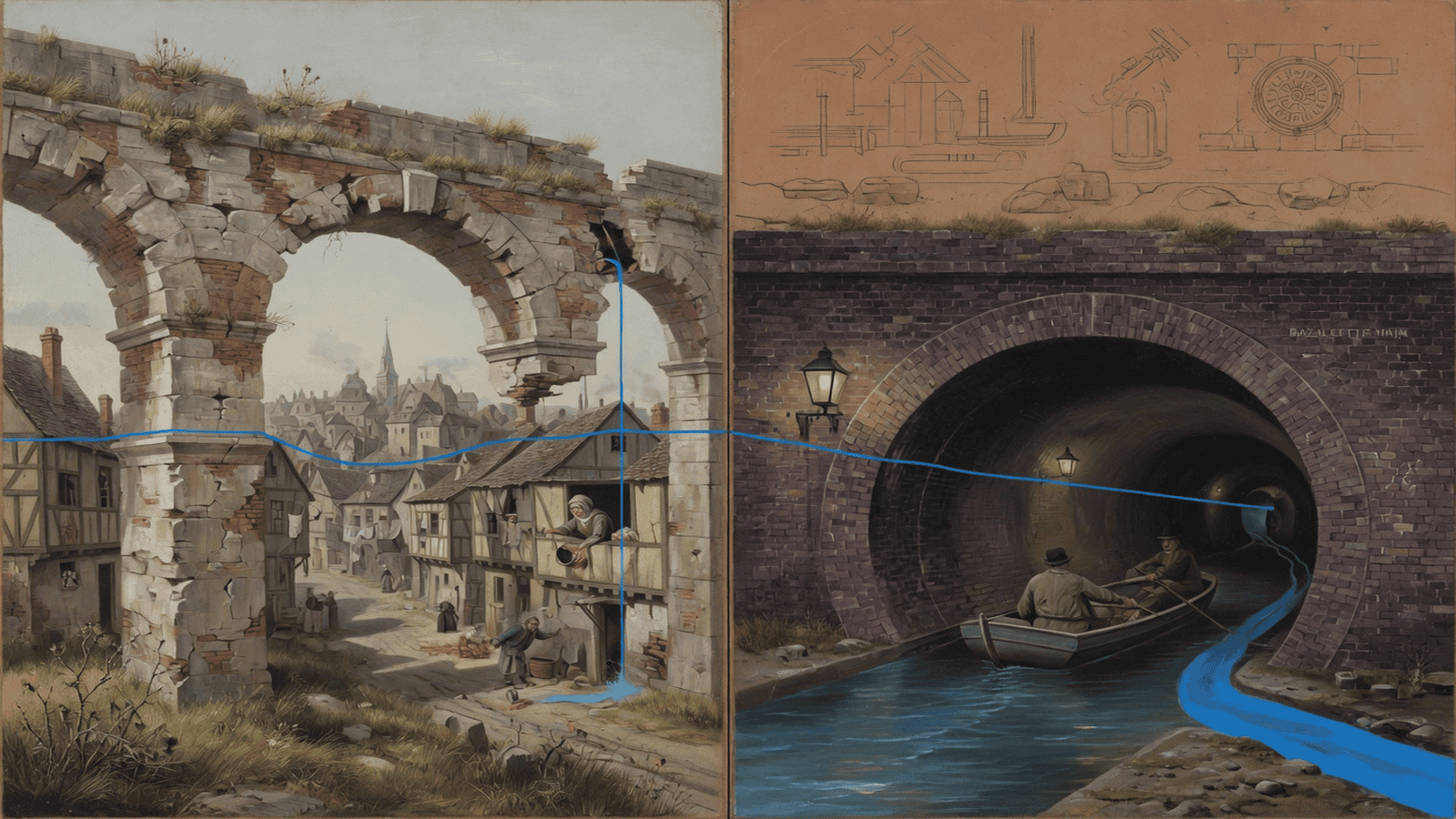
For a thousand years after the collapse of Rome, European cities were characterized by open sewers running through the streets, waste thrown from windows into the soil below, wells contaminated by human feces, and epidemics that returned with ceremonial regularity. During the Black Death—1346 to 1353—between thirty and sixty percent of Europe’s population died. The response was not engineering. It was processions. Flagellation. Plague saints. Aromatic powders burned to purify the air. The Jews were blamed. The stars were consulted. Everything, it seemed, except the thought to clean the well or reconnect the aqueducts whose broken arches still rose from the fields like monuments to a forgotten idea.
This is not a story about ignorance. It is a story about what happens when a society loses the institutional substrate that makes knowledge operational.
I. The Collapse of Maintenance
The Roman water system was not a recipe that could be inherited. It was an organism. Aqueducts required centralized administration, tax revenue, specialized labor—plumbers, surveyors, engineers—and legal frameworks to manage rights-of-way and costs. When the imperial apparatus withdrew, the system failed not because the knowledge vanished but because the organization to sustain it did. Individual wells replaced aqueducts. Private cesspits replaced sewers. The technology persisted as debris. The institution disappeared entirely.
This distinction matters. A Roman aqueduct is not like a piece of pottery you can dig up and learn from. It is a solution to a coordination problem. Every mile of arcades required a bureaucracy to keep it running. When that bureaucracy ceased to exist, the physical structures remained—visible, even haunting—but useless. Europe did not lack the know-how to build sewers. It lacked the authority to compel a landowner to allow one across his field. It lacked the tax base to fund ongoing maintenance. It lacked the role—there was no medieval curator aquarum.
The discontinuity, then, is not about forgetting. It is about the loss of institutional capacity masquerading as the loss of will.
II. The Narrative Shift
But there is something deeper here, something about how societies interpret the same facts in radically different ways and act accordingly.
The Romans were pragmatists about pestilence. Vitruvius advised on the orientation of cities for health. Varro speculated about “minute creatures” drawn in through the mouth and nose. When disease struck, the response was constructive: drain the marsh, divert the water, ventilate the building. The causal model might have been crude, but it pointed toward engineering as the appropriate response.
Medieval Christendom operated within an altogether different framework. Pestilence was divine punishment for sin. It was a conjunction of planets, a cosmic imbalance written in the stars. It was the work of heretics or the deliberate poisoning of wells by a scapegoated minority. The appropriate responses were ritual, repentance, and expulsion. When the body politic was diseased, the cure was prayer and purification, not pipes.
This is the core narrative discontinuity: the same observation—people are dying—was routed through entirely different causal frameworks, producing entirely different interventions. The Romans and medieval Europe were looking at the same phenomenon through different lenses, and the lenses determined what became visible as a solution.
The question becomes unsettling: How much of what we see as “the right way to think about a problem” is as contingent as medieval theology will appear to our descendants? How many of our confident frameworks are as hollow as the ones we now regard with anthropological curiosity?
III. The Miasma Interlude
By the sixteenth century, miasma theory had become dominant—the idea that disease arose from “bad air” produced by decaying matter. The theory was wrong about the mechanism. Disease is not caused by odor. But miasma theory had an accidental genius: it predicted the right interventions.
Drain swamps. Remove garbage. Clean the streets. Ventilate rooms. Improve water supply. All of these emerge naturally from miasma reasoning, and all of them work—not for the reasons miasma theory gives, but because they happen to eliminate the conditions that allow bacteria to flourish. The theory’s wrongness was orthogonal to its utility.
The Great Stink of London in 1858 crystallizes this paradox. The Thames was an open sewer. Parliament, olfactory distressed, hung curtains soaked in chloride of lime to block the “miasma” from entering the chamber. But they also commissioned Joseph Bazalgette to design the London sewer system—1,100 kilometers of brick tunnels, the largest civil engineering project of the nineteenth century. The causal model was wrong. The infrastructure it inspired was transformative.
This raises an uncomfortable question: How often do we get the mechanism wrong but the intervention right? And what does it say about our confidence in frameworks where we might be doing the same thing—acting on correct theories that happen to produce effective outcomes, but could easily produce disaster if the correlation broke?
IV. The Institutional Reconstitution
The nineteenth-century breakthrough in public health did not come from germ theory. Pasteur and Koch would confirm the mechanism later. It came from statistical evidence and utilitarian pragmatism.
Edwin Chadwick’s Report on the Sanitary Condition of the Labouring Population (1842) was not built on laboratory science. It was built on counting. The poor died more often. Their districts were filthier. When the districts were cleaned, the death rate dropped. That correlation was sufficient. The Public Health Act of 1848 in Britain emerged not from a complete understanding of disease but from the observation that intervention worked.
John Snow’s removal of the Broad Street pump handle in 1854 is celebrated as an act of epidemiological genius, but Snow himself operated within miasma theory—he thought removing the pump would stop the bad air. The theory was wrong. The intervention was right. The 19th century succeeded not by understanding the mechanism but by creating institutional structures that could act on partial knowledge and statistical evidence.
Public sanitation requires four preconditions: centralized authority with jurisdiction over private property (you cannot have one house poisoning another’s well), a tax base to fund long-term infrastructure, technical knowledge distributed widely enough to maintain systems, and a causal model—even if incomplete—that motivates action. Rome had the first three and the last, but lacked the political form to rebuild after collapse. Medieval Europe lacked all four. The modern nation-state rebuilt all four, but through a different mechanism: not imperial administration but statistical evidence and industrial necessity.
The sewer system is not just infrastructure. It is the physical embodiment of a changed narrative about how society works. The Romans built sewers to serve the empire. Bazalgette built them to serve industrial cities. The institution changed. The artifact persisted.
V. The Latent Framework
There is a danger in reading this history as a progress narrative—from superstition to science, from ritual to engineering. The COVID-19 pandemic showed that the medieval framework is not extinct. It is latent.
Vaccination rates followed patterns of trust and scapegoating that would be familiar to the fourteenth century. Conspiracy theories about origin and responsibility flourished. Ritual—both adaptive and maladaptive—reemerged as a primary response. Magical thinking did not disappear; it simply found new vessels.
The institutional apparatus was there: germ theory was established, the mechanisms were understood, the interventions were known. Yet the narrative framework that had been dominant for a century could be overtaken, almost overnight, by older patterns of interpretation. The Cloaca Maxima stands in Rome still, a monument to a civilization that understood permanence. But permanence in infrastructure does not guarantee permanence in the narratives that sustain it.
The question becomes whether the nineteenth-century institutional triumph—public health, statistical evidence, coordinated infrastructure—is as fragile as the Roman apparatus turned out to be. What conditions would re-activate the medieval framework at scale? How much of our modern sanitation system depends on a narrative consensus that could shift?
Further reading
De aquaeductu — Frontinus (c. 98 CE)
De architectura — Vitruvius (c. 15 BCE)
Report on the Sanitary Condition of the Labouring Population of Great Britain — Edwin Chadwick (1842)
On the Mode of Communication of Cholera — John Snow (1855)
The Foul and the Fragrant: Odor and the French Social Imagination — Alain Corbin (1982)
A Distant Mirror: The Calamitous 14th Century — Barbara W. Tuchman (1978)
H₂O and the Waters of Forgetfulness: Reflections on the Historicity of “Stuff” — Ivan Illich (1985)
Plagues and Peoples — William H. McNeill (1976)
The Great Stink of London: Sir Joseph Bazalgette and the Cleansing of the Victorian Capital — Stephen Halliday (1999)