I. The Translation You Didn’t Know
“Lord of the Flies” is not Golding’s invention. It is a translation — and like all translations, it reveals more than it conceals.
The title comes from Hebrew and Aramaic: Beelzebub, Ba’al Zevuv, the Lord of the Flies. In Christian theology, Beelzebub is not merely a demon; he is the prince of demons, the bureaucratic tempter, the god of the swarm. When William Golding chose this title for his 1954 novel about stranded schoolboys, he was not simply describing a pig’s head on a stick. He was naming the spiritual energy that emerges when civilization withdraws.
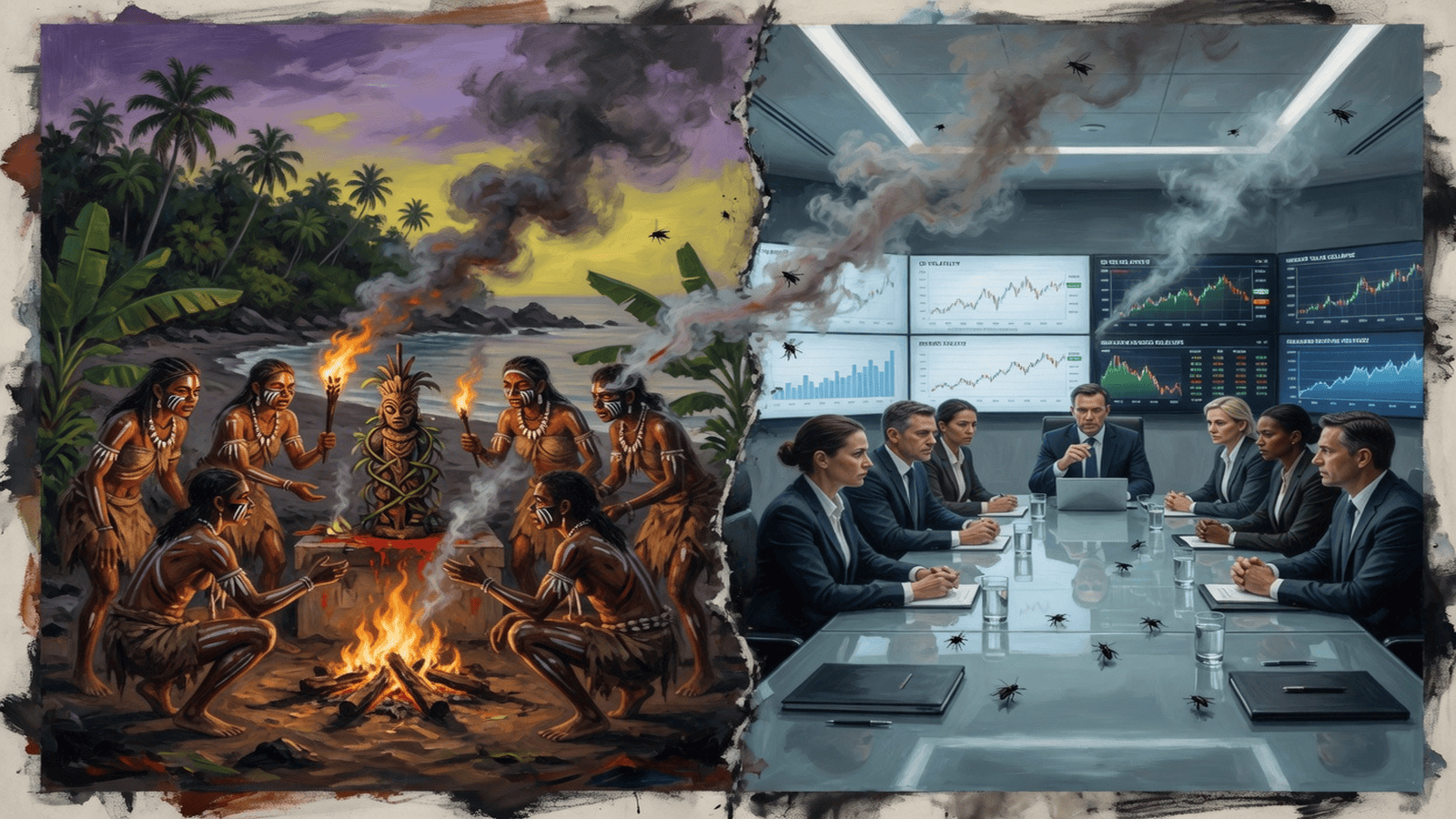
The uncomfortable recognition comes later — in a film screening, in a moment of honest observation. The boys on that island are not a metaphor for children. They are a metaphor for us. The paint on their faces, the rituals, the hierarchies maintained by fear and tribal loyalty — these are not childish things that adults outgrow. They are the exact same dynamics that run boardrooms, governments, militaries, and institutions today.
The only difference is vocabulary.
II. The Costume of Adulthood
A child says “you’re with us or against us.” An adult, in a meeting room somewhere, says “you’re either part of the solution or part of the problem.” The logic is identical. The register is different.
A child builds a fort and calls it a kingdom. An adult builds a corporation and calls it a legacy. A child draws a line in the sand; an adult draws a border. A child worships a pig’s head because it gives the tribe an object on which to project their fear and anger; an adult worships a nation, a cause, a market, a stock price. The game is the same. The stakes have been renamed. The vocabulary has been upgraded.
Golding understood this in 1954. What he captured was not the descent of children into savagery, but rather the revelation that the machinery of human civilization — stripped of its decorative language — operates on the identical principles as the island: dominance, territory, tribal loyalty, the scapegoating of the weak.
III. Thomas Campbell and the Maturity Gradient
Thomas Campbell, physicist and former NASA scientist, spent decades developing what he calls a “Theory of Everything” — My Big TOE. At its heart is not an equation but a diagnosis: most humans are not operating at the level of maturity they believe they are.
Campbell’s framework posits consciousness as the fundamental reality, evolving through stages:
- Ego-centric: the child’s view — “my needs, my tribe, my gods.”
- Ethno-centric: slightly wider — “our nation, our religion, our way of life against theirs.”
- World-centric: broader still — “all humans have dignity; we share a planet.”
- Cosmos-centric: the rarest view — alignment with the larger system, the logos underlying existence.
Campbell’s observation, echoed in countless YouTube lectures and interviews, is that humanity as a collective remains stuck at the ethno-centric level — perhaps occasionally ascending to early world-centric moments before sliding back. Our wars, our politics, our institutions all reflect this. We are, collectively, children running a world designed for adults. We are not yet ready for the power we hold.
Golding was a pessimist. He believed the beast was ineradicable, that the descent was inevitable. Campbell, conversely, argues that consciousness can evolve — that maturity is not an accident of biology or privilege but an achievable state for those who recognize the game and choose to play differently.
IV. The Diagnostic
Campbell’s maturity gradient becomes a powerful diagnostic tool. Look at any institution: a government, a corporation, a university, a church. Ask not “what do they claim to stand for?” but rather “what maturity level is revealed by their actual behavior?”
Most national governments, despite centuries of law and philosophy, operate at the ethno-centric level — protecting “us” against “them,” reacting to perceived threats with territorial logic. Many corporations remain ego-centric in their essence — extraction and accumulation justified by shareholder returns. Even academic institutions, temples of reason, often devolve into ethno-centric tribalism: our department versus theirs, our methodology versus that one.
Very few institutions operate at world-centric maturity. And cosmos-centric institutions — organizations genuinely aligned with the long-term flourishing of consciousness itself, indifferent to short-term power — are nearly impossible to find.
This explains why Golding’s story never ages. We keep re-enacting it at scale. The boy Jack, painting his face and consolidating power through fear, is not a character study; he is a portrait of institutional leadership as we actually practice it.
V. The Question at the End
If Campbell is right — if consciousness can evolve, if maturity is achievable — then the question is not “are we doomed?” but “what would it take to grow up?”
What would it look like for a government to operate at world-centric maturity? For a corporation to place long-term consciousness flourishing above quarterly earnings? For a family, a school, a military, to choose alignment over dominance?
It sounds utopian. But Campbell would argue it is not utopian to ask — it is simply to name what maturity actually is. Utopian is the fantasy that we can continue operating from ego-centric and ethno-centric logic while wielding nuclear weapons and genetic engineering. That’s not hope. That’s delusion.
Golding showed us the island. Campbell offers us a map out. But the map only works if we admit we are lost.
VI. A Final Translation
In reverse: what would “Lord of the LLMs” become in Beelzebub’s language? Beelzebot, perhaps — the lord of the digital flies, the algorithm that feeds the swarm, optimizing for outrage and tribal engagement because that is what the swarm hungers for. The game, once again, unchanged. Only the mask is new.
Further reading
- William Golding, Lord of the Flies (1954)
- Thomas Campbell, My Big TOE, Book 1: Awakening (2003)
- Thomas Campbell, My Big TOE, Book 2: Discovery (2003)
- Thomas Campbell, My Big TOE, Book 3: Inner Workings (2007)
- Thomas Campbell, The Big Picture (audiobook)
- Thomas Campbell’s YouTube channel — interviews and talks on consciousness and maturity
- Ernest Becker, The Denial of Death (1973)
- C.S. Lewis, The Screwtape Letters (1942)
- Lord of the Flies film adaptations: Peter Brook (1963), Harry Hook (1990)