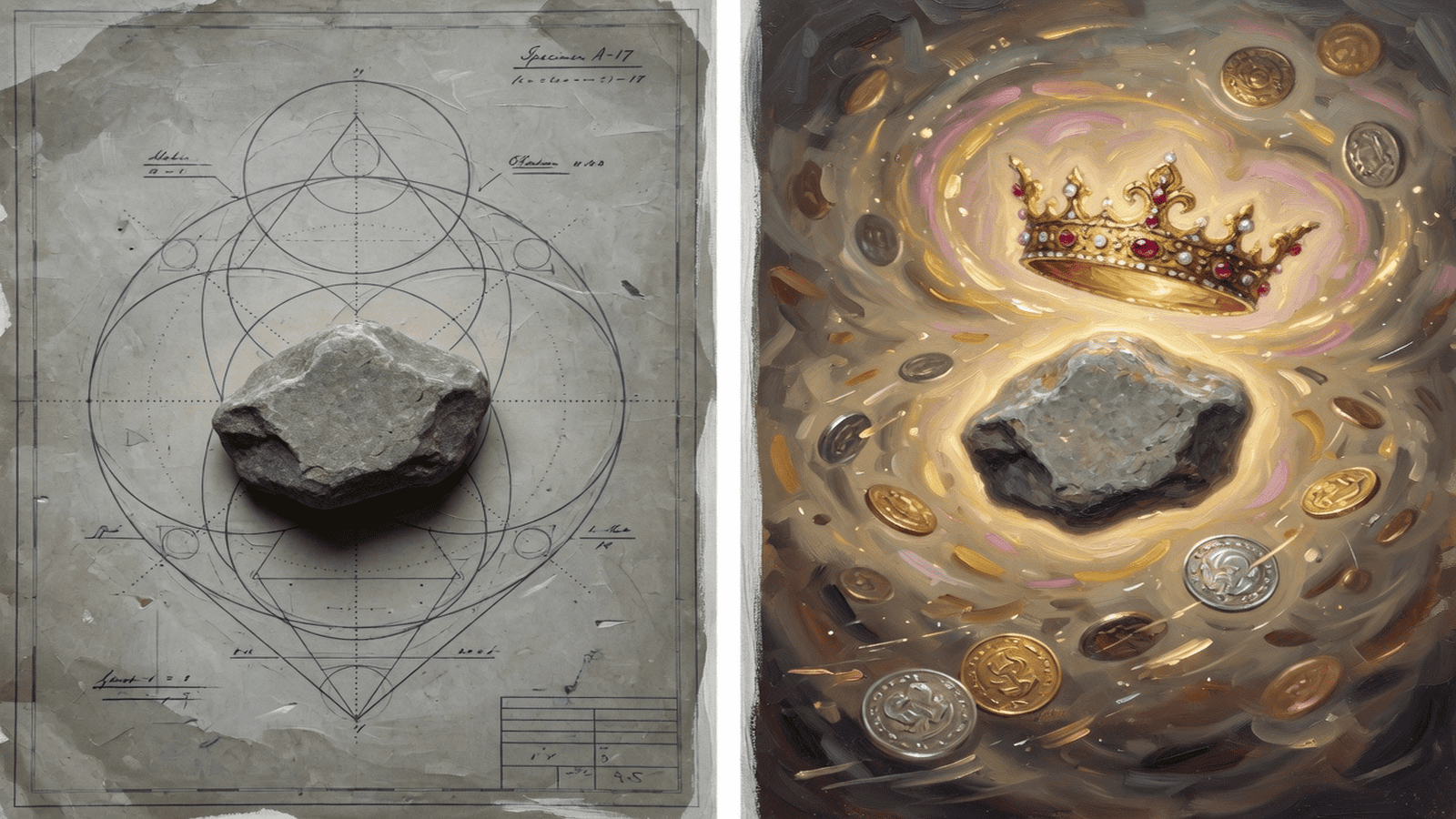
Joseph Campbell, in The Power of Myth (the Bill Moyers interviews), makes a passing remark about connotation vs denotation that cuts deeper than most full-length treatises on economics or politics. The distinction is simple, but its implications are not.
Denotation is what something is — its factual, measurable, dictionary-definition reality. Connotation is what it means — the associations, the emotional weight, the story that clings to it. A rock is a rock. But the Rock of Gibraltar, the Stone of Destiny, the Black Stone of the Kaaba — these carry connotations so heavy they bend the world around them. This is not metaphor. This is the actual engine of human civilization.
I. The Denotation-Connotation Split
The boundary between what something is and what it means appears everywhere, but we rarely treat it as a structural fault line. It is. Consider the same transaction from two angles: what gets exchanged (denotation) versus what the exchange signals or satisfies (connotation).
A white t-shirt costs five dollars. The same shirt with a swoosh costs fifty. The fabric is identical. The durability is the same. The denotation is unchanged. What shifts is purely connotative — the meaning you carry when you wear it, the story it tells about you, the tribe it signals. The entire advertising industry is a connotation factory, and it works because human beings don’t actually trade in denotation.
The stock market illustrates this even more clearly. What does the market trade? Nominally, shares of ownership (denotation). Actually, it trades in confidence, fear, narrative about the future, stories about what a company is and what it will become. The denotation can remain stable — the same earnings, the same assets, the same competitive position — while the connotation collapses. And so does the price.
II. Story vs History
The split between history and story maps onto the denotation-connotation axis. History is what happened (denotation of events). Story is what those events mean — the narrative arc, the moral, the identity-shaping charge that makes people act, build, destroy, love, kill.
Professional historians trade in denotation. They argue about facts, sources, what actually occurred. Everyone else trades in story. We ask: What does this mean for us? What does this reveal about human nature, about justice, about the trajectory of civilization? The tension between the two is the tension between truth and meaning — and they are not the same thing.
No one wins an election on policy details (denotation). They win on the story they tell about the country, about the opponent, about the future (connotation). The same tax code can be “freedom” or “tyranny” depending entirely on which connotation sticks. The same military intervention can be “national defense” or “imperialism.” The denotation stays constant while the connotation determines everything.
III. The Connotation Economy
If we redefined economic measurement to track the production of meaning rather than the production of stuff, the map of the world would look entirely different. Hollywood, Silicon Valley, Madison Avenue, Wall Street, the Vatican — these are the true engines of production. They manufacture connotation. They sell stories, identities, visions of the future. The physical goods matter only insofar as they carry the connotative weight.
The internet accelerates this dynamic beyond anything Campbell could have anticipated. Social media doesn’t trade in facts (denotation). It trades in emotional resonance (connotation). A headline that triggers outrage spreads farther than a nuanced analysis. The platform is optimized for connotation transfer, not truth transfer. Attention flows to the most emotionally loaded meaning-makers, and the signal-to-noise ratio inverts.
What you actually buy, when you buy anything, is a mix of denotation and connotation. The ratio varies by product, by person, by culture. Luxury goods are almost pure connotation. Commodities are mostly denotation. But even a barrel of oil carries connotations — energy, power, pollution, geopolitics, civilization’s lifeblood. Nothing is pure denotation. Everything is steeped in story.
IV. The Danger
If you optimize for connotation, you can become rich, powerful, famous. But you also lose touch with denotation — with what is actually true. The connotation game can consume its players. Campbell saw this as the central danger of myth: when the story forgets it’s a story and claims to be reality. When the connotation hardens into dogma.
A related trap: when you buy a story — a religion, a political ideology, a brand loyalty — you’re not buying something falsifiable. You’re buying an identity. And identities are the hardest things to change, even in the face of overwhelming denotative evidence. The connotation has become so densely woven that it resists denotation’s mere facts.
Yet the reverse risk exists too. Is a denotation backlash coming? A movement to strip things of their connotative weight and deal only in what they are? We see this impulse in minimalism, in scientific rationalism, in certain philosophical schools. But can a society survive on purely denotative communication? Or is connotation as necessary as water — we die without the stories that give our lives meaning?
Campbell drew a line between “myth” (life-giving connotation) and “misinterpreted myth” (connotation that has become toxic). The distinction matters, but in real time, it’s nearly impossible to see which is which. We live inside the story while we’re living it.
Further reading
- Joseph Campbell, The Power of Myth — the full interviews with Bill Moyers
- Roland Barthes, Mythologies — a semiotic analysis of how everyday objects carry ideological connotations
- Jean Baudrillard, Simulacra and Simulation — the endpoint where connotation has consumed denotation entirely
- Yuval Noah Harari, Sapiens — the argument that large-scale human cooperation is built on shared fictions
- Nassim Nicholas Taleb, Skin in the Game — the denotative/connotative split in risk