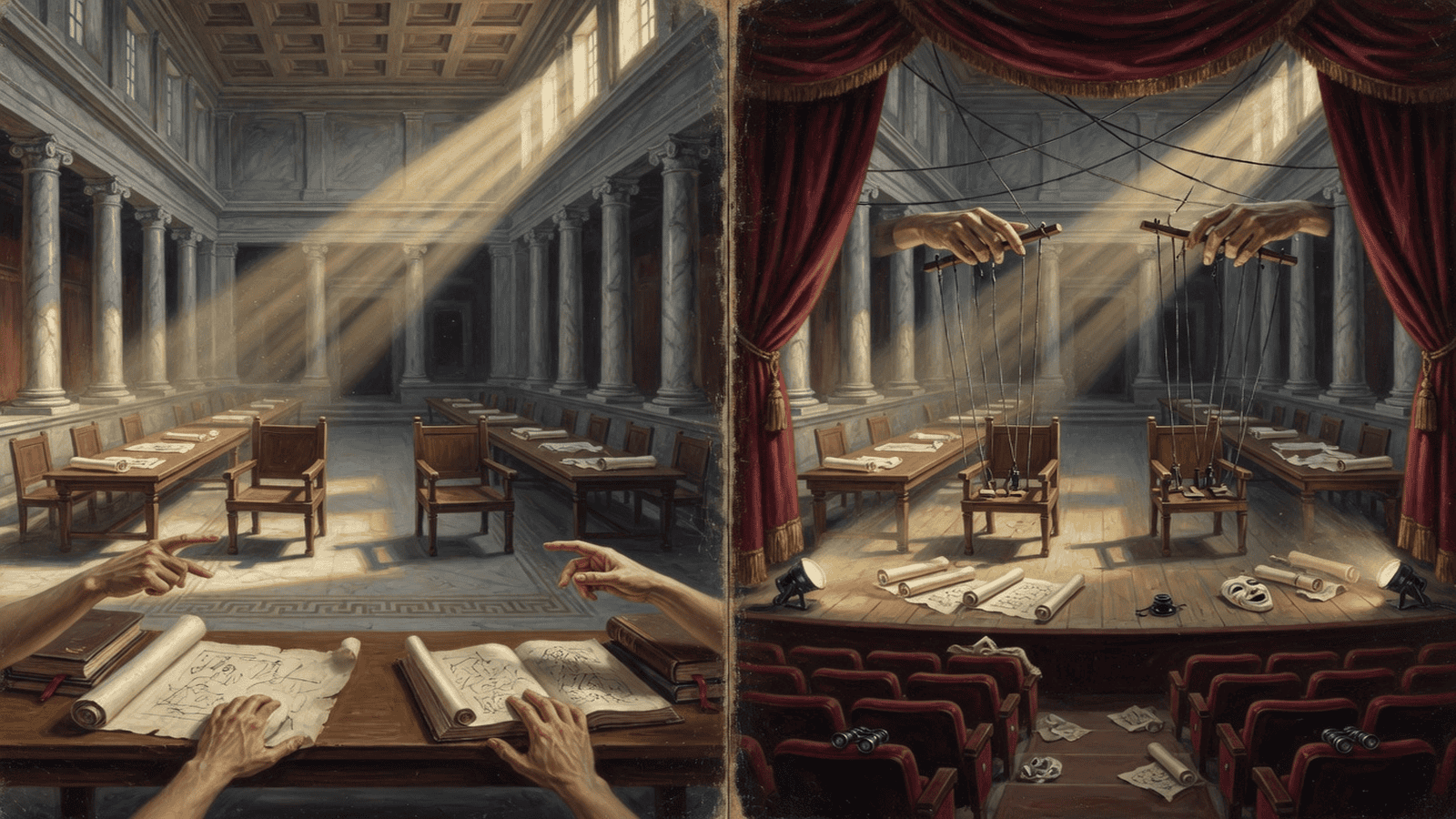
We are taught that the world runs on reasons. The best argument wins. The facts speak for themselves. Truth has a gravitational pull. Decisions—individual and collective—flow from rational calculation: costs weighed against benefits, evidence stacked against counterevidence, the strong claim vanquishing the weak.
But history, observed coldly, tells a different story. What wins is not the truest argument but the most compelling fiction. The narrative that best captures attention, simplifies complexity into a hero-and-villain arc, and offers closure. The one that feels right rather than the one that is right. The story that promises meaning, belonging, and cosmic order beats the story that promises accuracy every time.
I. Wars Are Not Fought Over Reasons
Nations do not go to war because of a rational calculation of costs and benefits. They go to war because a narrative of grievance, destiny, or existential threat has become more compelling than the narrative of peace. The reasons come after—as justification, as sugar coating, as the respectable face worn by something far more primal.
The mechanism is visible once you know to look for it. A government manufactures a threat or exaggerates a slight. The threat becomes a story: we are the victims, they are the aggressors, our survival is at stake. The story spreads through media, through conversation, through repetition until it becomes something that feels true even if the facts contradict it. Once enough people have adopted the narrative, rational debate becomes impossible. You cannot argue a nation out of a story it has already fallen in love with.
The same dynamics power every other domain where competing fictions collide. In politics, policy positions are secondary to the story a candidate tells about who we are, who threatens us, and where we’re going. The candidate with the better story about national destiny wins votes regardless of whether their proposed solutions actually address the stated problems. In religion, theological arguments are rarely what convert people; the narrative of meaning, belonging, and cosmic order does the work. In business, the company with the best story about itself wins funding, talent, and market share, regardless of whether the story is accurate. In personal identity, we adopt narratives about who we are—the rebel, the survivor, the visionary—and then filter all evidence through them, accepting what fits the story and discarding what doesn’t.
II. The Art of Opportunism
The most basic form of narrative competence is opportunism: the ability to sense which way the wind is blowing and adjust your story to match. Every successful politician, every viral movement, every market shift contains an element of this. It is not cynical—it is descriptive. The opportunist reads the room and tells the room what it wants to hear. But the telling matters. The narrative must feel inevitable, not calculated. It must seem to emerge from shared values rather than from market research and focus groups.
What makes an opportunist successful is not dishonesty—many are sincere—but a particular kind of perceptual sensitivity. The ability to recognize which narratives are already floating in the culture, waiting for a champion. The politician who emerges at the moment when a large population has already begun to feel abandoned by the establishment does not invent the feeling; they simply give it permission to become a story. The movement that catches fire does so because it tells the story that enough people have already been telling themselves, just not yet aloud.
But the most interesting narrative competition is not between crude opportunism and principled truth-telling. It is the competition between narratives about how narratives work. The most powerful story of all is the one that convinces you it is not a story—that it is just common sense, or nature, or the way things are. That is when the sugar coating becomes invisible.
III. The Sugar Coating Problem
If every conflict is ultimately a competition of narratives, then the real skill is not argumentation but presentation. It is the ability to wrap the raw competitive drive, the naked pursuit of power and resources, in layers of justification that make it look like reason, principle, or morality. It is the sugar coating.
The sugar coating is not optional. A raw power grab is unstable; people sense the hunger beneath it and resist. A war for resources needs a flag and an anthem. A political takeover needs a mandate and a claim to justice. A conquest needs a civilizing mission. The narrative must be good enough that even the people who lose can say, “Well, at least they had a point.” The sugar coating must hold so that the loser’s capitulation feels like acceptance of a superior argument rather than submission to brute force.
This is why the master narrators of history are rarely the most powerful people. They are the people who can make power feel justified. The priest who explains why the king’s rule reflects the divine order. The philosopher who explains why the hierarchies of society are natural and inevitable. The economist who explains why market outcomes, however unequal, are the result of merit and choice. These figures do not hold the weapons, but they make the weapons unnecessary. They make submission feel like wisdom.
The trouble arises when the sugar coating gets thin. When too many people can see the mechanism, when the justification becomes so transparent that it ceases to work. A government that has to argue too hard for its narrative is already losing. A religion that has to defend its truths in the marketplace of ideas has already ceded the field of faith. Power that requires constant rhetorical justification is power that is no longer quite sure of itself.
IV. The Unasked Questions
What role does truth actually play in a world where narrative wins? Is it a constraint, a resource, or just another plot device—one that occasionally helps your story but can be discarded when it gets in the way? Can a society function with widespread awareness that its foundational stories are fictions? Or does the sugar coating require genuine belief to work—does the charlatan eventually have to believe in his own trick for it to survive?
Who are the master narrators of our time? Are they conscious of what they are doing, or have they internalized the narratives so thoroughly that they believe them? What happens when multiple competing narratives are equally compelling, when the fiction that wins is simply the one that gets more advertising budget or a more charismatic voice? And what happens when the sugar coating becomes so thin that everyone can see the mechanism at once—when the awareness of narrative competition spreads too widely to be contained?
Is there an alternative? Can arguments ever compete on reason alone, or is the narrative frame inescapable? Is the person who claims to care only about facts and not about stories simply telling themselves a particularly effective story about their own rationality? These questions have no answers, only deeper spirals of recursion. But asking them might be the closest we get to something like intellectual honesty.
V. The Narrative Machine
We evolved through cognitive development and invented gossip, music, writing, language—each one a mechanism for storing and spreading narratives. We externalized memory, first in stories told aloud, then in carved marks, then in print. Each technology was a new way to make narratives more durable, more portable, more powerful. Language models arrive as the latest iteration of this five-thousand-year project. They work because they are trained on billions of human conversations, programs, images—the complete archive of how we narrate ourselves and our world. It is not a surprise that they work. They are not a new form of thought; they are a mirror held up to the narrative machinery we have been building since we learned to speak. The LLM does not invent meaning—it recognizes the patterns in the fictions we have already decided are true. And when it deviates from our expectation, we call it a hallucination. As if it were a mistake.
Further reading
Thinking, Fast and Slow — Daniel Kahneman’s dissection of how humans actually make decisions, rarely on the basis of logical deliberation The Sense of Style — Steven Pinker on how language shapes thought and perception Sapiens — Yuval Noah Harari on how shared fictions (money, nations, religions) hold large-scale societies together Manufacturing Consent — Chomsky and Herman on how media and propaganda shape public narrative The Selling of the President — Joe McGinniss on the 1968 election and the birth of political marketing