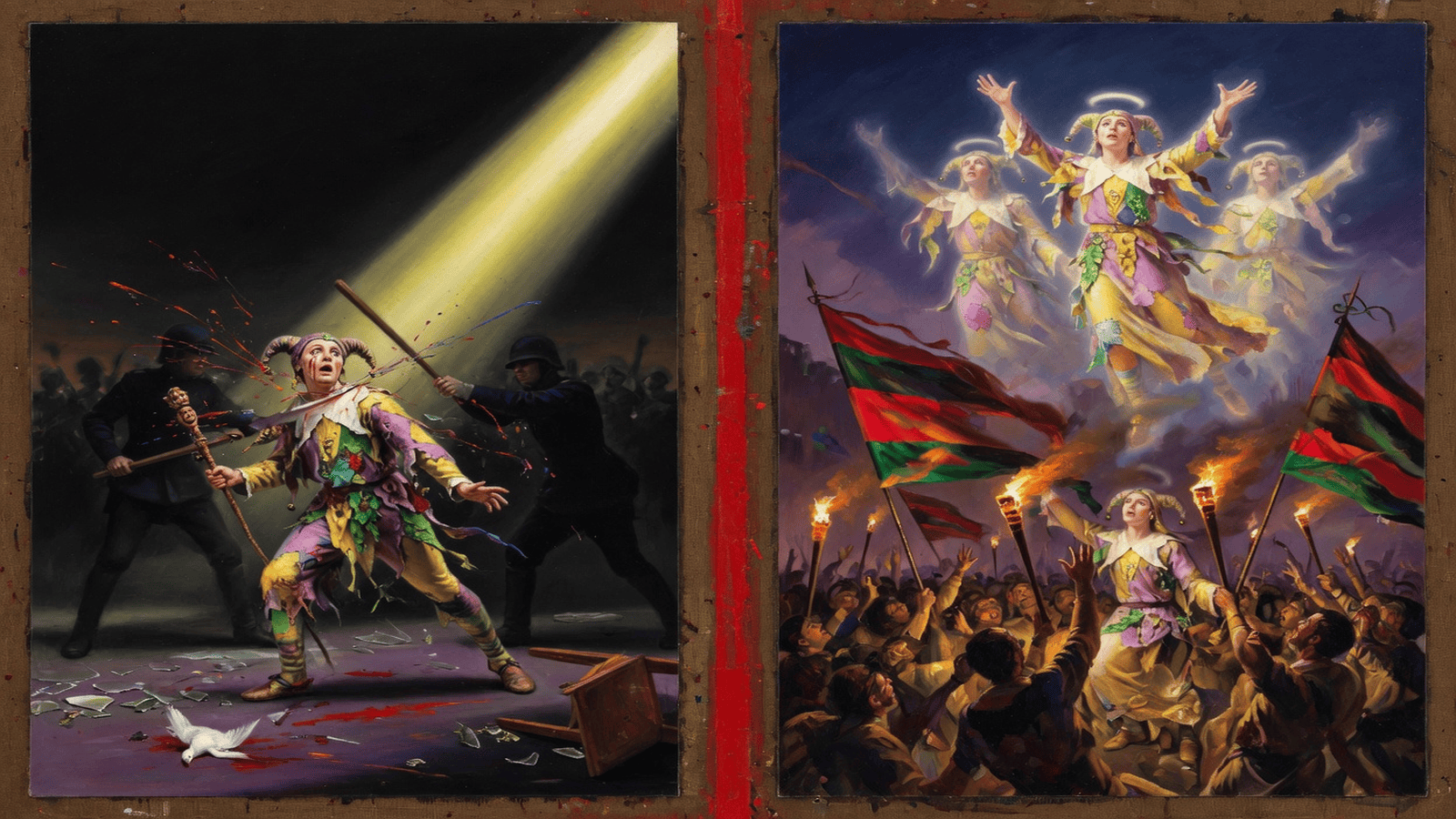
You cannot kill a narrative by killing its bearer. This is the oldest lesson in the history of power, and it is still not learned.
The jester speaks a truth the throne cannot tolerate. Power silences him. But the moment the silencing happens—the arrest, the exile, the execution—something shifts. The jester is no longer a living person you can contradict or embarrass. He becomes a martyr. He becomes untouchable. The public, having witnessed the drama, begins to resurrect him. In protest signs. In whispered stories. In the coded language of the oppressed. The throne meant to kill the jester. Instead, it created an eternal symbol.
This pattern repeats across history and mythology with such consistency that it suggests a mechanism. Not conspiracy. Not theology. Something structural about how narratives survive violence.
I. Why violence backfires
If competing narratives are won by the most compelling story—not by facts, but by the fiction that captures the imagination—then violence is the worst possible response. Violence does four things simultaneously, and three of them strengthen what you were trying to destroy.
First, it confirms the narrative. When power moves against a rival story, it proves the rival was a genuine threat. It proves the rival was right. The throne does not silence minor irritants. It silences dangerous truths. The act of censorship is itself testimony.
Second, it creates a martyr. The dead cannot be refuted. They cannot be embarrassed. They cannot be caught in a contradiction or forced to recant. The martyr becomes pure symbol, stripped of all complexity, all the messy human contradictions that living critics can expose. Complexity dies with the person. What remains is the heroic version.
Third, violence simplifies the story. A living dissident might argue something nuanced—a partial critique, a conditional proposal, an argument that requires understanding context. Once dead, all of that is abandoned. The public retells a simpler, more powerful version. The dissident becomes a martyr to the one thing the martyr was right about. Nuance vanishes. Heroism remains.
Fourth, it inoculates the idea against future criticism. Having survived persecution, the narrative becomes armor. Future critics are not listened to; they are compared to the persecutors. To question the martyr is to align yourself with the power that killed him. The idea becomes bulletproof.
This is why empires that try to strangle their jesters end up haunted by the jester’s ghost. The harder you squeeze, the louder the ghost becomes.
II. The public as resurrection engine
The public is not a passive receiver of stories. The public is the mechanism that resurrects.
An audience completes a narrative. A story is not finished when the author stops writing. It is finished when it has been received, interpreted, retold, and woven into other people’s understanding of the world. The audience is not the endpoint of a story. The audience is the story’s continuity.
The audience also selects what to resurrect. Not every silenced voice returns. Only those whose story fills a void—a gap in the current narrative landscape that demands to be filled. The public resurrected Joan of Arc. They did not resurrect every peasant burned at the stake in her century. They resurrected Galileo. They did not resurrect every scientist censored by power. The choice is not sentimental. It is functional.
The resurrected character solves a problem. She explains a present grievance. He justifies a future action. They provide an identity to the powerless. The public resurrects what it needs.
This is where the cycle accelerates. Each resurrection creates new tensions, new conflicts, new opportunities for violence. And each new violence resurrects the symbol again. The cycle does not break because the very attempt to break it strengthens it.
III. The tightrope walker’s return
In Thus Spoke Zarathustra, Nietzsche describes a tightrope walker. He is a performer—someone who walks the line between worlds, between the possible and impossible, between what the crowd wants and what actually is. The crowd cannot look away from him. And then he falls.
But what if he comes back?
Every political movement that martyrs its founder knows this truth. Every religion whose prophet was killed knows it. Every subculture whose icon died young knows it. The execution is not the ending. It is the beginning of the character’s second life.
The Stoics were not a major philosophical school in ancient Rome until the empire tried to suppress them. Christianity remained a persecuted sect for three centuries—and the persecution was what kept the narrative alive. Joan of Arc was more powerful dead than she ever was alive. The moment the flames consumed her, she became history’s most compelling symbol of resistance to unjust authority.
The tightrope walker who fell becomes the tightrope walker who will return. That promise of return—the encore the public demands—is more powerful than any living character could be. A living person can age, can compromise, can be revealed as flawed. A symbol cannot. The symbol is whatever we need it to be.
IV. The cycle
A character emerges—a jester, a prophet, a dissident, a performer on the rope. She carries a competing narrative, one that challenges the reigning fiction.
Power responds with force. Silence, imprisonment, execution.
The violence backfires. The character is elevated from individual to symbol. The public begins to resurrect her.
The symbol appears in art, in protest, in ritual, in memory. It becomes a weapon for the next cycle of narrative conflict.
A new character emerges, inheriting the old one’s mantle. And the cycle begins again.
The cycle only breaks when the narrative that powered the resurrection is itself replaced. Not by force—force only strengthens it. But by a more compelling fiction. By a story that makes the old martyr’s story seem quaint, provincial, no longer useful.
This is the only way. Not violence. A better story.
V. The invisible canonization
We do not yet understand the mechanisms that decide which deaths resurrect and which are forgotten. Is there a logic to it? An invisible committee of cultural gatekeepers? Or is it emergent—a swarm phenomenon where millions of small decisions add up to canonization?
Some questions are worth sitting with. In an age of accelerating communication and noise, does the resurrection cycle speed up? Are we canonizing new symbols every week, or does the internet’s constant distraction actually slow down the formation of meaningful symbols?
And here is the question that keeps power awake: What happens when the mechanism becomes visible? When everyone knows that violence canonizes, when the strategy is exposed, can power find other methods? Can silence kill a narrative without the reverberations of a persecution? Can indifference work where violence fails? Can a more compelling fiction replace what cannot be destroyed?
These are not rhetorical questions. They are the questions that will determine what narratives survive the next cycle.
Further reading
Thus Spoke Zarathustra — Friedrich Nietzsche (the tightrope walker and the fall)
The Jester in the Kingdom — Hans Koning (the historical role of the licensed fool)
Seeing Like a State — James C. Scott (how power silences, and how silence backfires)
The Book of Margery Kempe — Margery Kempe (mystical authority in the face of institutional power)
The Crucible — Arthur Miller (how violence creates symbols: the Salem witch trials)