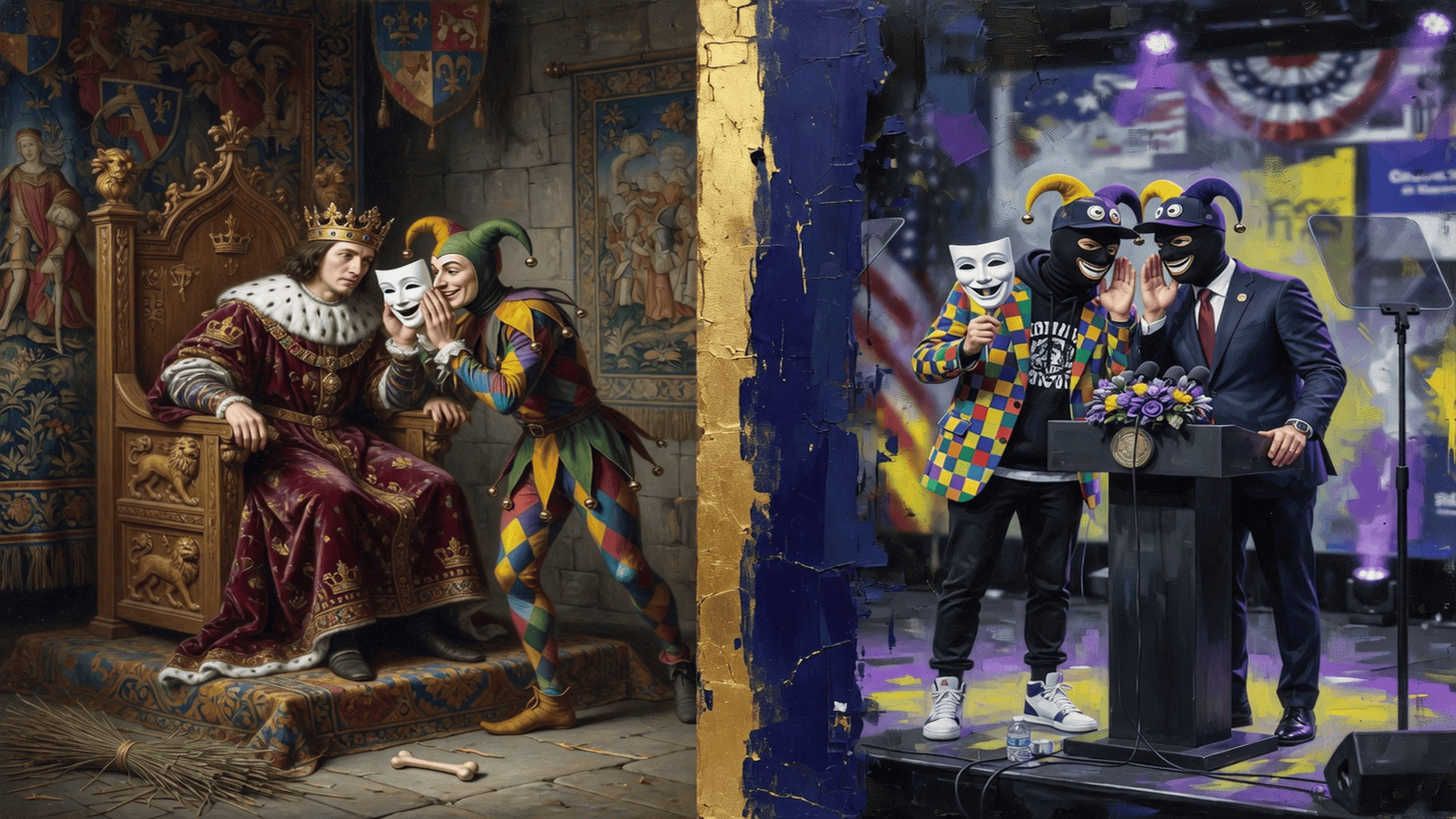
Wherever power gathers into a single pair of hands, a figure in motley appears beside it and begins to laugh. He is permitted what no one else is permitted: to mock the crowned head from arm’s length, to say over dinner what would cost a minister his own. We file the court jester under quaint medieval décor, somewhere between the falconry and the tapestry. He is nothing of the kind. He is a structural organ that grows wherever power concentrates — the way a callus grows where a tool keeps rubbing the hand — and he grows back long after we are sure we have abolished him.
I. The Fool at the Foot of the Throne
The jester can speak truth to power because he has been declared irrelevant. His mockery is tolerated because it is framed as entertainment, and the frame is the mask, and behind the mask is the one true sentence nobody else would survive uttering. Erasmus understood this five centuries ago: in In Praise of Folly, Folly herself boasts that only the fool may tell kings the truth to their faces and be thanked for it. Shakespeare gave Lear a Fool who is the sanest voice in the tragedy — and who disappears from the stage at the exact moment Lear has become a fool in earnest, the office no longer needed once the king fills it himself.
Mikhail Bakhtin found the deep logic in the carnival. In Rabelais and His World he showed how the licensed inversion — the day the fool is crowned and the king is mocked — exists precisely so the hierarchy can hold the other three hundred and sixty-four. The mask is permission. The laugh is a pressure valve. The truth gets out as a joke so that it need not get out as a revolt.
II. Rigoletto’s Two Faces
But the license is real and conditional at once, and Victor Hugo wrote the play that proves it. Le roi s’amuse gives us Triboulet, the hunchbacked fool of François I, who whets his master’s cruelty against the very courtiers he serves — until the machinery he greased closes on his own daughter. Verdi turned it into Rigoletto, and the figure who emerges is the whole truth of the type: the jester is not only the one who tells the truth, he is also the one who pays for it. He sells laughter to the powerful and lives on their sufferance, and sufferance is not a right. The instant his mockery draws blood — the instant the court stops laughing — the protection evaporates and the bladder becomes a target. Rigoletto curses, and is cursed; the cruelty he brokered comes home to the only thing he loves.
III. Who Wears the Motley Now
If every concentration of power grows its fool, who wears the motley today? The obvious heirs are the satirists and late-night hosts, saying what the correspondent cannot behind the alibi of only joking. Then the meme account and the anonymous avatar — the jester gone distributed, a thousand hands holding one inflated bladder, mockery without a single neck to hang it on. Then the whistleblower, who tears the mask off and points at the machinery itself — and who, having refused the joke, is not laughed at but crushed: the fool who forgot that the motley was the only armor he had.
And then the strangest inversion of the age — the billionaire who mocks the system from inside it, so wealthy the system cannot touch him, the jester who simply bought the court. Which surfaces the question the powerful have already learned to answer: what happens when the king laughs along? The sponsored roast, the strongman who tells the joke about himself before anyone else can, the critique absorbed into applause — co-optation is the most modern silencing there is. A license granted from above can always be withdrawn into laughter.
IV. Zarathustra’s Leap
Nietzsche staged the most violent version of the figure. In Thus Spoke Zarathustra, a tightrope walker steps out between two towers — man, in the book’s image, is “a rope stretched between beast and overman, a rope over an abyss.” Halfway across, a jester springs from the same little door, screaming at the walker to move, and leaps clean over his head. The walker loses his nerve, his pole, his footing, and falls to die in the marketplace below.
The jester is the one who has already made the leap and finds the crossing absurd seen from above. He does not teach. He does not reach down. He mocks — and the mockery says: you believe this rope is sacred; nothing is sacred in the way you need it to be.
V. Why Not Leave the Walker Alone
So why is the jester necessary at all? Why not let the walker cross in peace? Because the peace on offer is only a delusion left unopposed. The walker believes his task is the one task, his rope the one rope, his solemnity a kind of holiness — and the jester’s laughter is the only thing that breaks the spell long enough for a single path to stop looking like fate. The cruelty is a form of honesty: the refusal to let a man fall in earnest for a meaning he never once examined.
And notice what Zarathustra does next. He does not despise the jester, and he does not abandon the walker. He gathers the broken body, carries the corpse on his back, and buries it with his own hands. He needs both figures — the one who dares the crossing and the one who denies it any holiness — because a life is lived in the tension between them, not in the triumph of either.
VI. The Encore
Both of them die. Both of them come back. The walker falls; the jester, in his way, is silenced too. And yet the public resurrects them, because this is the law the powerful keep forgetting and relearning: violence against a narrative does not kill it — it consecrates it. René Girard spent a career on the mechanism. In The Scapegoat he showed how the murdered victim becomes sacred through the murder, how the crowd that destroys a man then kneels at the spot. The executed jester becomes a martyr. The fallen walker becomes a symbol. The audience that watched the drama demands an encore, and gets one.
The pattern is monotonous across history. The prophet is stoned and the following swells. The dissident is jailed and the idea travels lighter without him. The satirist is censored and the banned clip outruns everything he ever broadcast. To break a story with force is to canonize it. The only thing that has ever defeated a narrative is a better narrative — never a club. Which is exactly why the cleverest power has stopped killing its fools and started hiring them.
VII. The Dance No One Taught You
There is a last thing under all of this, and it is the hardest. The individual must walk his own rope; the collective walks its own, on a different schedule, toward a different tower. They were never going to stay parallel. Life is the moment they collide — when the path you chose meets the world’s path moving the other way, and you are asked to dance a dance you were never taught, that no one could have taught you, because the steps exist only inside the collision.
The jester laughs because he sees the choreography from above and knows there are no steps. The walker falls because he believed there were. To live well is maybe to keep crossing anyway — hearing the laughter, refusing both the walker’s solemnity and the jester’s contempt — to dance the untaught dance without pretending you know it, and without needing the rope to be sacred to be worth the crossing.
Further reading
- Friedrich Nietzsche, Thus Spoke Zarathustra (1883–1885)
- Victor Hugo, Le roi s’amuse (1832) — and Verdi’s Rigoletto (1851)
- William Shakespeare, King Lear (c. 1606)
- Erasmus, In Praise of Folly (1511)
- Mikhail Bakhtin, Rabelais and His World (1965)
- René Girard, The Scapegoat (1982)