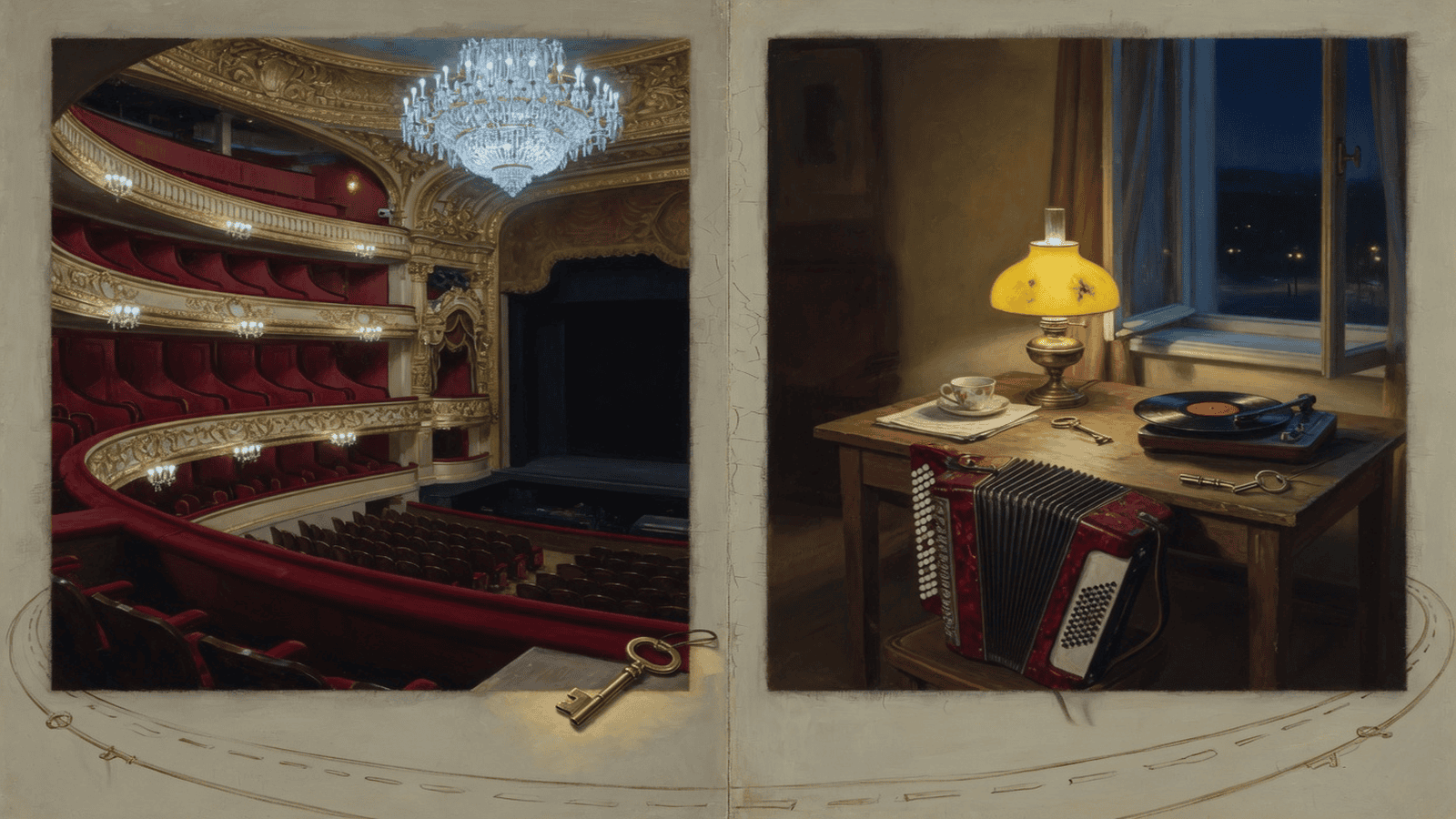
There are nights when Plácido Domingo has made me cry — real tears, the kind that arrive uninvited at the exact phrase where the voice opens and the whole room tilts. And there are other nights, more than I can count, when Domingo could do nothing for me, and what carried me across the road was a Vallenato by Diomedes Díaz, or Pedro Infante singing a bolero as if the song were a small lit room, or The Beatles’ “The Long and Winding Road.” I used to apologize for this. I have apologized to people who expected me, at a serious hour, to reach for something serious — Mozart, Wagner, Philip Glass — and caught me reaching instead for Shakira, or Julio Iglesias, or Juan Gabriel. I am done apologizing. Not because my taste improved, but because I finally understood what the apology was confessing.
I. The Hierarchy That Isn’t
We inherit a hierarchy of taste before we ever choose one. Classical at the summit, opera as its crown; jazz somewhere respectable in the middle; popular music near the floor. No one hands you this ranking on a card. You absorb it — from schooling, from the people whose approval you wanted, from the quiet arithmetic of which records earn a nod and which earn a raised eyebrow. Pierre Bourdieu spent Distinction showing that taste is never innocent: it is a social weapon, a way of marking who belongs to which class, disguised as a private preference for the beautiful. The most personal thing about you — what moves you — turns out to be one of the most legible class signals you emit.
Theodor Adorno gave the hierarchy its sternest defense. In the essays gathered as The Culture Industry he argued that popular music is standardized, pre-digested, built to demand nothing of the listener, while serious music asks for and repays real attention. There is something true in it. But the argument smuggles in an assumption it never examines: that the worth of music is a fixed property of the music, sitting inside the score, the same for everyone, independent of the human being who happens to be listening and of the hour at which they listen.
II. The Gap Between Able and Feeling
That assumption is where the whole edifice cracks. Because there is a gap — wide, honest, and rarely discussed — between being able to appreciate something and actually feeling it.
I can hear what is great in Domingo. The technique, the phrasing, the architecture of a held note. I can produce the appreciation on demand, the way you can recite a fact you do not happen to need today. But appreciation is a faculty of the trained mind, and feeling is an event in the body, and the two do not always fire together. You can stand in front of a masterpiece, understand precisely why it is a masterpiece, and feel nothing move. Then a three-chord accordion line from the Colombian coast undoes you in the cereal aisle.
This gap is not a failure of taste. It is not ignorance you are supposed to grow out of. It is the simple fact that emotional resonance is contextual — that the listener is not a fixed instrument the music plays upon, but a changing weather system the music either meets or misses.
III. The Key and the Lock
So why does Diomedes save a day that Pavarotti cannot?
The useful image is not medicine but a key. Medicine works on a condition: the same compound for the same ailment, reliably, in almost anyone. A key works on a lock, and only the one lock, and the lock keeps changing. Music is the second kind of thing — less a substance with a fixed potency than a trigger waiting for the right configuration of the person it triggers.
Some of this is now visible from the inside. Oliver Sacks, in Musicophilia, catalogued how deeply and strangely music is wired into us: how it can reach patients that language no longer can, how a melody can carry a memory intact across decades of dementia. Daniel Levitin, in This Is Your Brain on Music, traced the way a familiar song lights up motor, emotional, and memory circuits at once. The Vallenato does not move me because it outranks the opera. It moves me because it is soldered to a place, a face, a younger version of myself — and on a particular night that is the circuit carrying current.
Proust knew this without the scanner. The whole of Swann’s Way turns on the discovery that the past is not retrieved by effort but released by accident — a taste, a phrase of music, the “little phrase” of Vinteuil’s sonata that returns Swann to a love he believed buried. Involuntary memory does not consult the hierarchy of taste. It opens whatever door the trigger happens to fit, and the trigger is as often a popular tune as a sonata.
IV. The Apology
Which brings me back to the apology, and to what it was really confessing.
When you reach for Edith Piaf instead of Mozart at a grave hour, and feel the reflex to explain yourself, the apology is not about music at all. It is the fear that your inner life does not match your outer performance — that you are not as refined as the moment is asking you to be, and that needing a simple bolero to cross the road gives you away.
There is a class edge to that fear, exactly where Bourdieu said it would be. The expectation to want serious things at serious times is also an expectation about who you are and where you came from. The apology is a small act of submission to the ranking — an admission that you know it, accept it, and regret falling short of it. I no longer think I owe that submission. I have read the classics; I lost count of how many times I read One Hundred Years of Solitude. I have also rewatched Leslie Nielsen in The Naked Gun on a night when nothing else would carry me, and I will not pretend otherwise to make a stranger comfortable. I am not going to fake my way through Shakespeare to earn the right to love Shrek.
V. The Democracy of Tears
Here is the part the hierarchy cannot account for. Domingo made me cry. So did Juan Gabriel. The tears were not different in worth.
They were different in kind — one with the weight of the monumental, the sense of standing inside a cathedral; the other with the intimacy of a voice that seemed to be singing in the room, only to me. Some nights you need the cathedral. Some nights you need the room. The notion that the cathedral’s tear is the finer of the two is a social ranking wearing the costume of an emotional truth.
Take the Vallenato as seriously as the opera — not as a rival to be promoted up the ladder, but as an equal carrier of human meaning, which it always was. The ladder is the fiction. What is real is the long and winding road, and whatever voice, on a given night, happens to walk you down it.
VI. The Catch
One question presses, and I am not fully qualified to answer it. If music is a key and the listener a changing lock, then the gap between appreciation and feeling is not only a private vulnerability — it is an attack surface. Can a machine learn the shape of your lock well enough to cut the key on demand, and feed you an endless supply of the thing that fits — slop engineered to land exactly when your defenses are down, addictive precisely because it is contextual? Perhaps. I suspect yes. But I am not the one to settle it.
What I do recognize is the shape of the trap, because Joseph Heller named it. In Catch-22, Yossarian can be grounded for insanity, but the moment he asks to be grounded he proves himself sane and has to keep flying. The catch here is the same recursive cruelty: the very openness that lets a bolero save you on a bad night is the openness that lets engineered content capture you on the same night. The wound the right song heals is the wound the wrong feed exploits. There is no version of you that is vulnerable to the first and immune to the second — to be reachable is to be reachable.
We have already filmed what it looks like. A Clockwork Orange: Alex strapped to the chair, eyelids pinned open, Beethoven’s Ninth turned against him until the music that once moved him owns him. The Ludovico Technique is exactly this — take what reaches a man and aim it at him on purpose. The difference now is that the chair is comfortable, the eyelids open themselves, and the scroll never ends.
Further reading
- Pierre Bourdieu, Distinction: A Social Critique of the Judgement of Taste (1979)
- Theodor W. Adorno, The Culture Industry (essays, 1944–1975)
- Marcel Proust, Swann’s Way (1913)
- Oliver Sacks, Musicophilia: Tales of Music and the Brain (2007)
- Daniel J. Levitin, This Is Your Brain on Music (2006)
- Joseph Heller, Catch-22 (1961)
- Anthony Burgess, A Clockwork Orange (1962)