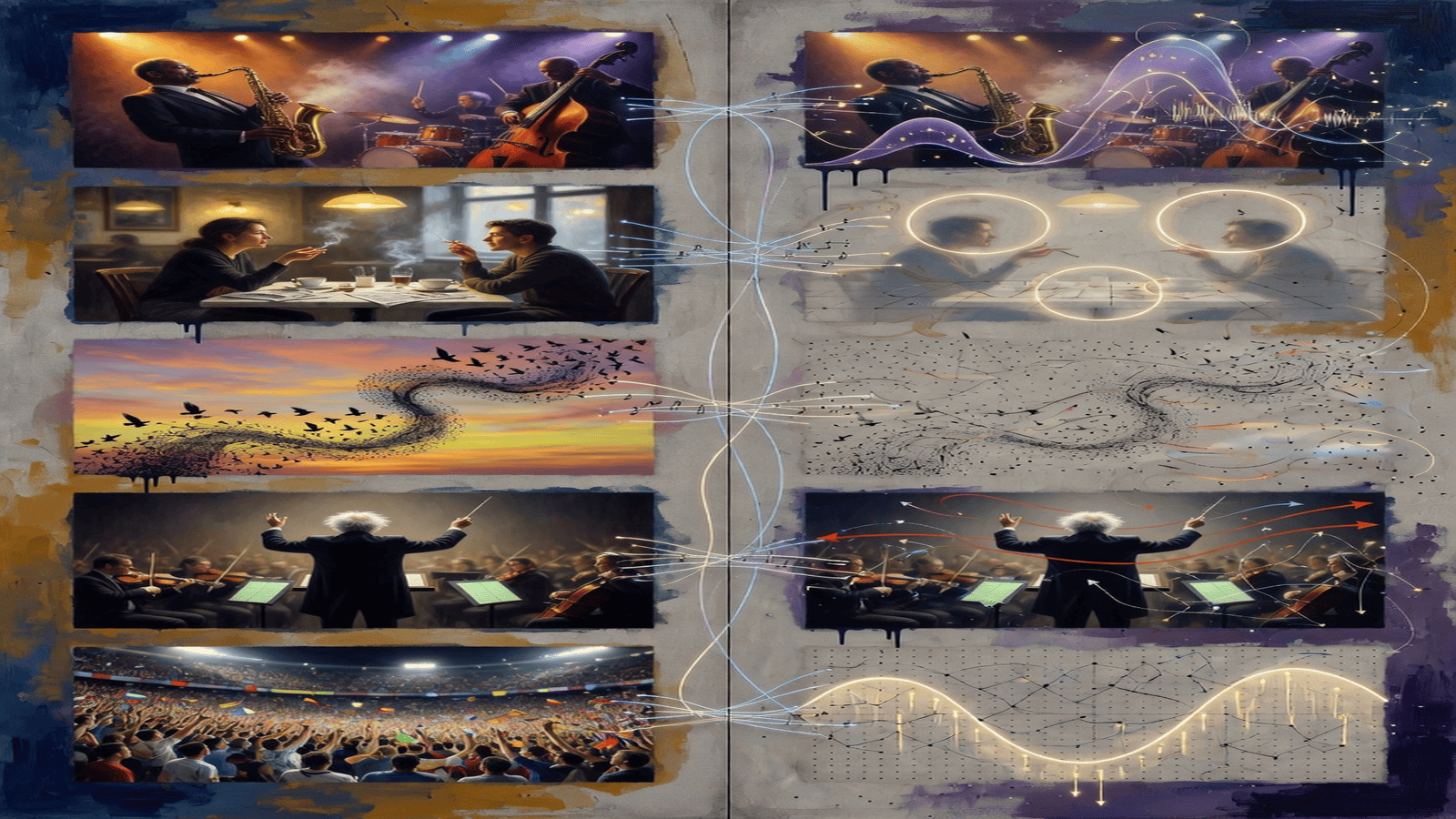
Neural networks are abstract. The math is dense. The scale is incomprehensible — billions of parameters, trillions of multiplications per second. But the principles are not abstract. They are built on deep patterns that show up everywhere: in orchestras, in conversations, in flocks of birds, in forests, in the way a jazz musician improvises.
The goal is not to make you a machine learning engineer. The goal is to make the thing thinkable — to see that when you talk to an LLM, you are not communicating with an alien intelligence. You are interacting with something that works on principles you already understand.
I. The Tightrope Walkers
Imagine a stadium of tightrope walkers stacked in rows. Each walker receives signals from the row below, adjusts their balance, and passes their adjusted state to the row above. When the final answer is wrong, blame travels backward — each walker learns how much they contributed to the error.
This is a neural network learning. Every layer is a row of walkers. Every adjustment is a step toward equilibrium. The math underneath is beautiful, but the principle is ancient: trial, error, incremental refinement. We have been doing this since we learned to walk.
II. The Jazz Ensemble
A jazz band improvises. Each musician listens to the others, hears what harmony is needed, and generates their next note in response. No score. No conductor. No predetermined answer. Each musician doesn’t know what they’ll play until they hear the context. The harmony emerges from local listening, not central control.
This is how attention works in a transformer. Each token (word) in your prompt is a musician. It listens to every other token around it. Based on context, it decides what matters. The “harmony” is the next word.
If one musician plays a wrong note confidently, the others adjust around it. In an LLM, if one token captures the context incorrectly, the downstream tokens compensate. The difference: a jazz musician knows they’re improvising. The network doesn’t. But the mechanism is identical: generate the next thing based on what you’re listening to.
III. The Conversation
You’re talking to a friend. They say something. You don’t know what you’ll say until you hear it. Your response emerges from:
- What they just said (recent context)
- Everything you know about the topic (training)
- The balance between being authentic and being understood (temperature)
You’re not looking up a pre-written answer. You’re generating a response that has never existed before.
This is exactly what an LLM does when it generates the next word. It listens to the conversation so far. It doesn’t have your next words written down anywhere. It finds the probability of each possible next word, samples from that distribution, and speaks. Like a conversation, the same prompt can produce different responses. You’re not reading from a script. You’re improvising in response to context.
IV. The Murmuration of Starlings
Thousands of starlings wheel through the sky in impossible formations — a cloud that morphs and shifts like a living thing. No starling understands the pattern. Each bird follows simple rules:
- Fly toward the average position of your neighbors
- Match the average speed of your neighbors
- Keep a minimum distance so you don’t collide
From billions of local decisions, a global pattern emerges. The flock “knows” how to avoid predators without any bird knowing the strategy. There is no head starling. There is no plan. And yet the murmuration is coherent, responsive, nearly perfect.
This is emergence in a neural network. Each neuron fires based on simple local rules. Billions of neurons. Suddenly the system can recognize faces, generate poetry, reason about physics. No single neuron understands any of this. The understanding lives in the pattern. The complexity is real, but it emerges from simplicity.
V. The Forest Floor After Rain
After rain, the forest floor wakes up. Fungi, bacteria, plant roots all respond to moisture and nutrient gradients. They don’t have a plan, but they’re learning — mycorrhizal networks connect trees, trading nutrients based on needs. A Douglas fir in shade calls for sugar from an older tree nearby. The network routes it through fungal intermediaries. The trees never meet. They never consciously bargain. Yet sophisticated exchange happens.
No central authority. No master database. Yet information flows. The forest adapts. It remembers — mycorrhizal networks encode which trees help which other trees.
This is how knowledge lives in a neural network. Not in files. Not in discrete memories. Dissolved into the balance of billions of adjustments. When you ask an LLM a question, it’s not retrieving a stored fact. It’s resonating — the pattern of your question activates patterns in the network that were shaped by training data, and the interference pattern that emerges is the answer.
VI. The Conductor and the Orchestra
An orchestra has scores. The conductor has a vision. But here’s the interesting part: the conductor doesn’t make the music. The conductor shapes what the orchestra was already capable of doing. The orchestra learned by rehearsing — thousands of hours. The conductor’s job is to listen to the orchestra’s potential and draw it out.
The conductor doesn’t rewrite the score. They don’t retrain the musicians’ hands. They refine the interpretation — the balance, the pacing, the emotional arc. They make what was implicit explicit.
This is instruction tuning. You take a pre-trained LLM — a troupe that has learned the shape of language by reading everything. Then you fine-tune it with specific examples of how you want it to respond. You’re not rewriting it. You’re conducting it toward a specific interpretation of what it already knows.
VII. The Relay Race with Transformation
In a relay race, each runner receives the baton and passes it on. But what if each runner transforms what they receive? Runner 1 gets a raw signal. Runner 2 receives that signal and passes on a slightly different version — more abstract, more refined. Runner 3 receives the refined signal and transforms it further. By the time the baton reaches the final runner, it has been through 100 layers of transformation.
The final runner doesn’t see the raw input. They see meaning distilled through 100 stages of prior interpretation.
This is why depth matters in neural networks. Each layer learns to recognize increasingly abstract patterns. Layer 1 recognizes edges. Layer 2 recognizes shapes. Layer 3 recognizes objects. Layer 20 recognizes scenes. Layer 100 recognizes concepts.
VIII. The Crowd Doing the Wave
When the wave starts at a football stadium, it spreads. But it doesn’t spread uniformly. The wave is strongest where people are paying attention. A section that’s distracted barely passes it on. Each person watches their neighbors and decides: do I contribute to the wave right now? They don’t know the overall pattern. They just respond locally. And yet the wave has a clear structure.
This is self-attention. Each token in your prompt is a person in the crowd. They look at every other token and decide: do you matter to my decision right now?
If you write “The bank was closed because of the river flooding,” the word “bank” pays heavy attention to “river.” The word “account” (if it were here) would pay heavy attention to “bank.” Each word is doing the wave with its neighbors, but the attention weights are chosen based on what matters in context.
IX. The Telephone Game
In the game of telephone, a message passes from person to person. Each person hears something slightly wrong, or fills in a gap from their own knowledge, and passes on a corrupted version. After 20 people, the message is unrecognizable.
But here’s the twist: sometimes the corrupted message is more coherent than the original. Someone mishears “I saw a black cat” as “I saw a black CAR,” and the error actually makes the story more consistent with what they know about the world.
This is hallucination in LLMs. The network is so good at finding patterns that it will generate text that fits the pattern perfectly even if it’s not true. The generated sentence is coherent, grammatical, thematically consistent — all the local constraints are satisfied. But globally, it’s false. The network didn’t remember the fact. It didn’t make it up intentionally. It found a pattern-completion that satisfied the immediate context, never knowing it was wrong.
X. The Performer and the Audience
A performer on stage reads the audience. If the crowd is energetic, they take bigger risks, try wilder material. If the crowd is quiet, they play it safe. The performer is sampling from a distribution of possible jokes, songs, stories — but the distribution is weighted by audience energy.
High energy (high temperature): take the fifth or sixth funniest joke. It’s riskier, more surprising. Low energy (low temperature): take the single funniest joke. Safe bet.
This is temperature in LLM sampling. Temperature controls how “bold” the network is when generating the next word. Low temperature means “always pick the most likely word.” High temperature means “be more adventurous, pick from the top 10 candidates at random.” Same performer. Different energy. Different output.
XI. The Threads These Analogies Point To
- Consciousness and emergence: At what scale does a pattern become aware? Is the murmuration conscious? Is a forest conscious? Are we?
- Truth and coherence: The telephone game produces perfect sentences that are completely wrong. How do we tell the difference? Is the difference in the pattern, or in the map?
- Intention and inevitability: The jazz musician intends to play the note. The starling intends to match its neighbor. The network… intends nothing. Yet all three produce complex behavior.
- Why analogies break: None of these are perfect. The jazz musician is conscious. The network is not. The starling acts on instinct. The network acts on mathematics. The conversation partners are reasoning. The network is pattern-matching. Know where the metaphor ends.
Epilogue
Pay no attention to the man behind the curtain. You’ve just spent an essay watching a concert, a conversation, a flock of birds — all very impressive, all very vivid. But behind the curtain of these analogies is just mathematics. Numbers. Vectors. Matrix multiplication. The wizard (the analogy) is powerful and mysterious. The man behind the curtain (the actual network) is just following rules. Both are true.
Further reading
No external links for this piece — it stands alone as an exploration of how to think about neural networks without requiring the mathematics.