In 1958, Frank Rosenblatt built a machine that could learn. Not be programmed—learn. The Mark I Perceptron was a room of wires and motorized potentiometers wired to a grid of four hundred photocells, and when you showed it images, it adjusted itself until it could tell them apart. The New York Times reported that the Navy expected it to “walk, talk, see, write, reproduce itself and be conscious of its existence.” It could do none of these things. What it could do was draw a line.
That is the whole story, and it is worth telling slowly, because the line Rosenblatt drew in 1958 is the same line running through every system we now call artificial intelligence. The perceptron did not fail. We simply learned how to stack it.
I. The Simplest Possible Classifier
Strip a perceptron to its logic and almost nothing remains. It takes a handful of inputs, multiplies each by a weight, sums them, and asks one question: is the total above a threshold or below it? Above, it fires; below, it stays silent. That is the entire mechanism.
Geometrically, this is a line. Or, in higher dimensions, a flat plane slicing space in two. The weights tilt and shift the line; learning means nudging the weights until the line falls between your two classes—cats above, dogs below. Rosenblatt’s contribution was the nudging rule: a procedure that, shown enough labeled examples, would converge on a separating line if one existed. No hand-coded features, no human writing rules for what a cat looks like. The machine found the boundary itself. In 1958 this was not engineering; it was something closer to prophecy.
II. The XOR Ceiling
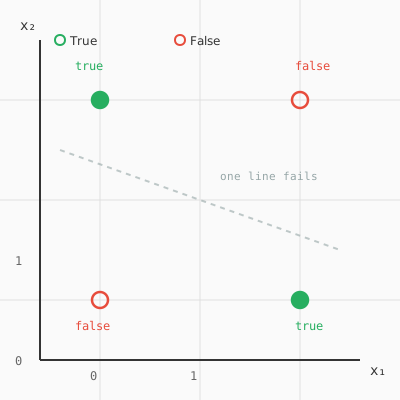
The prophecy had a wall, and Marvin Minsky and Seymour Papert found it. Their 1969 book Perceptrons proved, with unanswerable rigor, that a single perceptron cannot compute XOR—the function that returns true when its two inputs differ and false when they agree.
Plot XOR’s four cases on a plane and you see the problem instantly. The two true points sit at opposite corners; the two false points at the other two. No single straight line can separate one pair from the other. You would need two lines, or a curve—and a lone perceptron has only one line to give.
The proof was airtight, and its consequences were not. Perceptrons was read less as “here is a precise limit of one architecture” than as “here is why this whole direction is a dead end.” Funding evaporated. The field went quiet for the better part of a decade—the first AI winter. The irony is sharp: XOR is a toy, two bits in and one bit out, and the entire promise of learning machines was tabled over a problem a child solves without noticing.
III. What a Second Layer Buys
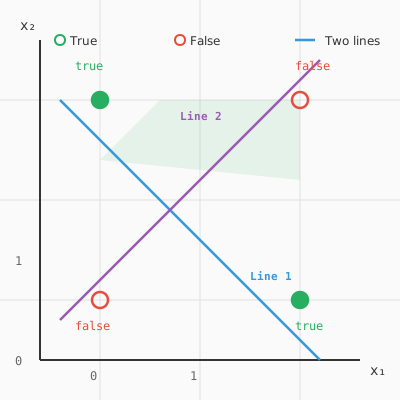
The escape was hiding in plain sight. One perceptron draws one line. But feed the outputs of two perceptrons into a third, and the lines combine. Now you can carve out a region—above this line and below that one—and XOR dissolves. The wall was never a wall around neural networks; it was a wall around networks one layer deep.
What makes the stacking work is the bend between the layers: a nonlinearity. Without it, a stack of linear layers collapses back into a single line, however many you pile up—linear functions of linear functions stay linear. Insert a kink—a sigmoid, a tanh, or the brutally simple ReLU that returns zero for anything negative and the value itself otherwise—and each layer can fold the input space. Fold it enough times and a tangle no line could separate becomes, in the folded coordinates, trivially separable. By 1989 the mathematics was formal: the universal approximation theorem showed a network with one hidden layer and a nonlinearity can approximate essentially any continuous function. The perceptron’s critics had been right about one perceptron and wrong about the sentence that started with the word but.
IV. The Gradient, and Why It Waited Until 1986
Knowing a network can represent a function is not knowing how to find the right weights. With one perceptron, Rosenblatt’s rule sufficed. With many layers, the question becomes: when the network is wrong, which of its thousands of weights deserves the blame, and in which direction?
The answer is backpropagation, made practical by David Rumelhart, Geoffrey Hinton, and Ronald Williams in their 1986 paper Learning representations by back-propagating errors. Run an example forward through the layers, measure the error at the end, then walk the error backward, using the chain rule from calculus to compute exactly how much each weight contributed. Adjust every weight a little against its share of the blame. Repeat a few million times. The technique is nothing more exotic than the chain rule applied with bookkeeping discipline—which is why, in hindsight, it is faintly embarrassing that it took until 1986. The ideas existed in pieces for years; what was missing was the conviction that piling up layers and grinding the gradient would actually work. It does work, even though the error landscape is a non-convex mountain range with no guarantee of finding the lowest valley. Empirically, a good-enough valley turns out to be everywhere.
V. When Compute Made Theory Secondary
A neural network, underneath the metaphors, is matrix multiplication—vast grids of numbers multiplied and added, the same dot product the perceptron performed, repeated billions of times. A CPU does these one after another. A GPU, built to shade millions of pixels at once, does them all in parallel. The hardware the gaming industry built to render explosions turned out to be the exact engine deep learning needed.
The moment everyone stopped arguing was 2012. Alex Krizhevsky, Ilya Sutskever, and Hinton entered the ImageNet competition with a deep network trained on two consumer GPUs and won—AlexNet—by a margin so large the result read like a typo. It was the perceptron, stacked deep, fed real photographs, and run on hardware cheap enough to try. That last phrase matters more than the theory. GPUs did not make the algorithm possible; the algorithm had been possible since 1986. They made it cheap enough to attempt at scale—and at scale, a simple machine with enough parameters and enough data stopped looking like approximation and started looking like understanding.
VI. The Architectures That Made Functions Learnable
Universal approximation promises that some network represents the function you want. It says nothing about whether gradient descent can find it, or how much data the search will cost. That gap is where architecture lives. Convolutional networks bake in the assumption that what matters is local and repeated—an edge is an edge anywhere in the image—and they are fast and brilliant at vision, but they strain to relate things far apart. Recurrent networks read sequences one step at a time, carrying memory forward, but the gradient must travel through every step, and over long distances it vanishes or explodes.
The unlock was attention, introduced in the 2017 paper whose title was a thesis: Attention Is All You Need. The transformer lets every element of a sequence look directly at every other element in a single step—no long chain for the gradient to crawl back through, every relationship one hop away, and all of it parallel, which is to say GPU-shaped. And attention itself is, once more, the old machinery: dot products to score how much each token should attend to each other, a softmax to turn those scores into a nonlinear weighting. Linear comparison, nonlinear gate. The perceptron, wearing a new coat.
VII. The Perceptron, Still
Open any large language model and look closely and you find no new fundamental object—only the 1958 one, repeated at a scale Rosenblatt could not have imagined. Each attention head is dot products and a softmax. Each feed-forward block is weights, a sum, a nonlinearity. LayerNorm, residual connections, quantization—refinements of plumbing, not new physics. Rosenblatt’s Mark I learned from four hundred pixels; a modern transformer learns from trillions of words, and the difference between them is almost entirely one of quantity—more layers, more parameters, more data, more parallel arithmetic.
That is the lesson the headlines keep missing. The intelligence in these systems is not hiding in some clever trick we have yet to name. It is the same line through the same data, drawn a trillion times, folded through enough dimensions that the folding becomes indistinguishable from thought. Minsky and Papert were right: a single line cannot solve XOR. They were only wrong about how far you can get by drawing more lines. We have not yet found the bottom of that answer, and the most honest thing to say about the perceptron is that, sixty-eight years on, we are still discovering what a single line can do once you are willing to stack enough of them.
There is a running gag in Austin Powers where Dr. Evil, freshly thawed after thirty years on ice, keeps unveiling diabolical master plans the world has quietly already invented and surpassed—threatening to hold it ransom for a sum that no longer impresses anyone in the room. The AI field runs the same gag in reverse. Every couple of years someone wheels out a revolutionary new architecture to gasps and headlines, and someone older has to lean in and explain that, underneath the new coat, it is weighted inputs, a sum, and a threshold—Rosenblatt’s machine from 1958, thawed and renamed. The difference is that here the old idea was never the punchline. It was the answer all along.
Further reading
- Frank Rosenblatt, The Perceptron: A Probabilistic Model for Information Storage and Organization in the Brain (1958) — the founding paper
- Marvin Minsky & Seymour Papert, Perceptrons (1969) — the rigorous proof of the single-layer ceiling
- Rumelhart, Hinton & Williams, Learning representations by back-propagating errors (1986) — backpropagation made practical
- Krizhevsky, Sutskever & Hinton, ImageNet Classification with Deep Convolutional Neural Networks (AlexNet, 2012) — the GPU moment
- Vaswani et al., Attention Is All You Need (2017) — the transformer
- LeCun, Bengio & Hinton, Deep Learning (Nature, 2015) — the field’s own retrospective
- The Universal Approximation Theorem — why one hidden layer is, in principle, enough
- YouTube: The Perceptron — a visual walkthrough of the perceptron and the XOR problem