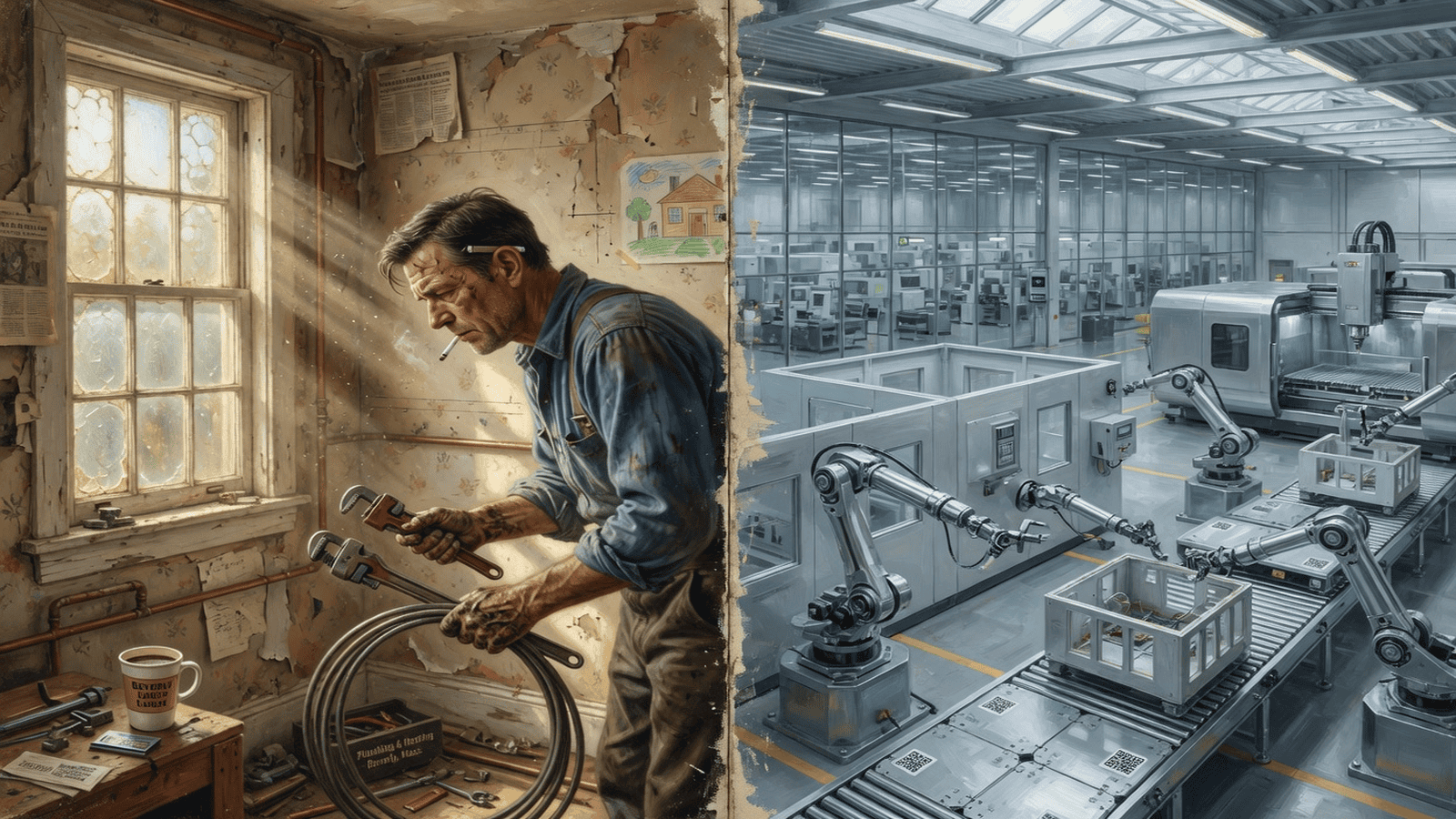
The reassurance has become a reflex: “Don’t worry about AI replacing your job. Learn a trade. Become a plumber. You’ll always be needed.”
It’s not false. But it’s not entirely true either—probably about 75% correct, which is the most dangerous place for an argument to land.
I. Three Hidden Variables
The advice works until you account for three things that never make it into the conversation: saturation, incompetence, and structural obsolescence.
Saturation is arithmetic. If millions of people wake up tomorrow and decide to become plumbers, there are not suddenly millions of new bathrooms that need them. The market doesn’t expand to accommodate mass retraining. It’s a zero-sum game with a fixed number of positions. Someone’s job security is someone else’s unemployment.
Incompetence is the second silence. The trade requires skill, judgment, years of apprenticeship, spatial reasoning, problem-solving under stress. Not everyone who tries to become a plumber succeeds. The safety-net narrative assumes you’ll be good at it. It doesn’t account for the unproductive, miserable plumber working forty-hour weeks for wages that never quite cover the cost of living. The profession itself doesn’t guarantee stability; it only promises that the demand exists. Delivering competence is your problem.
Structural obsolescence is the real threat, and it’s the one nobody wants to name.
II. The Carburetor Problem
Carburetors were brilliant technology. They’ve been refined for over a century. A skilled mechanic could diagnose a carburetor problem by sound alone, by the way an engine caught or stuttered. Then internal combustion engines switched to electronic fuel injection, and carburetors became unnecessary. The mechanics didn’t get replaced by robots that could fix carburetors better. The carburetor itself was architectured away.
Plumbing could follow the same path. Not because robots become master plumbers, but because building techniques change. Modular housing, prefabrication, alternative materials, different approaches to water distribution—these aren’t AI problems. They’re engineering problems. A future where homes are assembled from factory-made components, where water systems are sealed and maintenance-free, where traditional pipe fitting is irrelevant. The plumber’s job wouldn’t be automated. It would be made unnecessary by better engineering.
The same applies to dentists, pharmacists, nurses, even lawyers. Preventive dentistry and at-home diagnostic tools reshape what dentists do. Telemedicine and mail-order medications hollow out pharmacy. AI-assisted contract review and legal research change what lawyers actually spend their time on. Regulation isn’t enough protection—regulation changes too. The safe professions of 2026 are only safe from simple robots. They’re not safe from being engineered away.
III. The Virtuous Cycle Ended
In the industrial era, there was a perfect cycle. More production created more jobs. More workers created more consumption. More consumption created more demand for production. The shoe factory in Beverly, Massachusetts epitomizes it: a local boom that rippled outward, supporting merchants, landlords, schools, newspapers. Expansion created opportunity at every level.
Now: a pair of shoes produced in China costs N dollars to make. It sells for N×X dollars in the United States. Same product, different systems—a communist production economy feeding a capitalist consumption economy. Apple calls it “Designed in California, Made in China.” The design happens in Silicon Valley where capital concentrates. The production happens where labor is cheap. The markup—the X-factor—is captured by the middlemen: Apple, the distributors, the retailers. The factory worker in Shenzhen and the customer in the US are both subjects in a system neither controls.
That was a virtuous cycle. It doesn’t exist anymore. What exists now is extraction across borders.
IV. The Extraction Model
Today, efficiency doesn’t create jobs. It creates equity—concentrated, extracted, hoarded. A pair of shoes costs N dollars to manufacture in China. It sells for N×X dollars in the United States. That X-factor isn’t set by supply and demand. It’s set by mercantilists: middlemen, IP holders, capital owners, people who own the infrastructure of distribution. They capture the spread. The manufacturer captures nothing. The worker captures less.
Automation in this model doesn’t share gains. It concentrates them. A factory floor with ten workers earning middle-class wages is replaced by machines worth millions of dollars in equity. The savings don’t go into higher wages for the remaining five workers. The savings go to the shareholders. The technology becomes a tool for extraction, not a rising tide.
The IPO class owns the means of production. Everyone else participates in a labor market with a structural ceiling—a maximum wage, a maximum benefit, a maximum negotiating power. You can’t outrun a system designed to keep you running.
V. The Political Inversion
Here’s the bitter paradox of modern capitalism: The mechanisms of socialism—bailouts, state intervention, protection from market forces—are applied exclusively to the wealthy. The mechanisms of capitalism—competition, market discipline, creative destruction, “let the market decide”—are applied exclusively to workers and the poor.
When banks fail, we bail them out. That’s called capitalism.
When workers lose jobs, we tell them to retrain. That’s called the market.
When pharmaceutical companies inflate drug prices, we protect their patents. That’s the free market at work.
When unions ask for better wages, we say the market won’t bear it.
The game is not abstract. The rules are applied differently depending on your position. From the inside, if you own capital, the system is rigged in your favor. From the outside, if you have only your labor to sell, you’re watching a spectacle performed by people who think the rules apply equally to everyone. They don’t.
VI. The Last 45 Seconds
Nikolai Osterman’s Being There ends with the protagonist walking into a lake. The entire film is a masterwork of meaninglessness—a commentary on American society performed by characters who mistake emptiness for profundity. The final scene is the only honest moment: total ambiguity about what happens next. No resolution. No moral. Just the image of a man disappearing into water, and we don’t know if he drowns or walks on.
We are not characters in this story. We are the audience watching the final 45 seconds of a movie that has already lost its plot. The theme plays, the credits roll, and we’re still cheering for a screen that will soon go black. Cheering still doesn’t change the ending.
The advice to become a plumber isn’t wrong. It’s incomplete. It assumes a world where structural opportunity still exists, where education and skill can overcome economic gravity, where individual effort still moves individual outcomes. Those things were true once. They’re not entirely true now.
The safety net exists. But it’s a smaller net, with larger holes, held by people with less power to enlarge it. If you’re fast enough, skilled enough, lucky enough—it might catch you. But it’s catching fewer people every year, and the ones being caught are the ones who were always going to be caught anyway.
Further reading
- Nikolai Osterman, Being There (1979) — film
- Daron Acemoglu & James Robinson, Why Nations Fail — on economic extraction
- Jeremy Rifkin, The Third Industrial Revolution — on technological displacement
- David Graeber, Bullshit Jobs — on labor and meaning
- Karl Polanyi, The Great Transformation — on the market myth