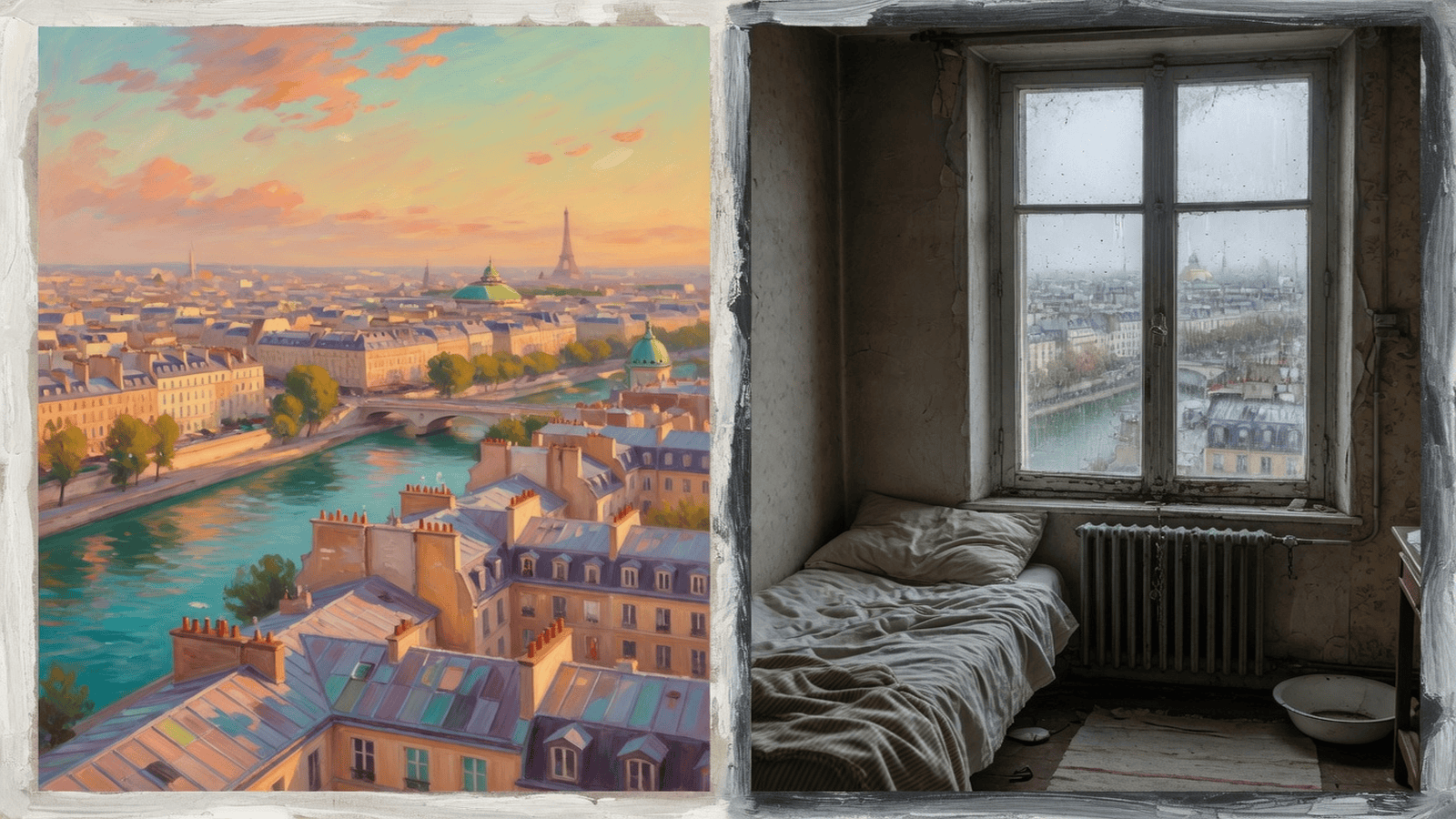
There are two cities wearing the same name. One is the postcard — the Paris of the wide shot, the accordion, the lovers on the Pont des Arts, the city you can love without ever having set foot in it. The other is the lived Paris: the sixth-floor chambre de bonne with the toilet on the landing, the radiator that dies in January, the prefecture queue at dawn, the particular loneliness of being a stranger in a city that was built to be admired rather than entered. I have not lived in the second city. I have only seen Paris through movies, songs, and books — Victor Hugo, Sartre, Dumas, Piaf, Aznavour — and through works that refused the postcard. But here is what I have learned: the works set in the postcard Paris are nearly illegible to anyone willing to look beyond them. The works set in the second Paris become clear to anyone who has learned, through art and attention, to see that way. You don’t have to suffer in Paris to read it. But you do have to be taught by someone who understands what it means to be there without glamour.
I. The Gap Between Two Films
Put two American-in-Paris films side by side and the gap does all the work. An American in Paris (1951) is the postcard at its most ravishing — Gene Kelly, Technicolor, a Gershwin tone poem, Paris as a painted backdrop for a man falling joyfully in love. It is about Paris the way a travel ad is about a destination: the city is scenery, weightless and warm. Now set Last Tango in Paris (1972) beside it. Same premise on paper — an American adrift in Paris — and an almost total inversion in truth. Bertolucci’s Paris is gray, wet, and indifferent; Brando’s Paul is not falling in love but hiding from grief, renting an empty apartment precisely because the city grants the anonymity of not belonging. The cold empty flat. The refuge of namelessness. The way Paris will let you dissolve without ever asking your name.
To a viewer schooled only in the postcard, Last Tango is just the scandalous one — the butter, the notoriety — and the actual subject sails past unseen. But to anyone who has learned to see Paris this way — through films and books that strip away the scenery — the film is suddenly legible. It is not a scandal. It is a portrait. An American in Paris tells you what the city promises. Last Tango tells you what the city actually is once the music stops and you are inside it.
II. The Library That Teaches You How to Look
The same gap opens wider when you approach the books — and here is where the teaching happens. Down and Out in Paris and London by Orwell is not reportage. It is a blueprint for seeing. It shows you the geography of poverty in a place designed for the rich — the pawnshop, the dishwashing inferno, the hunger that sharpens the senses. You read it and you understand: this is what the postcard does not show you. Tropic of Cancer by Henry Miller is ecstatic squalor — the manic energy of being broke in a beautiful city, euphoria and starvation in the same sentence. Good Morning, Midnight by Jean Rhys is the female counter-text: the cheap hotel room, the cafés rationed by what is in your pocket, the slow humiliation of being a woman alone and short of money. Not melodrama. Accuracy. Giovanni’s Room by James Baldwin shows Paris as the place an American goes to become someone he could not be at home — and the trap that freedom turns out to be.
Then there is A Moveable Feast by Hemingway, the dangerous one: the duress retold as romance — “we were very poor and very happy.” It is beautiful and it is a lie. It sells the hardship after the fact as charm. Read it last, after the others, or it will reinstall the postcard.
These books are not about Paris. They are about how to read Paris. They teach you to see that the real city is not in the monuments. It is in the cold flats, the queues, the ordinary struggle of being foreign and without much money. They train your eye.
III. The Film That Shows the Real Paris Without Requiring Suffering
But Amelie — Amélie (2001) — reveals something else entirely. It is not the postcard. It is a revelation, and the revelation is that the real Paris is not the one with fashion and glamour. It is not even the one that requires you to suffer to see it. It is the Paris of small, obsessive attentions: the texture of a fountain drink, the exact crispness of a baguette crust, the intimacy of a zinc café counter, the way a film of dust holds light, the precise crack in a stone wall, the particular sound of a door closing. Jeunet’s Paris is unglamorous to the point of eccentricity. There are no lovers on the Pont des Arts. There is instead a woman alone in a room with her phonograph and her need to fix the world in tiny, specific ways.
The city he renders is not beautiful in the way An American in Paris is beautiful — lush, painted, designed for pleasure. It is beautiful in the way the real Paris is beautiful: in the small, stubborn particularity of it, in the details that only reveal themselves to someone who has stopped rushing through and started noticing. And here is what matters: you do not have to have been broke and cold in Paris to understand this film. You only have to be willing to love the small things. To pay attention. To believe that a woman alone in a room with a record player, trying to fix broken things in the world, is doing something that matters.
Amélie teaches you a different way of seeing — not through suffering, but through presence. Through the willingness to notice. It shows that the real Paris was always in the details, waiting for a way of looking that requires only attention, only time. And this is the gift of the work: it tells you that you can know Paris this way before you ever arrive. You can learn to see it from here, through films and books and songs. You can study Piaf’s voice, Aznavour’s melancholy, Hugo’s Paris, Sartre’s cafés, and understand — before you step off the plane — that the city you want to live in is not the fantasy. It is the language. It is the people. It is the bread and cheese. It is the careful attention that a stranger with time and an open eye can learn to pay.
The postcard asks nothing of you and gives you a pleasant lie in return. The real Paris asks only that you look closely and love what you see. My mother had a line for exactly this, the kind of thing Colombian mothers hand down instead of philosophy: “Como sea, la rellena es negra.” However you slice it, the blood sausage is black. Dress it up, light it well, sell it as romance — it stays what it is. But Jeunet, in his odd way, teaches you that the black sausage itself, looked at closely and loved, is enough. The city is not the scenery. The city is what you see when you stop treating it as scenery and start treating it as home.
I don’t drink wine these days. But perhaps under the sun of Paris, with “Et pourtant” playing and the bread and cheese in front of me, I’ll make an exception. And when the moment comes, I’ll borrow Piaf’s voice: “Non, rien de rien, non je ne regrette rien.” Not because the suffering is noble — it isn’t. But because having learned to see this way, through film and book and song, I’ll finally be ready to live it. The postcard was just the invitation. The real gift is being taught how to say yes.
Further reading
- Down and Out in Paris and London — George Orwell
- Tropic of Cancer — Henry Miller
- Good Morning, Midnight — Jean Rhys
- Giovanni’s Room — James Baldwin
- A Moveable Feast — Ernest Hemingway
- The Notebooks of Malte Laurids Brigge — Rainer Maria Rilke
- An American in Paris — Vincente Minnelli (1951)
- Last Tango in Paris — Bernardo Bertolucci (1972)
- Amélie — Jean-Pierre Jeunet (2001)