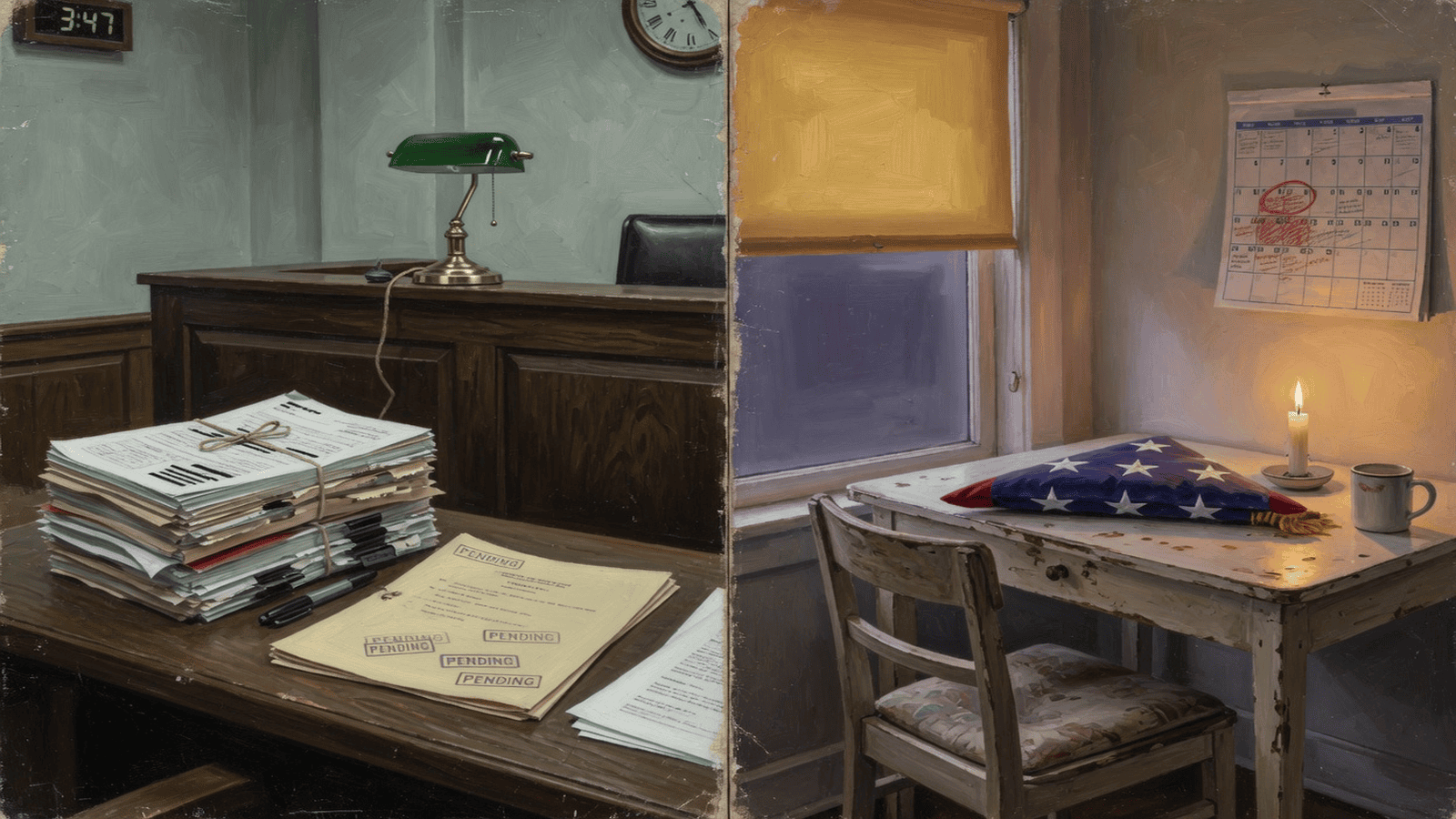
On June 8, 1967, the USS Liberty, a Navy intelligence ship in the eastern Mediterranean, was attacked. Thirty-four Americans died, nearly sixty were wounded. Nearly sixty years later, the kind of day it was remains in dispute—whether the attack was tragic misidentification in the chaos of the Six-Day War, or something deliberate. The inquiries and apologias answer one question; the families still mourning are asking a different one. The verdict never comes, and it was never going to come, and that is the whole bitter residue.
I am not qualified to settle what happened on the water that day, and I will not pretend to. What I can write about is something underneath the dispute: the sour, slow pain of an event whose verdict was never the point. History offers a record; grief asks for justice. The two almost never arrive on the same day. Usually they never arrive at all.
I. The Record Is Not a Record
What Is History?, E. H. Carr’s classic 1961 lecture series, opens with the historiographer’s oldest confession: the facts only speak when the historian calls on them. The historian is not an archivist. He is a reader of a battlefield, choosing what to hold up to the light and what to leave in shadow. Every narrative of an event is structurally incomplete because it must choose what to include and what to leave out—and that choice is made by someone, for some reason, from somewhere.
Hayden White took this further in Metahistory, arguing that the same events can be emplotted as tragedy, farce, or romance depending on which frame the historian selects. The “objective account” is the documentary’s lie in another costume—the claim to have no claim, to speak with no accent.
This is the same nerve Tim O’Brien touches in The Things They Carried when he distinguishes story-truth from happening-truth. A made-up story can be truer than the literal record because it delivers the feeling the facts leave out. Public memory runs almost entirely on story-truth. The forensic report is filed; the story is what gets carried.
II. The Rashomon of Public History
Akira Kurosawa’s Rashomon shows us four accounts of the same violent act—a bandit, a woman, a samurai, and a woodcutter—each internally consistent, mutually exclusive, and utterly persuasive on its own. The film’s genius is that it never resolves them. It holds the ambiguity open and lets it ache.
Most public history is Rashomon with the lights turned up too bright. We mistake the brightness for clarity. We believe that more documentation will close the circle, that another witness will settle the thing. Sometimes it does. Often it doesn’t. The USS Liberty has two serious bibliographies—James Scott’s The Attack on the USS Liberty and A. Jay Cristol’s The Liberty Incident—each answering a different question with evidence that is hard to dismiss. When the bibliography is a battlefield, the honest citizen’s position is not a verdict but a held breath.
III. Emotional Truth and the Bench Left Empty
Primo Levi’s The Drowned and the Saved warns us that trauma has a tendency to become simplified into morality play—the clean villain and the innocent victim. Levi, speaking from Auschwitz, warns against that simplification. He insists on holding the gray zone open: the complexity, the ambiguity, the refusal to make the suffering tidy. The bitterness is in the refusal.
Susan Sontag’s Regarding the Pain of Others asks what happens when a death becomes an image, a cause, a talking point. The distance between the mourner and the spectator widens. Remembrance curdles into use. The photograph that honors can also exploit.
When a tragedy is read aloud on a political stage, the function of remembrance quietly shifts. On June 4, 2026, Representative Thomas Massie announced that on the 59th anniversary, he would speak on the House floor “to honor and memorialize” the crew while survivors sat in the gallery. He called it an “unprovoked attack.” Note the adjective. That is his framing, and the whole point is that the adjective is exactly the contested thing.
The names on the floor are real and the grief is real. The reading goes on. A congressman reads the dead into the record while the courtroom that might have rendered a verdict sits empty. That is the whole sour taste in one image: the performance of justice in the permanent absence of the verdict. The judge is out. The reading goes on anyway, because the reading is what we have instead.
IV. The Personal Collision
Here is what I can only write as myself. June 8 is my day—the kind of date a person spends a life treating as a small private holiday, a date that belongs to him. And it is also a grave.
The universe filed my little celebration and a national wound under the same number, and I only really felt the weight of it late. Ego versus historical importance. What an important day for me; what a tragic one for families I will never meet. Well played, universe. The lesson is not guilt. It is proportion. The calendar does not arrange itself around any of us, and discovering that your private day is someone else’s worst day is one of the cleaner ways to be made appropriately small.
V. What Remains
We are left, after all the inquiry and all the rhetoric, with the one thing no investigation can account for: the grief. The day stays sour not because the facts are missing—there are too many facts—but because the verdict never lands and the mourning never ends and the two were never going to meet.
So the call is not to remember, which is easy and cheap. It is to hold the ambiguity without flinching. To stay skeptical of anyone selling certainty about other people’s dead. To refuse the tidy ending that would let us feel righteous instead of helpless.
Memory, History, Forgetting by Paul Ricoeur sits at the intersection of all these tensions—how do we carry what we cannot settle? The answer is not a method. It is a practice. It is the willingness to let a day be both.
What an important day, for me. What a tragic one, for them. The judge is out. Carry it anyway.
Paraphrasing Steve McCroskey (Airplane! 1980): “Looks like I picked the wrong week to quit being a fetus.”
Further reading
- What Is History? — E. H. Carr
- Metahistory — Hayden White
- The Things They Carried — Tim O’Brien (story-truth vs happening-truth)
- The Drowned and the Saved — Primo Levi
- Regarding the Pain of Others — Susan Sontag
- Memory, History, Forgetting — Paul Ricoeur
- Rashomon — Akira Kurosawa (1950)
- The Attack on the USS Liberty — James Scott
- The Liberty Incident — A. Jay Cristol
- USS Liberty incident — Wikipedia overview
- Rep. Thomas Massie’s announcement (June 4, 2026) — the House-floor memorial on the 59th anniversary