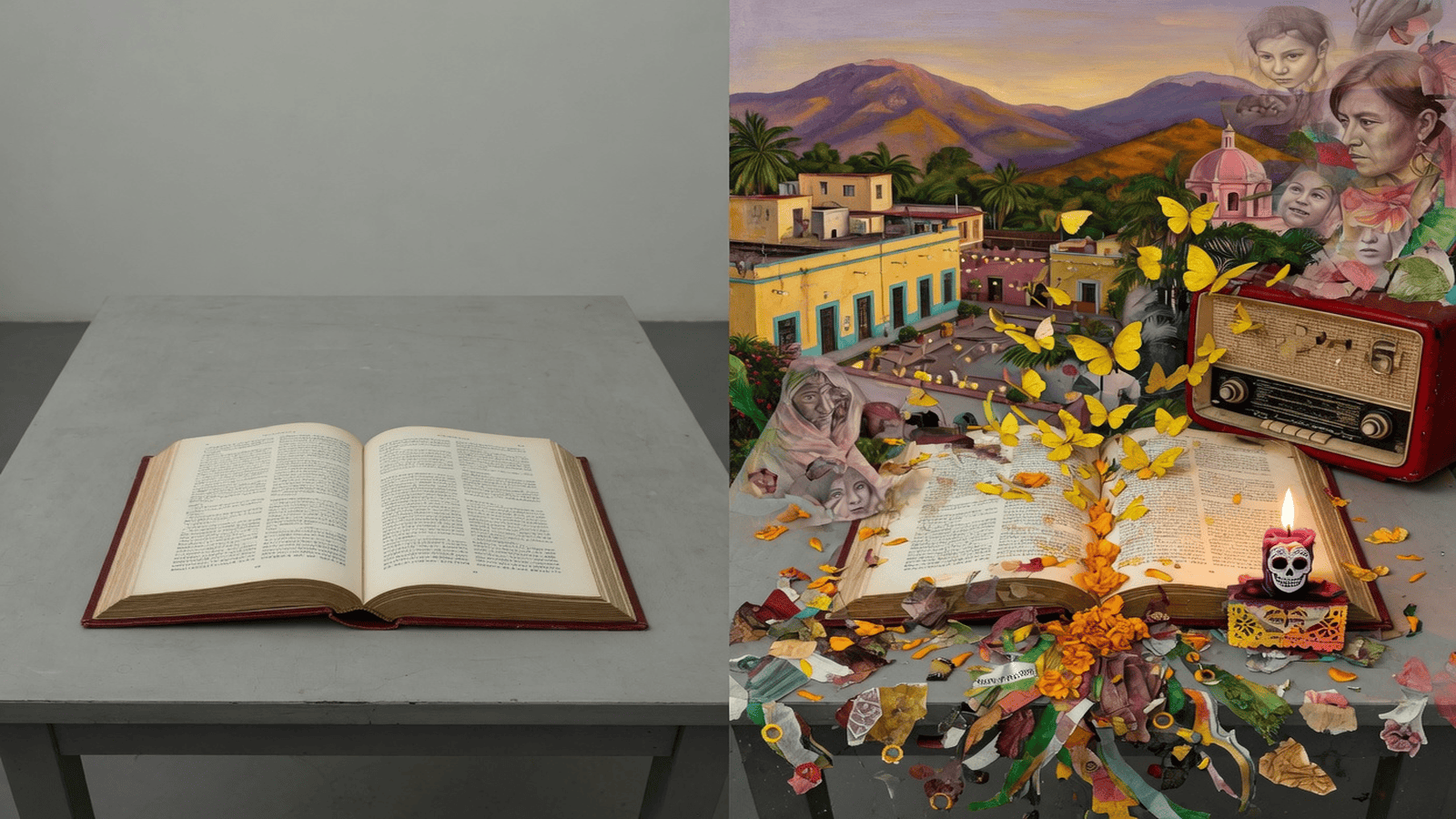
A book is not finished when the author stops writing. A film is not finished when the credits roll. The work is only half of the circuit; the other half is the life that meets it.
Meaning is not stored inside the text waiting to be extracted. It is completed at the point of contact—between the work and everything the reader already carries: their geography, their history, their language, their dead. Hand the same novel to two people and you have produced two different novels. Context is not decoration on the art. It is the other half of the art.
And because my context is specific—Colombian, raised inside Latin American literature and Mexican melodrama—I read the world through a prism most readers of “global Americana” don’t have. I grasp some things instantly and miss others entirely. The prism gives and the prism takes.
I. Universality Is What Survives the Loss of Context
We treat “universal” as the highest praise an artwork can earn. But universality is mostly what survives the loss of context—the lowest common denominator that crosses every border because it asks nothing of the reader. The richest reading runs the opposite way. It requires the most context, not the least. To understand deeply is to bring more, not to need less.
This is reader-response theory’s old insight—Wolfgang Iser’s “gaps” that the reader must fill, Stanley Fish’s interpretive communities—but lived rather than theorized. Gadamer called the goal a fusion of horizons: understanding happens when the horizon of the work and the horizon of the reader meet and merge. No horizon, no fusion.
Borges made it a fable in “Pierre Menard, Author of the Quixote”. The identical words of Don Quixote mean something entirely different when written by a twentieth-century Frenchman than by Cervantes—because the context around the words changed, and the words were only ever half of it.
II. The Same Frames, Two Different Films
First Blood (1982) lives in cultural memory as a muscle-bound killing machine. The actual film is a tragedy about an abandoned Vietnam veteran whose body remembers a war his country wants to forget; it ends in a weeping breakdown, not a victory. Strip out Vietnam and veteran trauma and you get an action figure. Keep them and you get an elegy. The franchise itself lost the context and became the thing it was indicting. The poster ate the movie.
Breakfast at Tiffany’s (1961) survives as the little black dress and the pastry at the window—a romance. Capote’s Holly Golightly is a sadder, harder figure, and Mickey Rooney’s Mr. Yunioshi is a yellowface grotesque that 1961 found unremarkable and we find appalling. Same frames, two eras, two films. The context of production and the context of reception are different lenses, and the work changes shape under each.
And there is a lens you can’t get from a book at all: place. The story doubles in resolution once you’ve actually been to New York—better still, lived in Manhattan. Stand on Fifth Avenue at dawn where Holly presses her face to the glass, feel the particular loneliness the city manufactures behind its glamour, ride the comedown of a small-town girl reinventing herself in a borough that eats reinventions, and her restlessness stops being charming and becomes recognizable. Some context you read. Some you have to go stand inside.
You cannot read Dennis Lehane’s Mystic River without the claustrophobia of working-class Irish-Catholic Boston—the tribal loyalty, the neighborhood code, the way place is fate. A reader who has never felt a neighborhood close around someone reads a thriller; a reader who has reads a tragedy. And without Jim Crow Alabama threaded into your bones—not summarized in a footnote, felt—To Kill a Mockingbird is a charming coming-of-age story. With it, it is an indictment. The history is not background to the book. The history is the book; the plot is just where you enter it.
III. The Whale Was an Economy
Moby-Dick is the clearest case for context as material literacy. A modern reader takes the hunt as pure metaphor—Ahab against God, man against nature—and skims Melville’s long cetology chapters as digression. To his 1851 readers, none of it was abstract.
Spermaceti and whale oil lit the world. Baleen was the plastic of its age, stiffening every corset and umbrella. New Bedford was, per capita, the richest city in America, and whaling employed tens of thousands across a global industry. The hunt is an economy, the cetology is the supply chain, and the Pequod is a factory ship. Strip that out and Ahab is a madman chasing a symbol; restore it and he is a chief executive burning the company down to settle a personal score.
This is precisely why the New Bedford Whaling Museum and its Nantucket counterpart have to exist. The book now assumes a world its readers no longer inhabit, so an institution supplies the missing half of the circuit—why a whale was worth dying for, both as raw material and as the livelihood of whole towns. The novel didn’t get harder. The context evaporated, and a building had to be raised to hold it.
The museum is the formal version; the town itself is the raw one. Walk the New Bedford waterfront, step into the Seamen’s Bethel where the cenotaphs on the wall name men the whale took and never gave back—Melville sat in those same pews—and the abstraction turns to weather. You stop reading about a vanished economy and start standing in its ruins. That is the difference between knowing the context and inhabiting it.
IV. The Prism I Was Issued at Birth
Here it turns from theory into autobiography. I grasp things in certain works instantly that careful, intelligent foreign readers labor over—not because I am a better reader, but because I was issued the context at birth.
One Hundred Years of Solitude is filed under “magical realism,” as if the magic were a literary device. To a reader who grew up where the miraculous and the mundane share a kitchen—where a grandmother’s premonition is just information, where the dead are discussed in the present tense—it isn’t a device at all. It’s reportage. The realism was never in scare quotes.
Pedro Páramo is the harder case and the better one. Rulfo’s town of ghosts is nearly unreadable without a felt grasp of Mexican Catholicism, the open relationship with death, rural fatalism, the Cristero wound. I didn’t get that from a syllabus. I got it from rancheras and boleros and corridos, from the telenovelas always playing somewhere in the house—the whole emotional grammar of honor, fate, melodrama, and the dead who won’t stay buried. That grammar is the operating system Pedro Páramo runs on. With it the book is legible. Without it it is a beautiful confusion.
V. The Prism Cuts Both Ways
Does this make art elitist—is “you had to be there” a cop-out that gatekeeps meaning? No. It’s an invitation. The fix for missing context isn’t to deny that it matters; it’s to go get more of it. Read wider, live wider. Reading is not passive reception; it is active completion, and you can train for it.
I know this because I lived it. The New York of Breakfast at Tiffany’s was just plot to me until I had paid rent in Manhattan and felt the particular loneliness the city sells as glamour; Paris stayed a postcard until I had stood inside it; and the decades I spent away from where I started did the strangest work of all—distance handed me the context that proximity had hidden. Books and films I had genuinely struggled with finally opened, not because I reread them harder, but because I had gone and lived the missing half. The difficult parts were never difficult. I had simply not yet earned the context that finishes them.
So I keep a standing list—not of books to read but of places to go stand inside, so the works waiting on them can finish. I dream of a wartime Casablanca, to read its café of exiles in the right light; of imperial Rome and Roman Judea before I claim I have understood Ben-Hur; of the drawing rooms of fin-de-siècle London and the grave at Père Lachaise, where Wilde’s epigrams still want their city; of Persepolis and Isfahan, of the Athenian agora and the Aegean, until the Persians and the Greeks stop being names and become weather. The reading list and the travel itinerary, it turns out, are the same document. And perhaps then, having stood in both, I will be able to draw my own conclusions about Dickens’s two cities—and to tell anyone who will listen that the London and Paris of A Tale of Two Cities never finished being our own, that 1859 is still, line for line, a description of now.
But the prism cuts both ways. My Colombian context is a key to some doors and a wall at others. I read Pedro Páramo in the original frequency and read To Kill a Mockingbird in translation—in every sense—getting the plot, missing the music. Everyone is a foreigner to most of the world’s art. Humility, not mastery, is the honest end state.
And there is a limit to push against. Susan Sontag warned in Against Interpretation that interpretation can smother the thing itself. So hold the line: context completes the work; it shouldn’t replace it. The goal is a fuller experience, not a louder explanation.
VI. The Flattering Lie of the Self-Sufficient Masterpiece
The dream of the self-sufficient masterpiece—the book that means the same to everyone, the film that needs nothing from you—is a flattering lie. It describes the poorest possible reading, not the richest.
The works that have marked me most are the ones I met halfway, where my specific life turned out to be the missing half of the circuit. That is not a limitation of art. It is the whole proposition. The art was always waiting for someone who had lived enough to finish it.
VII. I Am Legend
There is no cleaner ending than Richard Matheson’s I Am Legend. For the whole novel Robert Neville is the last man on earth, hunting the infected in their sleep, the hero by default. Then, awaiting execution, he finally sees himself through the eyes of the new society that has risen around him: not the survivor but the monster, the thing that comes in the dark to kill them in their beds. They have a word for that creature. Legend. He has become their Dracula.
The facts never changed—same man, same killings. Only the context changed, and the context delivered the verdict. The horror is that Neville was the one missing it: he kept reading himself as the protagonist of a story that had quietly swapped its readers. He was the one without the context, and being without it made him the villain.
That is the entire argument, which is exactly why the 2007 film had to throw the ending away and replace it with a hero’s martyrdom. It kept the events and discarded the meaning—the poster eating the movie one last time. Read the book and you get the vertigo Matheson built: you are never the protagonist of everyone’s story. Change the readers and the hero becomes the legend. Context was never decoration on the art. It was the verdict.
Further reading
- One Hundred Years of Solitude — Gabriel García Márquez
- Pedro Páramo — Juan Rulfo
- Truth and Method — Hans-Georg Gadamer (the fusion of horizons)
- “Pierre Menard, Author of the Quixote” — Jorge Luis Borges, in Ficciones
- The Act of Reading — Wolfgang Iser (the reader fills the gaps)
- Against Interpretation — Susan Sontag (the counterweight)
- First Blood — Ted Kotcheff (1982)
- Breakfast at Tiffany’s — Blake Edwards (1961)
- Mystic River — Dennis Lehane
- Moby-Dick — Herman Melville
- New Bedford Whaling Museum — the institution that restores the material context
- A Tale of Two Cities — Charles Dickens (the two cities I still owe a visit)
- I Am Legend — Richard Matheson (read the book; the 2007 film inverts the ending)