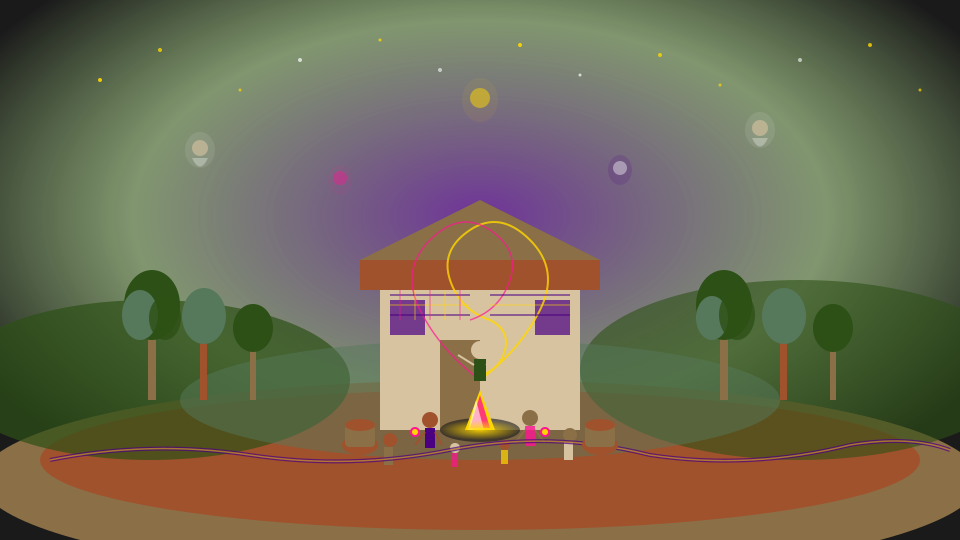
I grew up inside a convenience store, and a convenience store has no holidays. It has shifts. The calendar that organizes most people’s lives — the long exhale of Friday evening, the dread of Monday, the warm collective pause of a holiday — never reached behind the counter. Christmas was a high-traffic day; people who forgot something always needed somewhere open. New Year’s Eve sold ice and cigarettes. A Saturday was a Tuesday with more beer. My parents never asked, “any plans for the weekend?” because there was no weekend. There was only what we call, with no irony at all, business as usual.
So I arrive at adulthood missing an organ that everyone around me seems to have been issued at birth: the one that knows how to feel a Friday. I can recognize that other people feel it. I can watch the mood of an office lift at five o’clock and understand, intellectually, what is happening. But I don’t feel the lift. And from that strange vantage — raised on the bank rather than in the water — the entire apparatus of ritual looks suspicious. The birthday. The reunion. The framed photo on the desk. The candle, the toast, the card. I look at all of it and a question rises that most people never get to ask, because they were raised inside the answer: is ritual a glorified scam, or the only honest excuse we have to be in a room together?
The judge is still out. I want to keep him out for the length of this essay, because the moment you decide is the moment you stop seeing clearly.
I. The Cynic Behind the Counter
There is a reading of ritual that the store taught me to make automatically, and it goes like this: a ritual is a transaction dressed up as an emotion.
The birthday card carries an unspoken invoice. It says happy birthday, but underneath it says you must now feel celebrated, and you must perform that feeling back to me so that I know my gesture landed. The party is a performance review where the only metric is whether you looked like you had a good time. I have stood at gatherings and caught myself calculating — not the genuine, startled laugh, but the polite, we’re-all-having-fun chuckle, and how many of them the occasion seemed to require. The framed photograph on the wall is not really memory. It is evidence. It is proof, filed away for some future audit of whether your life was lived correctly, whether you accumulated enough documented joy to pass inspection.
Seen from the storeroom, the whole enterprise is inventory management with confetti. And the cynic has a sharp closing argument: the curated life on social media is simply this logic taken to its conclusion. The ritual fully converted into proof. The dinner that exists to be photographed. The gathering hollowed out until only the documentation remains, a flawless chronology of peak emotional moments that nobody actually felt. It isn’t happiness. It’s an elaborate, expensive lie that everyone has agreed to call a life.
That is the cynic’s case, and it is not nothing. But it is not the whole of it.
II. The Anthropologist’s Reply
Émile Durkheim, studying the religious life of Aboriginal Australian clans, noticed something the cynic misses entirely. He argued that ritual is almost never about the thing being celebrated. The totem, the festival, the rite — their content is arbitrary. Their function is not. When people gather and move and chant in unison, something is generated that Durkheim called collective effervescence: a charge, a heat, a sense of being lifted out of the individual self into something larger. That charge is what turns a crowd into a society. The ritual is the machine that manufactures belonging.
Read this way, the cynic has the logic exactly backwards. We do not gather because it is your birthday. Your birthday is the pretext we invented so that gathering would not require a reason. Human beings need to assemble, to synchronize, to feel the warmth of the group — but we are too proud or too shy to do it nakedly, so we hang the need on a hook. The hook is the occasion. Remove every birthday and anniversary and holiday from the calendar and people would not become more sincere; they would simply have nowhere to put the need, and it would go unmet.
The scam, if it is a scam, is one we run for ourselves — not on ourselves. Arnold van Gennep showed that the great thresholds of a life — birth, coming of age, marriage, death — are crossed not by the event itself but by the rite that marks it. The wedding does not record a marriage that already exists; it makes one. The funeral does not describe grief; it gives grief a shape it can be carried in. The mark is not decoration on the moment. The mark is how the moment becomes real to the people living through it.
III. Both Things Are True
Here is what took me a long time to see: the two readings do not cancel. The ritual is empty and load-bearing. The streamer means nothing and it is the only thing holding the room up.
A toast you don’t believe a word of still bonds the table that drinks to it. Erving Goffman spent a career showing that all of social life is performance — front stage and back stage, a self continuously managed for an audience — and the lesson is not that we are all frauds. It is that performance is not the opposite of sincerity. It is the medium sincerity travels in. The marriage that is “just going through the motions” is in trouble, yes. But notice: the marriage that ends usually ends because someone stopped going through the motions first. The motions were not the symptom. They were the structure. They were what was holding.
There is no cleaner parable for this than Groundhog Day (1993). Phil Connors arrives in Punxsutawney as exactly the man I recognize in myself: a cocky cynic who holds the small-town ritual in open contempt, too clever and too cold to feel what the locals feel about a groundhog and a calendar. He is then condemned to live the ritual — the same provincial ceremony, the same day — over and over until it breaks him. And the irony, the one that lands like a verdict, is that going through the motions a thousand times does not expose the ritual as hollow. It does the opposite. The forced repetition wears the cynicism off him like water on stone, and somewhere in the endless mimicry he stops performing warmth and simply becomes warm. The cocky man learns that the tradition was never beneath him. He was beneath it.
So I have learned to do something that, from the store, looks almost absurd. I follow the guidelines. I put up the photo. I show up to the reunion I did not especially want to attend. I light the candle. I do all of it the way a person follows a recipe written in a language they cannot read — executing each step correctly, privately unsure what any of it is for. The mimicry is real and a little lonely. But here is the thing I keep colliding with: the mimicry works anyway. The people at the table feel held. The friend whose reunion I dragged myself to was glad I came. The function does not seem to require my belief. It only requires my presence.
IV. The Receipt and the Purchase
There is a harder question underneath all of this, and it is the one the store pressed into me before I had words for it. Is sincerity a luxury good?
My parents did not get to feel a Friday because they were working through it. They did not get to be unhurriedly, genuinely moved by a holiday, because the holiday was the busiest day of the week and the register did not stop. The capacity to experience ritual as feeling rather than labor may be something that only a stable calendar and disposable time can afford. From behind the counter, the people performing leisure on the other side of the glass did not look like liars. They looked like people who could afford a thing my family could not. The cynicism I inherited was never really contempt for ritual. It was the resentment of someone shut out of it — and that is a very different thing, and a more honest one.
Which is why I refuse to close the case. I still cannot feel a Friday. I still put up the streamer. And I have stopped needing those two facts to agree with each other. Maybe ritual is a scam, and showing up is simply the cover charge for admission to other people — the price of not being alone. But maybe a cover charge is not a scam at all. Maybe that is just what a society costs, paid in small insincere gestures that somehow add up to something true. Maybe the cynic is not the clear-eyed one in the room. Maybe he is the one who got short-changed, who learned to read the receipt so well that he never noticed he was holding something worth the price.
The store taught me to read the receipt down to the last line. It never taught me whether the purchase was worth it. I suspect that question is not supposed to be answered. I suspect you are supposed to keep showing up, candle in hand, recipe in a language you don’t speak, and let the room decide.
Further reading
- The Elementary Forms of Religious Life — Émile Durkheim
- The Presentation of Self in Everyday Life — Erving Goffman
- The Disappearance of Rituals — Byung-Chul Han
- Mythologies — Roland Barthes
- The Rites of Passage — Arnold van Gennep
- Groundhog Day — Harold Ramis (1993)