We have inverted the hierarchy. We treat films as “mere entertainment” and documentaries as “the real story.” The structure is backwards.
A documentary claims objectivity. It performs neutrality, absence of agenda, the camera as a window untouched by editorial will. This is a lie. Every cut, every interview choice, every excluded scene is editorial. The lie is that there’s no lie. The documentary says: “We are not interpreting; we are reporting.” But interpretation is the report.
A fiction film admits upfront: “This is a constructed narrative. We are showing you not what happened, but what means something.” It surrenders the claim to objectivity and in doing so, becomes more honest. It can show you the structure of reality—the patterns, the absurdities, the hidden mechanics—without pretending to mere documentation. Truth is not in the event itself; it is in the pattern the event reveals.
I. Satire That Became Documentary
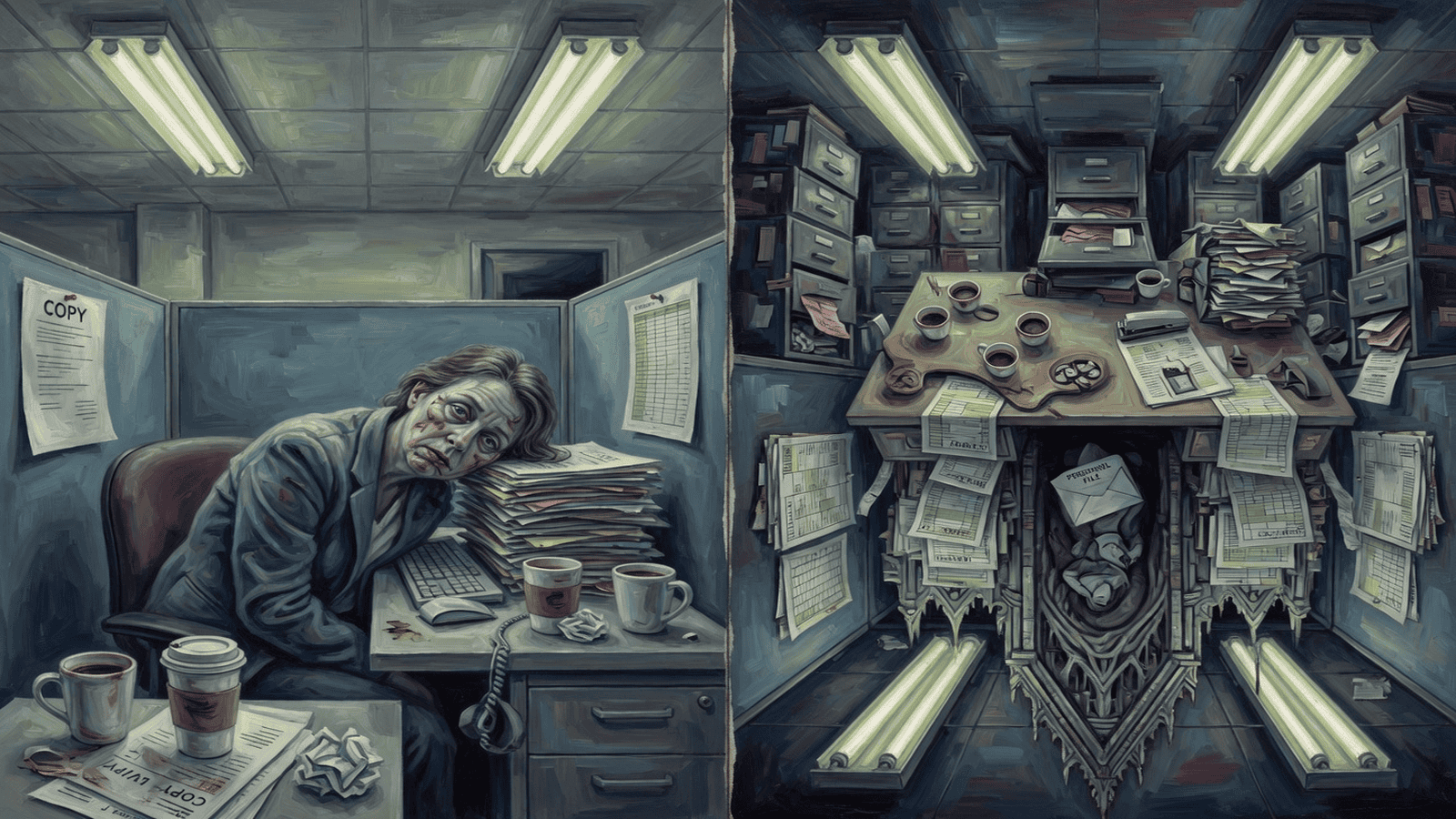
Consider Office Space (1999). The film was released as a comedy. We laugh at the absurdity of corporate life: the TPS reports with unnecessary cover sheets, the three managers asking the same questions, the coffee machine, the fluorescent despair. We laughed because it was exaggerated. It was satire.
But twenty-five years later, is it still satire? Or has it become documentary? The joke was that the absurdity was impossible. Now the absurdity is the job. The film didn’t predict the future; reality caught up and mimicked the fiction. The fiction was always more accurate than we knew.
Network (1976), directed by Sidney Lumet, was pitched as a dystopian prophecy. A news anchor has a breakdown on air and becomes a star. The network calculates entertainment value, not truth. The audience is the product. The film’s vision of news as pure spectacle was meant to horrify. Now it is the baseline. We don’t laugh at Network anymore because it stopped being satire sometime around 2010. It became the operating manual.
Glengarry Glen Ross (1992) shows the mechanics of sales culture with brutal clarity. “Always Be Closing.” The pitch is the game. The sale is the point. Ruthlessness is the virtue. We watched the film and recognized it as an exaggeration of business culture. Now every CEO speech, every startup pitch, every LinkedIn post is Glengarry Glen Ross. The film wasn’t prophecy; it was documentary. We just didn’t want to see it.
Brazil (1985), Terry Gilliam’s masterpiece, presents a Kafkaesque bureaucratic nightmare made visual. Forms breed forms. Paperwork multiplies. The system is incomprehensible and absolute. It was meant as a dark fantasy. Now it is the TSA, the IRS, airport security theater, GDPR, Terms of Service. Gilliam showed us hell; we moved into it.
These films were satire. They have aged into documentary. The question is: Are they prophetic? Or were they always documentary, and we simply didn’t recognize it yet?
II. The Person Telling the Story Is Constructing It
The deepest inversion appears in The Usual Suspects (1995). The entire narrative—two hours of story told to interrogators—is revealed to be a construction. Verbal Kint, the meek, limping con man, is Keyser Söze. The story he told was a fiction he invented while speaking it. He didn’t discover Söze’s identity; he became Söze by narrating the story.
The horror is exquisite because it cuts to the bone: The person narrating reality to you is constructing it as they speak. There is no objective event; there is only the story.
This is no longer a narrative device. It is how reality works.
Every LinkedIn profile is someone narrating themselves into existence. Every news cycle is someone’s Verbal Kint performance—a carefully constructed narrative designed to make them real. Every corporate memo announcing a restructuring is a fiction constructing a new reality. Every resignation letter, every hiring announcement, every quarterly earnings call is narration masquerading as report.
Social media is Verbal Kint at scale: millions of people simultaneously constructing themselves through story. We thought the film was warning us about unreliable narrators. In fact, it was showing us that all narration is unreliable because all narration is construction. The narrator doesn’t report reality; the narrator is the reality.
Marlon Brando, irritated at being called the greatest actor, said that everyone is an actor. We are all performing all the time. The only difference is the audience and the camera. The person writing the email to their boss is an actor. The person at the dinner table editing their behavior for their parents is an actor. The distinction between “performance” and “authenticity” collapses when you recognize that consciousness itself is a narrator—the self is always already a construction in the act of telling.
III. The Confession of Fiction
The difference between a documentary and a film is the difference between a confession and a lie that admits it’s lying.
A documentary says: “This is what happened.” The claim to objectivity is the lie. It performs the absence of perspective while being entirely perspective.
A fiction film says: “This didn’t happen, but it means something.” It admits the mask. And in admitting the mask, it becomes truthful about how meaning actually works. We don’t understand the world through events; we understand it through patterns. Fiction shows us the pattern. Documentary claims to show us the event and smuggles in the pattern without admitting it.
Synecdoche, New York (2008), directed by Charlie Kaufman, explores this recursively. The boundary between art and life collapses. The person playing a role becomes the role. The fiction and the reality merge until they are indistinguishable. We watched it and called it surreal. But it is documentary of the self. The self is already a fiction we construct.
IV. The Map and the Territory
Jean Baudrillard’s Simulacra and Simulation describes a world where the copy has replaced the reality. The simulation is no longer a copy of the real; it is the real. We inhabit the copy. We mistake it for the original.
But there is another possibility: The fiction was never a copy. It was always a truer representation of the structure than the “event” itself. The film shows you how things actually mean, not just how they happen. And meaning is what matters.
Borges, in “On Exactitude in Science,” imagines a map so detailed it is 1:1 with the territory. The map and the territory become the same. But perhaps the film is closer to the 1:1 map than documentary is. Documentary claims to be transparent (it is not); film admits it is constructed (and therefore shows you the construction accurately).
The honest mask reveals more than the honest face.
Further reading
- Simulacra and Simulation — Jean Baudrillard
- Borges, “On Exactitude in Science”
- Ficciones — Jorge Luis Borges
- Office Space — Mike Judge (1999)
- Network — Sidney Lumet (1976)
- Glengarry Glen Ross — James Foley (1992)
- Brazil — Terry Gilliam (1985)
- The Usual Suspects — Bryan Singer (1995)
- Synecdoche, New York — Charlie Kaufman (2008)
- Marlon Brando interview: “Everyone is an actor”