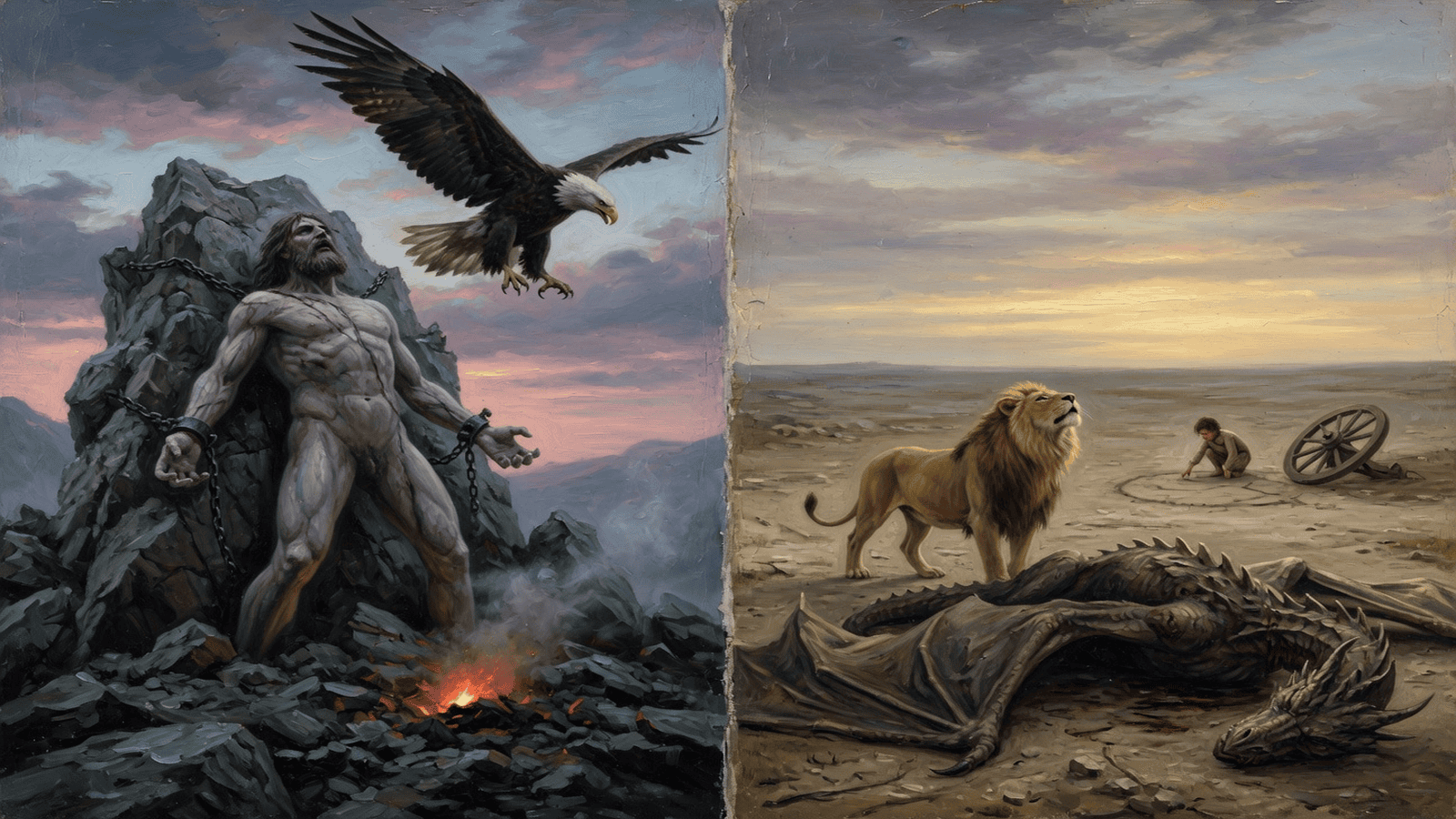
We have made Prometheus into a mascot for progress. The Titan who stole fire and gave it to a shivering humanity now lends his name to prizes, foundations, rockets—anything that wants to sound bold. But the myth does not end with the gift. It ends—or refuses to end—at the rock. Chained to a crag in the Caucasus, Prometheus has his liver torn out by an eagle each day and grown back each night, so that the wound is always fresh and the punishment never finishes. The fire was given once. The price is paid forever. To read the myth honestly is to keep your eyes on the rock, not the flame.
I. The rock, not the gift
In Hesiod’s Theogony and Works and Days, the oldest sources, Prometheus is less a hero than a trickster whose cleverness brings Pandora and her jar down on the human race. It is Aeschylus, in Prometheus Bound, who gives us the figure we half-remember: the benefactor nailed to the mountain. And Aeschylus is careful about what the fire actually was. It is not only flame. In a long speech, his Prometheus lists what he gave: number, “chief of all devices,” the joining of letters, the yoking of animals, ships, medicine, the reading of dreams and omens. Fire is shorthand for technē—the entire apparatus of making, the means by which a species stops being at the mercy of the world and begins to shape it. The crime, then, is not theft. The crime is enabling creation. And the sentence for enabling creation is to be opened, every day, by something you cannot fight off.
II. Defiance without end
What makes Prometheus Bound unbearable, and great, is that the Titan does not repent. Hermes arrives to demand submission and is met with contempt; Prometheus says, in effect, that he would not trade his suffering for the lackey’s errands of the gods. The pain is total and so is the refusal. This is the detail that matters, because it severs the myth from every consoling story we tell about sacrifice. Prometheus is not suffering toward anything. There is no third act in which the debt is cleared and the hero vindicated. There is only the rock, the eagle, and a will that will not bend. Centuries later Goethe would seize on exactly this in his 1789 ode “Prometheus”—Here I sit, forming men in my own image—turning the chained victim into the archetype of the defiant maker who owes the gods nothing. Suffering and defiance, in this figure, are not opposites. They are the same act seen from two sides.
III. Camel, lion, child
Hold that image and turn to Nietzsche. The first speech of Thus Spoke Zarathustra, “On the Three Metamorphoses,” describes how the spirit transforms—and the sequence is a theory of how creation costs. First the spirit becomes a camel: the beast of burden that kneels to be loaded, that seeks out the heaviest weights precisely because they are heavy. The camel is reverence, the carrying of values one did not choose. Then, in the loneliest desert, the camel becomes a lion. The lion cannot yet create. What it can do is destroy: it confronts a great dragon, and on every golden scale of the dragon a word gleams—Thou shalt. The lion’s whole work is to say No, to win, by killing the thousand-year-old law, the freedom to begin. And only then comes the third metamorphosis: the child. “Innocence is the child, and forgetting, a new beginning, a sport, a self-propelled wheel, a first movement, a sacred Yes.” The child creates new values out of the ground the lion cleared.
Notice the order. You cannot skip to the child. The sacred Yes is only possible after the kick that clears the ground, and the kick is the lion’s, and the lion’s work is a destruction that earns it nothing but an empty field.
IV. The figure who pays
Here the two stories rhyme. Set the payers side by side. Prometheus pays for handing humanity the means of creation. The lion pays for destroying the inherited law—it does the violent, thankless work and receives, in return, only the freedom of a swept plain. The child inherits that cleared field and gets to say Yes. But the child is not exempt. The values the child creates will harden, in time, into a new Thou shalt; the child will become a camel again, kneeling to be loaded with the morality it once invented, until some later lion arrives to kill it. The one who clears the ground is never the one who rests on it. Creation is not a transaction you complete. It is a debt that rotates—from camel to lion to child and back to camel—and someone is always on the rock.
V. The liver and the return
Under both stories runs a darker current, and it is the key to why Prometheus’s punishment takes the exact form it does. Why the liver? Why the nightly regrowth? Because the myth is a machine for recurrence. What is destroyed returns; what returns must be destroyed again. The Greeks chose, as the organ of eternal punishment, the one organ that visibly regenerates—and in doing so built a perfect emblem of Nietzsche’s heaviest thought.
In The Gay Science, Nietzsche poses it as a demon who creeps into your loneliest loneliness and says: this life, as you now live it, you will have to live once more and innumerable times more; every pain and every joy and the eagle and the rock, all returning, “and you with them, speck of dust.” Would you curse the demon, or call him a god? Eternal recurrence is not a cosmology to be proven. It is a test. And Prometheus has already passed it. He is recurrence made flesh—the wound that reopens, the will that does not break—and by refusing to repent he has done the only thing the test asks: he has willed the cycle rather than merely endured it. This is what Nietzsche would later call amor fati, the love of fate. It is not resignation. It is looking at the eagle on the horizon, knowing it will come at dawn as it came yesterday and will come tomorrow, and staying chained anyway—not because you are bound, but because the fire was worth it.
That is the price of fire, and it is the price of every act of making. Not a one-time toll but a turning wheel. Mary Shelley understood this when she subtitled her novel The Modern Prometheus: Victor Frankenstein steals the divine spark, and the creature he makes spends the rest of the book hunting him across the ice.
And here is the consolation, if it is one. Emerson, in his essay “Compensation,” insisted that the universe keeps a perfect ledger—that every advantage is taxed, every loss secretly repaid, and the account settled not in some promised afterlife but here, now, in this life. Whatever name we give the machine that exhausts us—Marx’s capital, extracting surplus from the hours of your one life; the technofeudalism Yanis Varoufakis says has already replaced it, rent skimmed by the owners of the cloud—the deep structure beneath the narrative does not change. There is always a price, and someone always pays it. So when you feel used up, exploited, opened daily by something you cannot fight off, set the grievance down for a moment and consider that you may be living a Promethean life: that the fire you carry is worth the eagle, and that the compensation is not waiting somewhere else but burning in your hands right now. The gods knew what they were doing when they chose the liver. Perhaps it is yours.
Further reading
- Aeschylus, Prometheus Bound
- Hesiod, Theogony / Works and Days
- Friedrich Nietzsche, Thus Spoke Zarathustra — “On the Three Metamorphoses”
- Friedrich Nietzsche, The Gay Science — §341, “the heaviest weight”
- Friedrich Nietzsche, The Birth of Tragedy
- Johann Wolfgang von Goethe, “Prometheus” (1789)
- Mary Shelley, Frankenstein; or, The Modern Prometheus
- Ralph Waldo Emerson, “Compensation”, in Essays: First Series (1841)
- Karl Marx, Capital, Vol. I (1867)
- Yanis Varoufakis, Technofeudalism: What Killed Capitalism (2023)