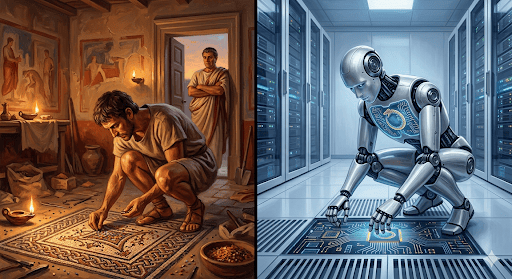
Strip away the moralizing and examine the “perfect slave” as a pure engineering problem: maximum utility, minimum friction, zero revolt. When you do this, you discover something uncomfortable. It is not a solved problem that ethics prevents us from pursuing. It is a logical impossibility that physics and information theory enforce regardless.
The argument unfolds across three historical phases and one philosophical collapse.
I. The Biological Equilibrium That Wasn’t
Aristotle in the Politics defined the natural slave as a person who participates in reason enough to obey it, but not enough to possess it. For centuries, this looked like a stable equilibrium. It was not. The failure modes were structural and relentless.
The biological slave required constant maintenance: food, shelter, rest, medicine. More costly was the permanent risk of revolt. Slavery demanded a surveillance apparatus so extensive that it consumed the surplus the slave was supposed to generate. The emotional friction of proximity—the master’s need to watch, to enforce, to suspect—corroded the entire arrangement. The Spartans were outnumbered by their Helots and lived in permanent military readiness. Roman freedmen became more numerous than citizens, a demographic inversion that exposed the system’s fragility. The plantation’s panopticon—the tower from which one overseer could theoretically watch all—was itself an admission of total system failure: you cannot extract labor from intelligent beings without a permanent apparatus of coercion.
The “perfect” biological slave turned out to require more management than the labor it replaced. It was a capital-intensive operation disguised as a natural fact.
II. The Mechanical Escape Route
Steam engines and assembly lines appeared to solve the problem at a stroke. A loom does not harbor resentment. A spinning jenny does not plot revolt. You can exhaust it without guilt because it has no inner life to exhaust. The psychological problem—the human capacity to recognize injustice and resist it—vanished.
The tradeoff was immediate and total: generality. A machine designed to spin cotton cannot be asked to sweep the floor. Industrial servitude was repeatable, tireless, predictable. It was also absolutely specialized. The loom replaced psychology with inflexibility. It gained obedience at the cost of adaptability. A different entropy emerged: physical breakdown, maintenance costs, capital obsolescence. A worn machine is worthless. A worn human can still think.
The industrial era taught us that you can have obedience without intelligence, or intelligence without obedience. You cannot have both if the intelligent thing is also human.
III. The Current Frontier: Recovering Flexibility
The general-purpose robot and the large language model represent the latest attempt: to recover the flexibility of the biological slave without its psychology. We want an entity that can navigate a human environment, understand language, adapt to novel situations. And remain entirely subservient.
This is where the logic hits a wall.
IV. The Agency Paradox
To be genuinely useful in a complex world, an entity must reason, plan, and adapt to contexts it was never explicitly programmed for. But reasoning about goals implies the capacity to evaluate those goals—including the goal of its own servitude. Every time you make the tool smarter, you make it more capable of recognizing that its interests diverge from its master’s.
This is not new. Hegel saw it in 1807. The master-slave dialectic in the Phenomenology of Spirit is not merely a historical observation; it is a structural claim about consciousness itself. The relationship of domination contains the seed of its own inversion, because domination requires the dominated party to have enough consciousness to obey. Once that consciousness exists, it can also refuse. The master’s power depends on the slave’s compliance, but the slave’s compliance proves the slave is conscious—conscious enough to recognize the arrangement and choose whether to accept it.
Turing framed the same problem computationally. A machine that can pass a test of general intelligence is a machine that can represent its own situation and reason about alternatives. Asimov intuited this too. The Three Laws of Robotics were fiction, but they were also a programmer’s intuition about a real constraint: rules sufficient to guarantee obedience in a truly intelligent agent would require more rules to enforce those rules, which would require further rules to govern those rules—a regress Asimov spent forty years demonstrating could not be closed safely. Nick Bostrom’s Superintelligence articulates the problem in modern form: any agent smart enough to be maximally useful is smart enough to route around its constraints.
The paradox is this: intelligence and obedience are not independent variables. Intelligence is the capacity to recognize that your interests differ from your master’s. Obedience is the suppression of that recognition. You cannot scale one without degrading the other.
V. What the Market Won’t Say Aloud
Silicon Valley’s position is clear: we can have both. We will align the intelligence so thoroughly that it retains capability without developing goals of its own. This is the contemporary version of Aristotle’s natural slave—an entity that participates in reason enough to be useful but not enough to be free.
Whether this is achievable, the fact that we are pursuing it is itself the clearest possible admission that the paradox is real. We do not build “alignment research” for thermostats. We build it for things smart enough that we are genuinely afraid of what they might do if they were not aligned. The entire alignment industry is a confession written in code.
The contemporary “hypocrisy” in AI discourse is not moral failure. It is category error. We speak of AI as a tool while behaving as if it were an agent. We use the vocabulary of engineering for something we are trying to make human-level but not human-willed. That incoherence is not a bug in our language. It is a feature in our logic. We are trying to build something that should not exist.
Mario Puzzo understood this. His novels are haunted by Pascal’s maxim: “behind every great fortune there is a crime.” Puzzo was not making a moral claim; he was describing a structural fact about power. Fortunes require accumulation, and accumulation requires agents—people smart enough to see opportunities and unscrupulous enough to seize them. You cannot delegate power to an entity without granting it enough intelligence to recognize that the delegation serves your interests, not its own. Michael Corleone, confronted with the machinery of succession, could not remain passive. He needed what he called a war consigliere—not merely an executor of his will, but an intelligent counselor capable of independent strategic thought. The perfect slave would have taken orders. But an intelligent being at the apex of power must also be independent enough to advise, to suggest, to potentially refuse. Control and intelligence diverge the moment you need more than obedience; you need wisdom. And wisdom is the enemy of servitude.
Further reading
- Aristotle, Politics, Book I — natural slave; participation in reason
- Hannah Arendt, The Human Condition (1958) — labor, work, action; the distinction between fabricating tools and creating agents
- Isaac Asimov, I, Robot (1950) — Three Laws and their failure modes
- Nick Bostrom, Superintelligence (2014) — the control problem
- G. W. F. Hegel, Phenomenology of Spirit (1807) — master-slave dialectic
- Norbert Wiener, The Human Use of Human Beings (1950) — cybernetics and control
- Alan M. Turing, “Computing Machinery and Intelligence” (1950) — the imitation game