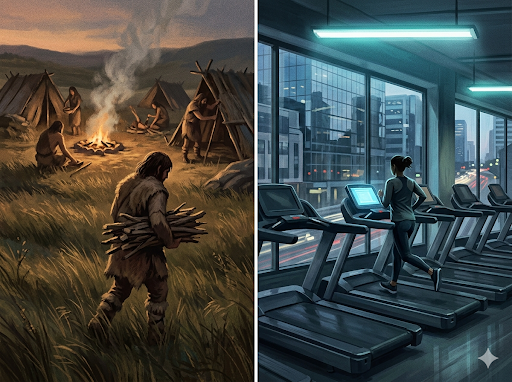
Try to picture an ancestor from ten thousand years ago — before agriculture, before cities, before the concept of leisure time — doing bicep curls. The image collapses immediately. Not because they lacked biceps; they had better ones than most of us. The image collapses because the question is wrong. They did not exercise. They moved, constantly, because stillness was failure. Hunting, carrying, building, walking to water, running from danger, kneeling to tend a fire. Movement was not a habit they cultivated. It was the texture of being alive.
We inherited that body. We did not inherit that life.
I. The bifurcation.
What we built instead is a strange arrangement that anyone from any other century in human history would find difficult to parse. Most of the day is spent sedentary — desk, screen, couch — and then we carve out one hour to compensate. We call it a workout. We schedule it. We track it. We measure it in reps and watts and calories burned. We feel guilty when we skip it. This bifurcation is so normalized that the alternative — a life in which movement is simply the default texture of the day — has become difficult to even imagine without sounding nostalgic or romantic.
Nothing here is an argument against the gym. If you love to lift, if the weight room is your community, if training sharpens your mind and your body — go, without apology. Athleticism has its own logic, and at the elite end it is a beautiful one. The problem is not the gym. The problem is the narrative that has grown around it: the story that says health is a result of exercise, that exercise is a measurable schedulable intervention, that missing sessions is a failure, that the body is a project to be managed by the appropriate combination of apps and supplements and accountability partners.
This narrative is extraordinarily useful for selling memberships, wearables, protein powders, and online coaching programs. It is less useful for actually being healthy. It turns a biological need into a performance, and then it ties the performance to identity, which means that when life interferes you do not just miss a workout — you fail at being someone who works out. The shame is the product. The shame is the part that keeps the subscription active.
Meanwhile, the other twenty-three hours go unexamined.
II. What the body was actually built for.
Daniel Lieberman, the Harvard evolutionary biologist who has spent his career studying human movement, makes the argument carefully in Exercised (2020). Humans are not built for exercise in the modern sense. There is no hunter-gatherer society on record that has anything resembling a workout. There are also no hunter-gatherer societies on record with the rates of cardiovascular disease, type 2 diabetes, or chronic lower-back pain that industrialized populations now consider baseline. What our ancestors did, and what the surviving populations in Dan Buettner’s Blue Zones still do, is something subtler and harder to monetize: an uninterrupted low-level engagement with physical life. Walking because cars are not default. Cooking because food does not arrive processed. Cleaning because disorder has consequences. Tending children, animals, gardens, neighbors. Socializing in ways that require physical presence and sometimes physical labor. Movement woven into purpose. No bifurcation.
Herman Pontzer’s Burn (2021) sharpens the picture from the metabolic side. His measurements of the Hadza in Tanzania — one of the last hunter-gatherer populations on Earth — showed that they do not, in fact, burn dramatically more calories per day than a sedentary office worker in Manhattan. The body adapts. What differs is not the total expenditure but the distribution: the Hadza are active in low-intensity ways for most of their waking hours, and the cardiovascular and metabolic consequences of that distribution turn out to be the thing that matters. An hour of intense exercise inside an otherwise sedentary day is metabolically not the same animal as eight hours of low-intensity movement. The total numbers can match; the bodies do not.
III. The other twenty-three hours.
Then there are the things almost embarrassingly obvious but chronically undervalued because they cannot be packaged. Sleep — Matthew Walker’s Why We Sleep lays out, with a thoroughness that is honestly alarming, the consequences of treating the eight hours as the negotiable variable in the day. Food that has not been engineered, in the precise technical sense Michael Pollan has been documenting for two decades, to override the satiety signals that evolved to keep us from eating ourselves to death. A level of stress that does not chronically marinate the nervous system in cortisol, which Robert Sapolsky’s Why Zebras Don’t Get Ulcers explains is the mismatch — our stress response was designed for the lion, not for the email — and which under sustained activation will quietly demolish almost every system in the body. Sunlight, which regulates more downstream processes than is currently fashionable to acknowledge. And — this one gets quietly excised from polite health discourse more than it should — an active sexual life, which is not a luxury good but part of what the nervous system was built around and what it goes strange without.
None of this is supplemental to the workout. This is the substrate on which the workout either flourishes or fails. Train hard on four hours of sleep and bad food in a chronically stressful life and the gym will not save you. The gym was never going to save you. It was never asked to do that job, and selling it as if it could is the part of the story that the industry has the least incentive to correct.
IV. The question worth sitting with.
The hardest thing to admit is that most of what we call health problems are lifestyle problems — not in the moralistic sense, not in the you should try harder sense that has done enormous damage to public discourse on health, but in the structural sense. We built a world optimized for sedentary productivity and then added an exercise industry as a patch. The patch is better than nothing. It is still a patch. Ivan Illich made the parent version of this argument in Medical Nemesis in 1975: industrial medicine treats the symptoms produced by the industrial way of life, and in the treatment perpetuates the conditions that produced the symptoms. The fitness industry is a particular case of the general pattern.
The question worth sitting with, then, is not how should I exercise. It is how did I build a life in which movement had to be scheduled as a separate task? Not everyone can answer it the same way. Constraints are real — children, rent, jobs that require sitting, cities that punish walking. But the question itself reframes what health is for. It stops being a performance delivered in gym clothes for an hour a day and starts being a property of how the other twenty-three hours are arranged: whether the days contain cooking and walking and physical engagement with people one cares about, whether sleep is treated as the load-bearing variable it actually is, whether the food is something the body recognizes, whether the stress is the kind the nervous system was designed for or the kind it was not.
Ten thousand years ago, no one had to decide to be active. Activity was the default. We built a world that made sedentary the default, and now we sell the antidote to the same people who bought the problem. The antidote works, partially, and is a much better thing than no antidote at all. But the cleaner move, where it is available, is to stop needing it.
Perhaps health, in the end, is less about the narratives we have been sold — you need to exercise, you need to optimize, the body is a project — and more about the unglamorous variables the industry cannot package. Sleep treated as non-negotiable. Food the body recognizes. Social interaction that requires presence. Stress in the doses the nervous system was built for. Movement as what happens between the things that matter, not as the thing you have to schedule because nothing else moves you. The workout is a useful patch. It is not the question. The question is the life.
Further reading
- Daniel E. Lieberman — Exercised: Why Something We Never Evolved to Do Is Healthy and Rewarding (2020)
- Herman Pontzer — Burn: New Research Blows the Lid Off How We Really Burn Calories (2021)
- Dan Buettner — The Blue Zones (2008)
- Robert M. Sapolsky — Why Zebras Don’t Get Ulcers (1994)
- Matthew Walker — Why We Sleep (2017)
- Michael Pollan — In Defense of Food (2008)
- Ivan Illich — Medical Nemesis (1975)
- James C. Scott — Against the Grain (2017)