The last pages of One Hundred Years of Solitude are among the strangest in modern literature. Melquíades—the ancient gypsy who has haunted the Buendía household for a century—turns out to have written the entire family history before it happened. Every birth, every obsession, every death, encoded in Sanskrit parchments locked in a room while the family lived out the story they did not know was already written. Aureliano Babilonia deciphers the manuscript in the novel’s final moments and reads the history of his own life as it is ending. The text and the event are simultaneous.
García Márquez was not making a claim about predestination. He was making a claim about knowledge and time: in a certain sense, everything that can be known already exists, and what we call discovery is really recognition. We stumble into something that was already there, name it, and call it ours.
This is either a profound observation or a very old confusion. Possibly both.
I. Found or Built
The standard modern answer is that we build knowledge. We run experiments, accumulate data, construct theories, revise them. Knowledge is a human artifact, made by human minds, contingent on human history. Without Newton there is no calculus. Without Fourier there is no Fourier transform.
The alternative view is older and harder to dismiss. Plato’s version—that mathematical truths exist in a realm independent of human minds and we encounter them rather than invent them—keeps being rediscovered because it captures something real about the experience of doing mathematics. Calculus was formulated simultaneously by Newton and Leibniz, independently, on opposite ends of Europe. The Pythagorean theorem was known to Babylonian scribes before Pythagoras was born. Mathematicians across cultures with no contact arrived at the same results. This is either coincidence or the signature of something waiting to be found.
The Buddhist formulation is different but adjacent. The idea that all sentient beings already possess buddha-nature—that awakening is not an acquisition but a recognition of what was always already the case—is not a claim about mathematics. It is a claim about awareness itself. The enlightened mind is not a mind that has learned more; it is a mind that has stopped obscuring what it already is. The rest of us are not ignorant, strictly speaking. We are asleep.
II. Tools as Sensors
What are antennas, then? Or oral traditions? Or large language models?
One way to read the history of information technology is as a progressive improvement in our capacity to receive. The oral tradition was a low-bandwidth sensor: high in context, requiring presence, dependent on memory and the trust of the community. What survived was not everything—only what was useful, repeated, chanted, stored in the body. Writing was a more reliable sensor with different trade-offs: it could hold more, but it lost the voice, the gesture, the relationship between speaker and listener. The printing press multiplied the reach of writing while standardizing it. The antenna received signals that had been traveling through space, converting electromagnetic radiation into sound. The internet turned everything into data and moved it at light speed.
LLMs sit at the end of this sequence and look different only in scale. They are trained on the compressed record of human writing: everything we have thought worth writing down, or argued about, or repeated enough times to survive digitization. The model is a mathematical summary of that record—a very high-dimensional antenna tuned not to electromagnetic waves but to the statistical structure of human language. When you ask it something and it responds, it is telling you what the corpus implied about that question.
The question is what the corpus is a sensor for. Is it a sensor for human opinion? For the structure of reality as human minds have encountered it? For something beyond human minds that human minds have been imperfectly reaching toward? The answer you give determines whether you think LLMs are mirrors or telescopes.
There is a detail in the vocabulary worth pausing on. The word spectrum—which physicists and engineers use for the range of frequencies at which electromagnetic signals travel—comes from the Latin spectrum: an apparition, a ghost, a vision. Newton borrowed it to describe the band of color a prism casts onto a dark wall. Engineers inherited it for radio waves, then for all electromagnetic frequencies. In spirituality the same territory belongs to spirit—from spiritus, breath, the animating presence that cannot be seen but is undeniably real to those who sense it. Both words describe the same genus of experience: something invisible that travels through space, that attuned instruments can detect, that carries meaning or presence across distances the body cannot cross. The vocabulary leaked between domains not by accident but by recognition.
This is not a coincidence to shrug off. Humans, across very different traditions and projects, kept encountering something they could not quite see—something that traveled, that carried information, that had to be received rather than taken—and reached for the same metaphors each time. The engineers and the mystics were naming the same phenomenon and grabbing the same words. The spectrum is haunted. The signal has always looked, to those paying attention, like a spirit.
III. The Fingerprint Problem
Our tools are not neutral. They carry the fingerprints of what made them.
Language was invented for communication among social primates navigating a world of physical objects, social hierarchies, and survival threats. It is extraordinarily good at those things and visibly limited at others. It has no native way to represent quantum superposition, or the experience of color to someone who has never seen, or the simultaneity of events that relativity makes strange. We can gesture toward these things with language, but the gestures are imprecise—we know they are imprecise because mathematicians and physicists keep needing to invent new notations when existing language fails.
Money is the same kind of tool. It was invented to make trade legible, to convert unlike things into a common scale. It is extraordinarily good at that and catastrophically bad at representing things that are not exchangeable—dignity, relationship, ecological stability, time. But because money became the dominant signal in the coordination of human activity, we rebuilt the world in its image. What cannot be priced struggles to survive. This is not a flaw in money; it is money working exactly as designed. The flaw is in treating the tool as a measure of reality rather than a measure of a particular slice of reality.
Logic is the subtlest version of the same problem. Formal logic is a system of inference—it tells you what conclusions follow from what premises. It cannot tell you whether the premises are true. The history of Western philosophy is partly a history of mistaking the limits of formal logic for the limits of reality.
LLMs inherit all of this. They are trained on text produced by people using language, logic, and concepts shaped by money and power and survival. They reproduce those structures with extraordinary fidelity. If you ask an LLM to reason about justice or value or consciousness, you get back the statistical center of what humans have written about those things—which is not the same as an answer. It is a mirror of the record. We are currently in danger of mistaking the reflection for the room.
IV. And Yet
Every generation has believed its tools were the culmination—that nothing after could be more powerful or more true. The monks who copied manuscripts believed the book was the ultimate vessel of knowledge. The first generation of print thought the press would settle all controversy by giving everyone access to the same texts. The positivists of the nineteenth century believed that science would eventually explain everything. Each of these was a version of arriving at the end of the journey and finding more road.
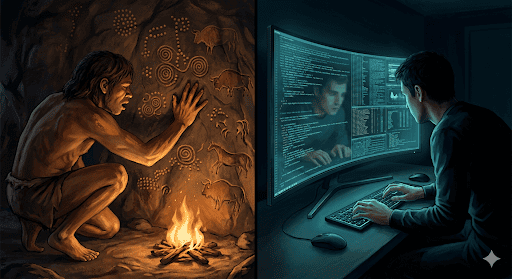
The question Melquíades poses—silently, through the parchments—is whether all of this is already written somewhere, in some form we cannot yet read. Whether oral tradition, antennas, printing presses, and LLMs are not stages in a journey toward truth but increasingly powerful instruments for picking up a signal that was there the whole time. And whether the next instrument, whatever it is, will make the LLM look like a particularly clever cave painting.
The humility this requires is not comfortable. It means our most powerful tool—the one we are currently building the future around—is probably a toy. Not a bad toy, and not a useless one. But a toy, in the hands of a species that has not yet woken up to what it is trying to hear.
Further reading
- Gabriel García Márquez, One Hundred Years of Solitude (1967)
- Plato, Meno — the doctrine of anamnesis: learning as recollection of what the soul already knows
- Shunryu Suzuki, Zen Mind, Beginner’s Mind (1970)
- Claude Shannon, A Mathematical Theory of Communication (1948) — the original paper on information as signal and noise