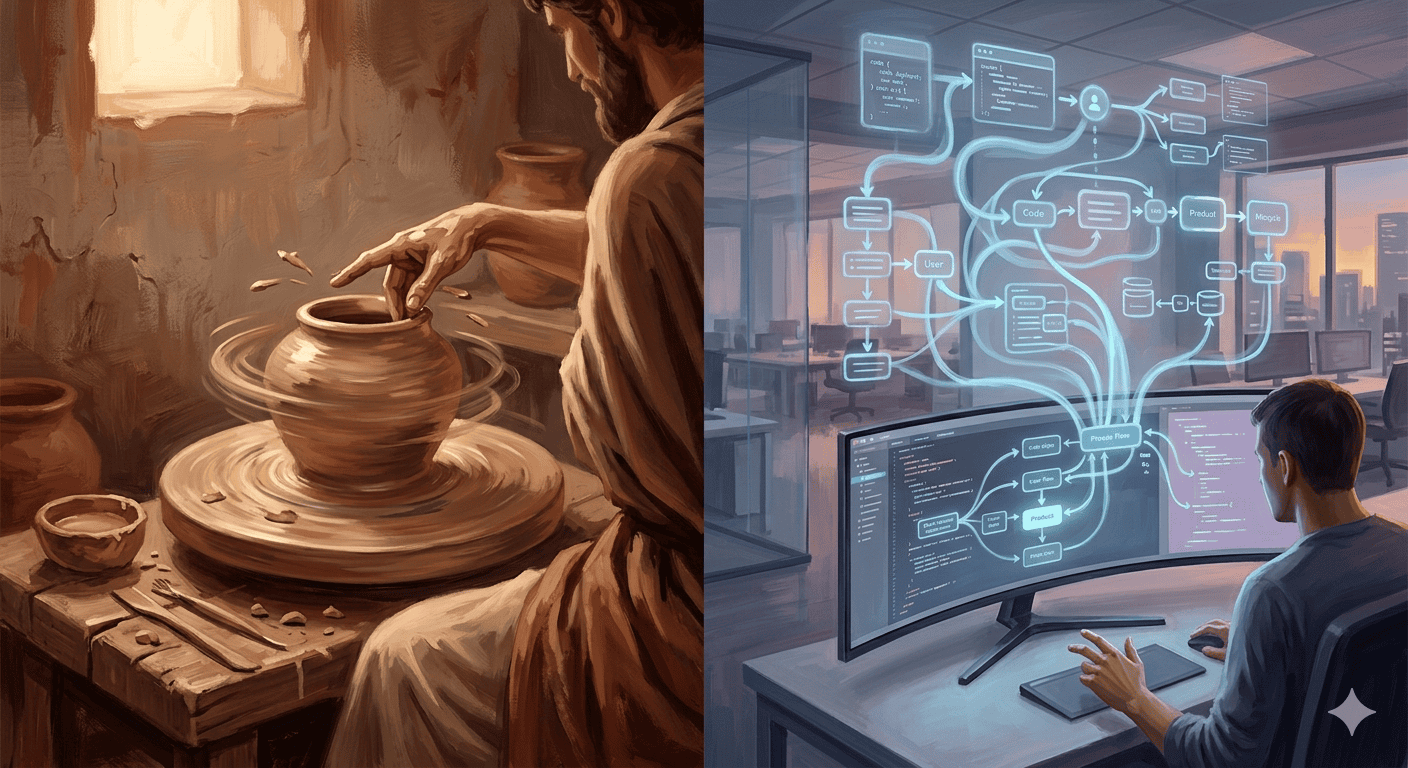
I. The Greek Quarrel
The ancient Greeks asked a question that looks simple until you try to answer it: What is real? Not what exists, but what counts as being—what has substance, what deserves our attention.
Socrates, wandering the agora of Athens, said it was the process. Not the object—the statue, the law, the definition scrawled in wax. What mattered was the method: how do we think? How do we question? How do we arrive at what might be true? The Platonic dialogues, maddeningly circular to modern readers, are exhibits A. Socrates would corner someone, let them stumble through their confident assertions, and show them the gaps. The doing was the philosophy. The dialogue itself was the point.
Plato, his student, disagreed. He saw the eternal objects—the Forms, the perfect, unchanging templates that floated beyond the material world. A specific just action participated in Justice itself. A beautiful face mirrored Beauty. The world of process and change was mere shadow. The real thing was the idea, the template, the form.
Aristotle split the difference, but when the dust settled, he sided with process. Everything, for Aristotle, has an ergon—a function, an activity, a way of operating. The essence of a knife is not its bronze atoms but what it does: it cuts. A good knife cuts well. A good human being acts well. Being is activity. Being is becoming. This is what he meant by actuality—not a static state but the continuous unfolding of potential into action. A thing is what it does, again and again, over time.
The Middle Ages and Renaissance buried process philosophy under layers of scholasticism and mechanical metaphor. By the time the modern era arrived, we’d inherited a world split into discrete objects: atoms, bodies, minds, souls, facts. We’ve been cleaning up that mess ever since.
II. The Modern Inversion
Here’s the painful part: we’re making the opposite mistake today.
We’ve fixated on the object. The AI model. The algorithm. The tool. ChatGPT-4. Claude. Llama. We talk about these as if they are the thing that matters—as if intelligence itself is an object you can buy, license, finetune, plug into your system. We’ve made them into the modern Form: the perfect, abstract, unchanging intelligence somewhere in the cloud.
And we’re missing the process entirely.
When you actually use automation in work—real work, not hype—what you’re doing is externalizing a method. You’re taking a workflow, examining it, breaking it into steps, finding which steps a machine can handle, which require human judgment, where information flows, where decisions happen. You’re modeling the process. Then you encode it.
But we don’t talk about it that way. We talk about “deploying AI,” as if the intelligence is portable and stable. We talk about “replacing workers,” as if work is a simple input-output machine. We miss that automation is process philosophy in action. It requires you to think like Socrates—to examine what you actually do, to find the unstated rules, to make the invisible visible. It requires you to respect the Aristotelian principle: the essence of work is how it flows and transforms over time.
III. Encoding the Method
When someone says “everyone needs to learn to code,” what they really mean—if they’re thinking clearly—is that everyone needs to think like a process architect.
Not syntax. Not loops and variables and object-oriented design patterns. Those are tools; they’re not the point. The point is: Can you map out a workflow? Can you see where a decision happens versus where a rule applies? Can you identify the difference between a human judgment call and a mechanical step? Can you model how information cascades through a system?
These are ancient questions dressed in modern clothes. Socrates was a process architect—he just did it through dialogue. He mapped out the implicit steps of how someone thought. He found the contradictions. He rebuilt the structure. He automated the method into a repeatable form: ask the right questions, listen to the answers, find the gaps.
Aristotle was a systems thinker. He looked at natural processes—how organisms grow, how cities form, how societies organize—and found the underlying patterns. Function, potential, actualization. The parts and the whole working together.
Automation in the modern sense is the same exercise: externalizing process so it can be shared, examined, improved, and delegated. When you set up a workflow—a pipeline, a checklist, a decision tree—you’re doing what the Greeks did when they moved from oral culture to writing. You’re moving knowledge outside the skull, making it repeatable, making it collaborative.
The object (the AI, the tool) is just the medium. The thing that matters is the process encoded inside it.
IV. The Philosophy of Handoffs
Here’s where it gets real: automation always reveals something painful about how we work.
You can’t automate something you don’t fully understand. You think you understand your job, your process, the way you make decisions. Then you try to explain it to a machine—or to a system, or to a colleague—and you realize you’re missing steps. You’re making assumptions. You’re skipping over things that seemed too obvious to mention, except they weren’t obvious at all. They were buried.
That’s the Socratic moment. That’s the payoff.
The handoff—the point where a human decision meets an automated process—is where the architecture becomes visible. In a well-designed automation, the machine handles the repetitive, deterministic work: fetch data, format it, check it against known rules, pass it forward. The human makes the judgment call: Is this interesting? Does it deserve attention? Does the rule apply in this particular case? What should happen next?
The design of that handoff is process philosophy. It’s asking: What can be delegated? What requires presence? What requires judgment? Where do we gain efficiency, and what do we lose if we’re not careful?
Some of the best automated systems in the world—hospital workflows, airline operations, financial trading systems—are the ones where the handoff between human and machine is clearly thought through. The process is crisp. The roles are clear. The points of judgment are explicit.
And some of the worst are the ones where companies tried to replace process philosophy with an object: We bought this AI system; now we just run it. They didn’t encode the method. They didn’t model the workflow. They just hoped an intelligent object would solve problems that are fundamentally problems of structure, not capability.
V. Why Automation, Not AI
This is why the word matters. “AI” points to the object. It suggests intelligence as a transferable commodity—something you have or don’t have, something you can buy and deploy. It flattens the real work, which is process design.
“Automation” is honest about what’s actually happening. You’re making a system, a workflow, a repeatable method. You’re encoding knowledge that was in someone’s head into rules that a machine (or a team, or a system) can execute. You’re being a process architect. You’re thinking like the ancients did when they asked: What is real? What actually happens when we work? How do it differently, better, more fairly?
The philosophy is that work itself can be examined, modeled, improved, shared. Not replaced. Not optimized into oblivion. But understood clearly enough that it can be redesigned—made more humane, more efficient, more aligned with what actually matters.
That’s the Greeks in us. That’s the work we’re doing when we automate anything worth automating. The object is just the vehicle for the method.
Footnote on history: This is a philosophical argument, but it has a concrete history. From punch cards through Cobol, C, the OOP revolution of the 1980s-90s, and into today’s microservices and serverless architectures, software has oscillated between these poles—Grady Booch and the Gang of Four made the object the star; now functional languages, event-driven systems, and process mining show the pendulum swinging back. That eighty-year arc is traced in The Software Pendulum.
Footnote on DDD: The software field’s clearest formal attempt to correct this mistake is Domain-Driven Design—Eric Evans’s 2003 corrective to the OOP era, which had drifted so deep into patterns and layers that the business problem got buried under technical structure. Evans said: the domain is the driver, technology is the means. Bounded contexts, aggregates, the ubiquitous language—all of these are tools for making the domain legible in code, not for celebrating the code itself. It sounds obvious. Every other engineering discipline—mechanical, electrical, civil—always knew that the physical problem drives the design, not the lathe or the oscilloscope. Software spent decades thinking it was the exception. It wasn’t, and isn’t. A dedicated article on DDD and what it reveals about software’s peculiar relationship with its own tools is coming soon.
Further reading
- Metaphysics — Aristotle on actuality, potentiality, and the essence of things as their function
- Plato’s Phaedo — The dialogue form as inquiry, with Socrates examining what we think we know
- Alfred North Whitehead, Process and Reality — The 20th-century rehabilitation of process as the fundamental category of being
- Christopher Alexander, The Timeless Way of Building — Process as the architecture of how humans make and inhabit systems
- Lucy Suchman, Plans and Situated Actions — How work actually differs from plans; the ground of human-machine collaboration
- Eric Evans, Domain-Driven Design — The domain is the driver; technology is the means