Benedict Anderson made a simple observation that took a century to reach mainstream consciousness: the nation — the thing we paint on our faces at sporting events, the cause we die for, the imagined container of culture and identity — is a social construct. Not in the soft postmodern sense where everything dissolves into relativity. In the precise engineering sense: it is a machine that someone built, for reasons, and the reasons printed on the package are not the actual reasons.
I. The map mistaken for the territory
Imagined Communities is Anderson’s term, from 1983: millions of people who will never meet, who share no meaningful daily experience, who may live in opposite corners of a territory, nonetheless agree they share something profound. They call it a people. The communion is imaginary, which doesn’t make it weak — it makes it almost infinitely manipulable by whoever controls the symbols.
The border on the map is not a fact of nature. It is the current position of a negotiation that has been conducted, mostly violently, for centuries. The territory — the land, the rivers, the mineral deposits, the trade routes — exists. The country is the label the current management affixed to it. Most members of any nation will never encounter most other members. What they share is a story told to strangers who agree to believe it, enforced by the people who profit most from the agreement.
This is not cynicism. It is a description of mechanism. A hammer is not a conspiracy; knowing it is a hammer does not make you unable to build with it. But confusing the hammer for a sacred object — believing the label is the territory, the flag is the land, the anthem is the history — is how the people being hammered learn to bless the nail.
II. The franchise model of empire
When empires “fall,” who actually loses?
Not the capital — only the management changes. The USSR collapses in 1991, and the assets do not flow to the people who built them. They flow to whoever was close enough to the machinery to reach in first. The result is not freedom; it is the largest peacetime transfer of wealth in modern history, from state property to a handful of men who would be called oligarchs only once they became inconvenient.
Rome does not disappear in 476 CE. It restructures. The Catholic Church inherits the administrative architecture — the dioceses trace the old provincial borders, Latin remains the bureaucratic language, and the tithing model is, if anything, more efficient than the old tax. The same extraction mechanism runs under new branding for another thousand years.
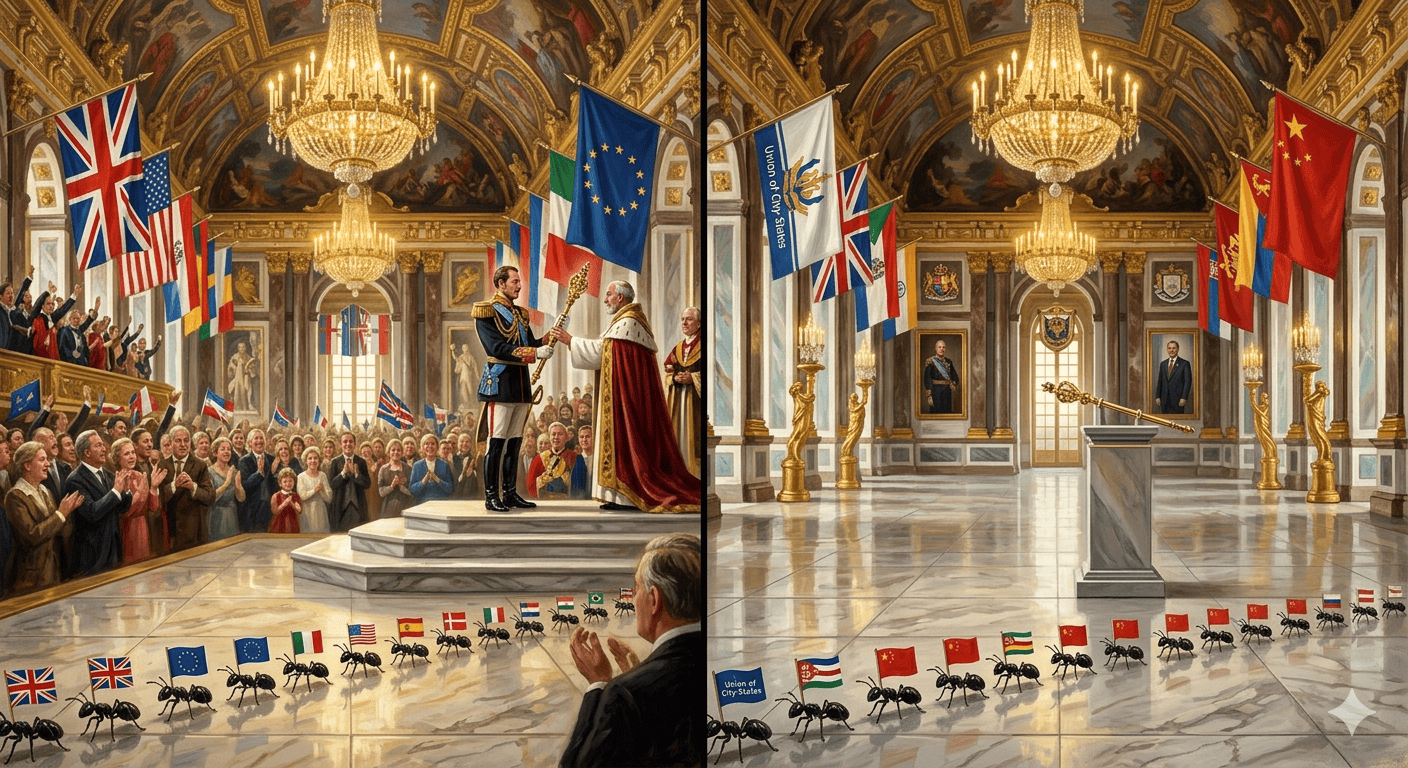
The Dutch VOC builds the first planetary trading empire in the seventeenth century; when it overextends, the British East India Company inherits the routes, the relationships, and the financial instruments. When British hegemony exhausts itself in two world wars, the Americans absorb the system: dollar supremacy replaces the pound, and the IMF and World Bank replace the colonial office. Giovanni Arrighi called these “systemic cycles of accumulation” in The Long Twentieth Century: not the death of empire, but the migration of hegemonic capital to a new host. The ants keep marching. The uniforms change.
Another business day. Another day in paradise for the main stars. Another Dante’s Inferno for the rest.
III. Patriotism as the sunk-cost fallacy of the body
The soldier who admits the war was a financial project has to face that their sacrifice was a transaction, not a mission. That is existentially unbearable. So the sacrifice gets elevated to sacred status: the flag on the coffin, the solemn vow never to question, the ritual of thanks for your service that forecloses any follow-up.
Randolph Bourne wrote, in an unfinished essay in 1918 that has still not been refuted: War is the health of the state. The state is healthiest when the workers and soldiers believe they are heroes rather than inputs. Antonio Gramsci called this hegemony: the process by which the ruling class’s interests become everyone’s common sense — not through a secret conspiracy, but through the sincere internalization of a story. You don’t need to manipulate the ant when the ant genuinely believes in the flag. The sacrifice then compounds.
The “Rambo” fantasy is not a propaganda poster. It is the sincere expression of a person who needs the story to be true, because the alternative is that the story was not true and they gave it everything. That sincerity is precisely what makes it so efficient. A conscript who doubts costs ten; a volunteer who believes is almost free.
IV. Former Indras All
Joseph Campbell, in The Power of Myth, retells a parable from the Brahma Vaivarta Purana: Indra, king of the gods, has just defeated a great monster with his thunderbolt and is commissioning an ever-more-magnificent palace to celebrate his glory. Vishwakarma, the divine architect, builds; Indra demands more. Then a boy appears — Vishnu in disguise — who points to a procession of ants crossing the marble floor.
“Former Indras all,” the boy says. “Through many lifetimes they rise to highest illumination. And then they drop their thunderbolt on a monster, and they think: What a good boy am I. And down they go again.”
The same ants march through García Márquez’s Macondo — that column that arrives before the plague and remains after the massacre, indifferent to the rise and fall of the Buendía family, carrying their miniature loads in the same direction before and after every catastrophe. The ants are not a metaphor for failure. They are a metaphor for the cycle that failure refuses to see.
Every empire believes itself the culmination of history: divine mandate, exceptional virtue, permanent power. Rome. The Caliphate. The British Empire on which the sun never set. The American Century. The thunderbolt feels permanent because you are holding it. It is not permanent. It is the current position in a cycle that predates every civilization that has ever claimed to be the last one.
V. The question the collapse doesn’t answer
When the voices start — the empire is falling, the end is nigh, the old order is collapsing — the question worth asking is not whether it is true. Empires always fall; the timing is the only variable. The question worth asking is: who benefits from the next founding myth?
The fall of Rome produced the Church. The fall of the USSR produced the New World Order narrative and the oligarchs who wrote it. The “end of American hegemony” will not produce equality by default; it will produce whoever controls the next story. That story is already being written, and it will come with its own flags, its own sacred sacrifices, its own version of thanks for your service.
The error of the imperial critic is symmetrical to the error of the patriot. The patriot defends a particular uniform; the critic celebrates its fall; neither asks who is stitching the next one. Both are invested in the fate of a flag.
The antidote is not rooting for a different empire. It is recognizing the franchise for what it is and asking the only question that survives every rebrand: who benefits from my belief in this particular flag? The ants who answer that question honestly are the ones who stop carrying cardboard shields.
The thunderbolt was never yours. You were holding it for the cycle.
Further reading
- Benedict Anderson, Imagined Communities (1983)
- Giovanni Arrighi, The Long Twentieth Century (1994)
- Joseph Campbell with Bill Moyers, The Power of Myth (1988)
- Randolph Bourne, War Is the Health of the State (1918, unfinished)
- Antonio Gramsci, Prison Notebooks (1929–1935)
- Michael Hudson, Super Imperialism (1972, updated 2021)
- Emmanuel Todd, After the Empire (2002)
- Gabriel García Márquez, One Hundred Years of Solitude (1967)