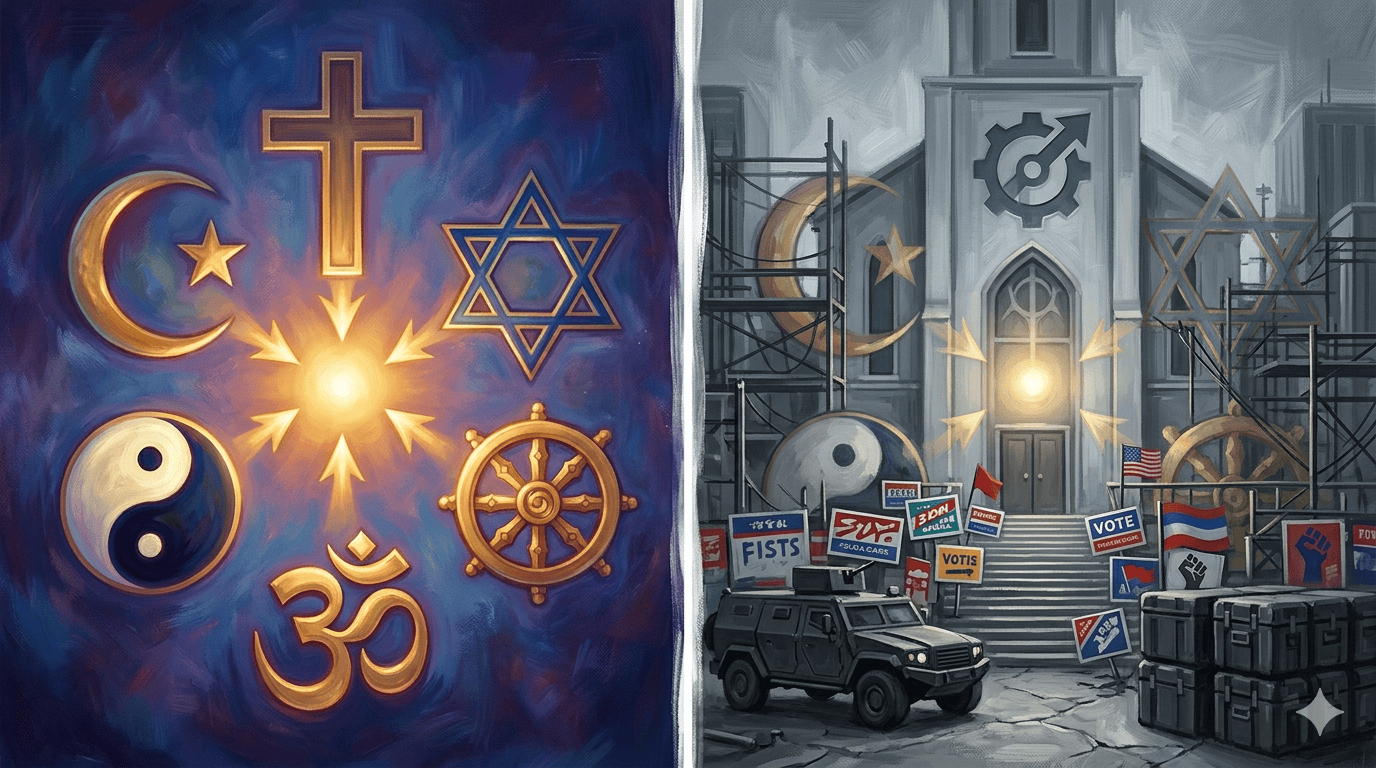
I. The convergence — what Campbell and Jung actually claim
In 1949, Joseph Campbell published The Hero with a Thousand Faces and made a claim that, if true, should have changed everything. Every mythology, across every culture that has ever existed, produces the same story: departure, initiation, return. The hero leaves the known world, undergoes a transformation in the depths, and returns with something for the community. Campbell’s argument was not that the stories resemble each other by coincidence or by diffusion. It was that they resemble each other because they describe the same thing: a psychological process, available to any human being willing to undergo it.
Aldous Huxley had articulated the philosophical frame a few years earlier. In The Perennial Philosophy (1945) — borrowing a term Leibniz had used in the sixteenth century — he argued that behind every religious tradition, stripped of its local costume, sits the same core: the unity of consciousness, the dissolution of the separate ego, and the emergence of compassion as its natural consequence. Not compassion as a commandment but compassion as what happens when the illusion of separateness lifts.
Jung arrived at the same place from a different direction. The archetypes — Shadow, Self, the Wise Old Man, the Great Mother — are not cultural inventions. They are structural features of the human psyche, encoded across millennia, discoverable in any individual’s unconscious if they are willing to look. The self-knowledge that comes from confronting them is not mystical performance. It is psychological hygiene.
The question this post is asking is not whether any of this is true. The question is: if the human species has been generating this wisdom for at least five thousand years, why does Babylon keep winning?
II. The map is not the territory — archetypes become institutions
Campbell was explicit about something that is almost always forgotten in his popular reception. The hero’s journey is a psychological map — a description of what happens inside the individual who undergoes genuine transformation. It is not a social blueprint. The mistake, and it is the organizing mistake of civilization, is to externalize the myth into an institution.
Watch how it happens. The Christ archetype — ego-death, resurrection, unconditional love — is absorbed by the Church, which becomes a machine for managing the afterlife franchise. The liberation archetype — the cry of the enslaved, the breaking of chains — is absorbed by the revolution, which becomes a bureaucracy protecting the interests of the new hierarchy. The abundance archetype — the covenant of enough — is absorbed by the market, which becomes a system for concentrating scarcity in fewer hands. Every institution is the Shadow of the myth it claimed to embody.
Jung called the underlying mechanism enantiodromia: the tendency of any principle, pushed to its extreme, to flip into its opposite. The pursuit of peace becomes the machinery of war. The aspiration to community becomes the discipline of conformity. The pursuit of holiness becomes the prosecution of heresy. The intermediaries — priests, politicians, bankers, platform operators — are not parasites on an otherwise healthy system. They are the system that emerges when psychological truth is scaled into organizational structure without the individual doing the inner work first.
This is why Babylon keeps winning. Not because evil is stronger than good but because the people who hold the wisdom keep handing it over to be administered.
III. The two ways to avoid living it — saviors and tools
There are two stable ways to avoid living the wisdom, and they look like opposites but are the same evasion.
The first is the savior path. We recognize the wisdom, feel its pull, and then outsource the work of living it to an external figure — the messiah, the correct leader, the movement, the revolution. We want the return without the initiation. We want the transformed world without the transformed self. This is what Campbell called refusing the call: the hero hears the invitation and turns back toward the familiar. The vacuum this refusal creates is exactly the space the demagogue fills. The mercantilists and war-mongers win not because they are stronger than the wisdom but because the people who hold the wisdom are waiting for someone else to implement it.
The second is the tool path. We recognize the wisdom, panic at the chaos of actually living it, and encode it into rules, systems, and procedures — trying to compel the output without the transformation. Totalitarianism is the extreme case, but the pattern appears everywhere: hyper-legalistic ethics, doctrinal purity tests, bureaucratic systems sold as rationalized benevolence. The tool path mistakes the output of genuine transformation — compassionate behavior — for a substitute for it: rules compelling that behavior. The intermediaries thrive here too. A system that requires rules requires administrators, and administrators require administrators.
Both paths are forms of what Jung called projection — the conviction that the work of transformation is located out there, in the savior who will arrive or the system that will compel compliance, rather than in here, in the shadow material I have not yet integrated.
IV. The evolutionary complication — the Pleistocene in the polis
Campbell and Jung work at the level of symbolic meaning. Evolution works at the level of reproductive fitness, and it is not particularly interested in the Perennial Philosophy.
The universal truths of peace and cooperation are higher-order outputs of the psyche. They emerge when conditions are stable enough for the nervous system to relax its tribal defenses. But the nervous system did not evolve for stability. It evolved for the Pleistocene, where the relevant signals were scarcity, predation, and out-group threat. Robert Sapolsky’s Behave (2017) documents this in exhaustive biological detail: the same amygdala that fires when you see a spider fires when you see a political opponent, and the downstream behavior is structurally similar. Mercantilism, war-mongering, and power accumulation are not corruptions of human nature. They are features of a nervous system doing exactly what it evolved to do in a world where the stakes were different.
The tragedy is the mismatch. We have the symbolic capacity to imagine a coordinated species and the biological architecture of a tribal primate. The wisdom tells us what we could be. The amygdala, every time it detects a threat, tells us what we instinctively do instead. The corrupt politician does not defeat the Perennial Philosophy. They activate the Pleistocene override. Any account of the gap that ignores this is incomplete — and any prescription that assumes the wisdom alone is sufficient is naive about the wiring it is up against.
Coda. Integration as the only exit
The post ends without a prescription, because a prescription would be the savior path in miniature — the implication that following a checklist will spare you the actual work.
What the analysis points to is specific. Jung’s shadow integration is not mysticism. It is the recognition that the qualities you most reliably despise in the corrupt politician, the war-monger, the opportunist — the self-serving calculation, the willingness to look away, the preference for comfort over truth — are also present in you. Differently dressed. More politely justified. But structurally identical.
As long as evil is something they do, the projection remains intact and the vacuum remains open. The Perennial Philosophy did not fail. The people who held it kept subcontracting it — to the institution, to the movement, to the arrival of a better future.
Karen Armstrong, in A Short History of Myth, makes a point that clarifies everything: myth was never meant to be believed. It was meant to be enacted. The difference is the difference between reading the hero’s journey as a story about someone else and recognizing it as the instruction manual for your own afternoon.
The wisdom is not missing. It has been here for five thousand years, in every language, in every tradition, in every human being who has ever gone through enough that the usual consolations stopped working. What is missing is the willingness to stop treating it as a destination and start treating it as a practice.
That is not an accusation. It is a description of the situation most of us are already in, whether we know it or not.
Further reading
- Joseph Campbell — The Hero with a Thousand Faces (1949)
- Aldous Huxley — The Perennial Philosophy (1945)
- C.G. Jung — The Archetypes and the Collective Unconscious (1959)
- Robert Sapolsky — Behave (2017)
- Karen Armstrong — A Short History of Myth (2005)
- Chögyam Trungpa — Cutting Through Spiritual Materialism (1973)