The body in front of the doctor is easy to measure. Weight goes on a scale. Height goes on a chart. Divide one by the square of the other and you have a number — a BMI — that gets entered into a database and flagged if it falls outside a range established in the 1830s by a Belgian astronomer named Adolphe Quetelet who was studying the statistical distribution of soldiers, not the metabolic health of individuals. Quetelet called his formula the Indice de Corpulence. He did not intend it as a clinical tool. He was doing population statistics.
We have been using it as a clinical tool for nearly two centuries.
I. The proxy problem.
Two people at the same BMI can be in opposite metabolic states. One has high insulin sensitivity, low fasting glucose, low C-reactive protein, healthy mitochondrial function. The other has insulin resistance, elevated fasting insulin, systemic inflammation, and is three years from a type 2 diabetes diagnosis. The scale cannot tell them apart. The BMI chart cannot tell them apart. The insurance form cannot tell them apart.
What can tell them apart is a blood panel measuring hsCRP — high-sensitivity C-reactive protein, a marker of systemic inflammation — alongside fasting insulin, ApoB, and triglycerides. Most routine checkups don’t order these. Most insurance systems don’t routinely reimburse them.
Robert Lustig has been making this case since at least Fat Chance (2012) and refined it in Metabolical (2021): the disease driver in most chronic conditions — cardiovascular disease, type 2 diabetes, non-alcoholic fatty liver disease, a growing share of Alzheimer’s, a growing list of autoimmune disorders — is not weight. It is chronic systemic inflammation. Adipose tissue contributes — visceral fat secretes pro-inflammatory cytokines — but it is one source among many. Chronic sleep disruption is inflammatory. Chronic psychological stress is inflammatory. Ultra-processed food is inflammatory. Environmental toxins are inflammatory. Two people at the same weight, with different sleep quality, food inputs, and stress loads, will have radically different inflammatory profiles.
Ben Bikman’s Why We Get Sick (2020) tightens the causal claim: insulin resistance is not merely correlated with chronic disease — it is the upstream mechanism. Cardiovascular disease, type 2 diabetes, non-alcoholic fatty liver disease, Alzheimer’s, PCOS — the list of conditions downstream of insulin dysregulation now covers most of the chronic disease burden of the developed world. Casey Means’s Good Energy (2024) adds the diagnostic frame: metabolism is the operating system of the body, and a continuous glucose monitor makes the upstream dysfunction visible in real time in ways the annual cholesterol panel cannot.
The fire is the disease. The smoke is just what we can see from the street.
II. The unmonetizable oil change.
The entire logic fits in a line García Márquez would have recognized: el bisturí es el fracaso de la medicina — the scalpel is medicine’s failure. By the time the knife is necessary, prevention has already not happened.
Modern medicine is structured around the break-fix model: wait until a system fails, intervene with medication or procedure. It is profitable because it sells products — drugs, devices, hospital time. Prevention is structurally harder to monetize, because no one bills for the disease that didn’t happen.
The functional medicine literature has named this gap precisely. Jason Fung showed in The Obesity Code (2016) why the break-fix model fails even on its own terms: caloric restriction without addressing the hormonal root — insulin dysregulation — reliably fails because it treats the effect, not the cause. Casey Means frames the wider problem in Good Energy (2024) as a system that has optimized for suppressing downstream symptoms rather than understanding the metabolic root variable. Peter Attia’s Outlive (2023) draws the institutional line: Medicine 2.0 treats established disease; Medicine 3.0 maintains function before the cascade begins. The seven-minute clinical visit is not designed for that second conversation. Insurance doesn’t reimburse it. The incentive structure doesn’t reward it.
The oil change is the better intervention. Nobody makes money on the oil change. And so the oil change doesn’t happen, the engine seizes, and the mechanic who charges for the engine rebuild gets paid.
This is not a conspiracy. It is a structural misalignment between what medicine can do and what medicine is paid to do. The outcome is a system that is genuinely excellent at late-stage intervention and genuinely bad at early-stage prevention — not because the knowledge is missing, but because the incentives point the other way.
III. Stone Age hardware, 2026 software.
The mismatch runs deeper than economics. Daniel Lieberman, the biological anthropologist at Harvard, traces the evolutionary logic in The Story of the Human Body (2013): our genome was selected over hundreds of thousands of years for scarcity, movement, seasonal eating, and intermittent acute stress. The biology was wired to crave salt, sugar, and fat because those were rare and calorically dense in the environments where the selection pressure operated.
Then, in three biological eyeblinks, the environment changed:
The Agricultural Revolution (~10,000 years ago) shifted the diet heavily toward starch, reduced micronutrient variety, and concentrated populations in ways that introduced new disease vectors. The Industrial Revolution introduced refined sugar, industrial seed oils, and the first generation of shelf-stable processed food. The Digital Revolution brought sedentary work at scale, chronic low-grade stress from notification architectures, artificial blue light disrupting circadian biology, and a social-media cortisol loop the adrenal system was never designed to sustain.
The inflammatory response is not a malfunction. It is the correct biological answer to inputs the body was never designed to receive. Chronic inflammation is what happens when an acute-stress immune system runs continuously because the acute stressor never resolves — because the food is inflammatory, the sleep is disrupted, and the psychological environment never reaches the off-switch.
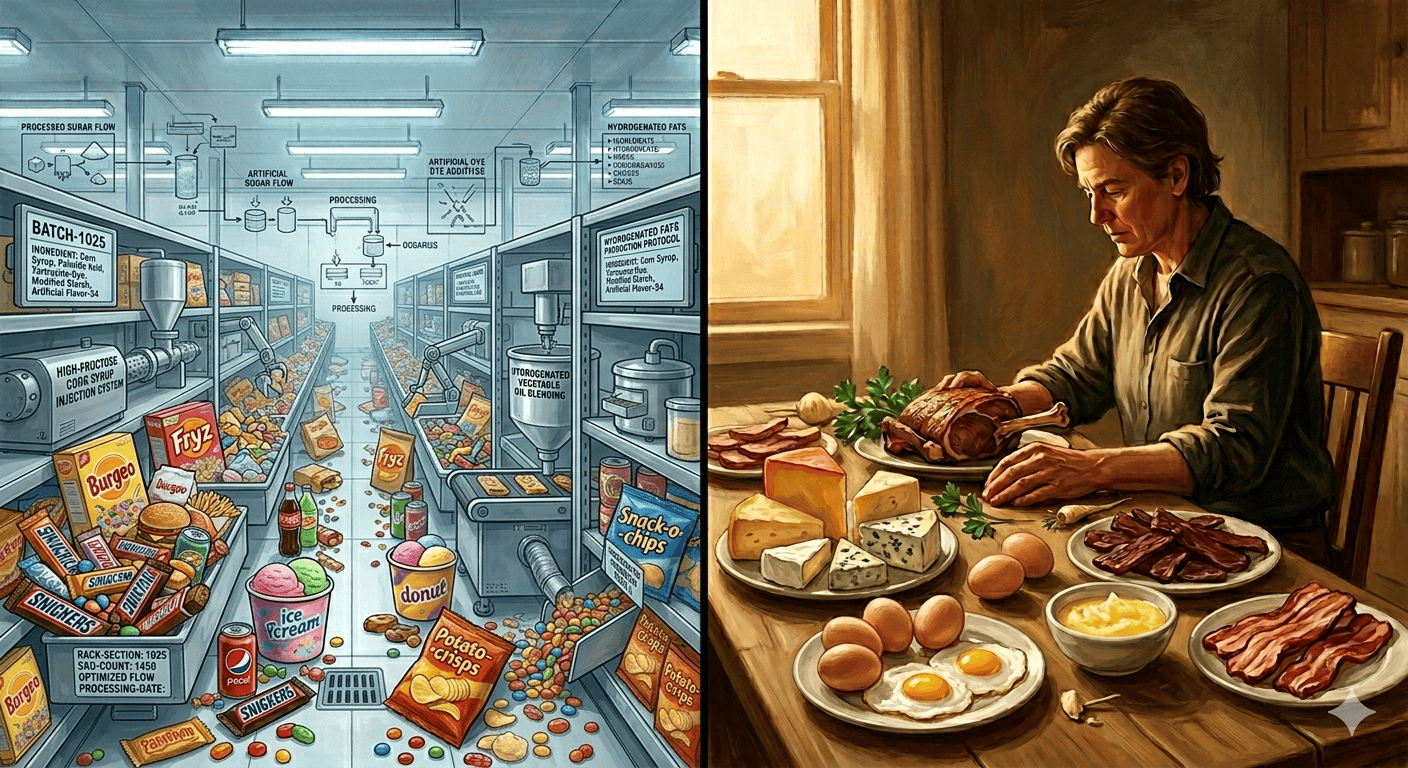
David Kessler, former FDA commissioner, documented in The End of Overeating (2009) how the food industry had reverse-engineered the brain’s reward architecture: layering salt, fat, and sugar in combinations that hyperactivate dopamine reward while bypassing satiety signaling. Chris van Tulleken extended the frame in Ultra-Processed People (2023): the engineering logic is identical to the logic used in industrial animal husbandry. Select for palatability. Maximize per-unit consumption. Minimize per-calorie cost. The result is a product consumed in quantities far exceeding biological need, delivering inadequate micronutrition and producing systemic inflammation in the population that consumes it at scale.
IV. We are not cattle.
The dietary advice that taught a generation to fear butter and embrace whole grains is not ancient wisdom. It is mid-twentieth-century policy, built on Ancel Keys’s Seven Countries Study — which excluded countries whose data contradicted his hypothesis, a selection later documented by Gary Taubes in Good Calories, Bad Calories (2007) and Nina Teicholz in The Big Fat Surprise (2014). The 1977 McGovern Senate report institutionalized the low-fat, high-carbohydrate recommendation. The agricultural industry, sitting on vast quantities of surplus grain and seed oil, found itself with the institutional tailwind it needed. Meat, eggs, and animal fat were not the culprit. They were the casualty.
The evolutionary record runs the other way. The human brain tripled in size over the past two million years in direct correlation with increasing consumption of animal protein and fat — the energy-dense, bioavailable inputs that enabled the metabolic investment a large cortex requires. Richard Wrangham’s Catching Fire (2009) makes the case that cooking, which dramatically increases the digestibility of animal flesh and starchy roots, was the cognitive inflection point. The salad is a modern invention. Bread and pasta are new arrivals in evolutionary time. The diet that built the human brain was not the one on the food pyramid.
The fiber argument has an inversion problem worth naming. Ruminant animals — the prey that fed our ancestors — convert grass and plant cellulose into the meat, fat, and organs we evolved to process. The fiber that benefits us arrived pre-processed, through the gut of our food. The recommendation to consume industrial quantities of plant fiber to maintain gut health is not wrong exactly, but it is backward as a baseline claim: the need for fiber in large quantities is partly a symptom of a gut already disrupted by processed food, not a universal metabolic requirement. The same logic applies to the eight-glasses-of-water prescription — sensible when the kidneys are clearing high loads of refined sodium and carbohydrate metabolites, less relevant on ancestral inputs that don’t generate the same waste stream.
Someone needed to sell the seeds. Vegetable oils — soybean, corn, canola — are industrial byproducts of seed processing. Breakfast cereals are a monetization mechanism for milled grain remnants. The “heart-healthy whole grain” designation is not a conspiracy; it is a structural outcome. When an economy is built around producing vast quantities of a commodity, the science validating consumption of that commodity will find funding, publication, and institutional support. The science pointing the other way will struggle to find a sponsor.
Here is the paradigm shift:
| Current paradigm | Root-cause paradigm |
|---|---|
| Metric: BMI / weight | Metric: hsCRP, fasting insulin, metabolic flexibility |
| Focus: managing symptoms | Focus: maintaining homeostasis |
| Action: pharmaceutical intervention | Action: change the inputs |
| Goal: longevity (not in the hospital) | Goal: healthspan (functioning well, longer) |
The food industry optimizes a human being the way a feedlot optimizes a cow: maximize caloric intake, minimize cost, produce a fattened consumer of further products. The difference is that cows don’t choose. We do. Or we could.
This is not an argument against medicine — pharmaceutical interventions that manage established disease are real and often life-preserving. And it is not an argument for the wellness-industrial complex in its supplement-stack form; that world has its own proxy problem, selling the appearance of optimization while often measuring nothing that matters. The argument is more basic: measure the actual mechanism, not the visible proxy. Change the inputs — food quality, sleep, chronic stress, movement — because those are what drive the inflammatory state that drives the disease.
What does that mean in practice? Eat food that existed before industrial processing. Prioritize the high-density inputs the human body evolved to recognize: animal protein and fat, organ meats, eggs, mineral-rich whole foods. These are the nutrients the genome was calibrated for over millions of years of selection. A diet built around them, with adequate sleep and some version of the movement our ancestors couldn’t avoid, produces a different metabolic state than the one the standard modern diet produces — and the blood markers will confirm it. Inflammation drops. Fasting insulin normalizes. The body runs the way the genome designed it to run.
Michael Pollan’s In Defense of Food (2008) gave the shortest useful formulation: eat food, not too much, mostly plants. The first two words are the operative ones. The third is contested by the evolutionary record, which suggests animal products were the nutrient-dense core of ancestral diets, not their garnish. But “eat food” — real food, food that would have been recognizable before 1900 — is the hinge the whole argument swings on. The body knows what to do with real inputs. It is choking on the engineered ones.
A map of the researchers, clinicians, and books working the gap between not sick yet and actually healthy is collected in From ‘Healthy’ to Healthy — a starting point for anyone who wants to read the primary sources rather than wait for the standard model to catch up.
We are not cattle. The appropriate response to the feedlot model is to leave the feedlot — to treat the human body not as a set of symptoms to suppress but as a biological system to maintain, with the inputs it was built for and the measurements that actually track its state.
The diagnosis is not complicated. The incentive structure that makes it hard to act on is.
Further reading
- Robert Lustig — Fat Chance (2012)
- Robert Lustig — Metabolical (2021)
- Ben Bikman — Why We Get Sick (2020)
- Casey Means — Good Energy (2024)
- Peter Attia — Outlive (2023)
- Jason Fung — The Obesity Code (2016)
- Daniel Lieberman — The Story of the Human Body (2013)
- Chris van Tulleken — Ultra-Processed People (2023)
- Gary Taubes — Good Calories, Bad Calories (2007)
- Nina Teicholz — The Big Fat Surprise (2014)
- Richard Wrangham — Catching Fire (2009)
- Michael Pollan — In Defense of Food (2008)