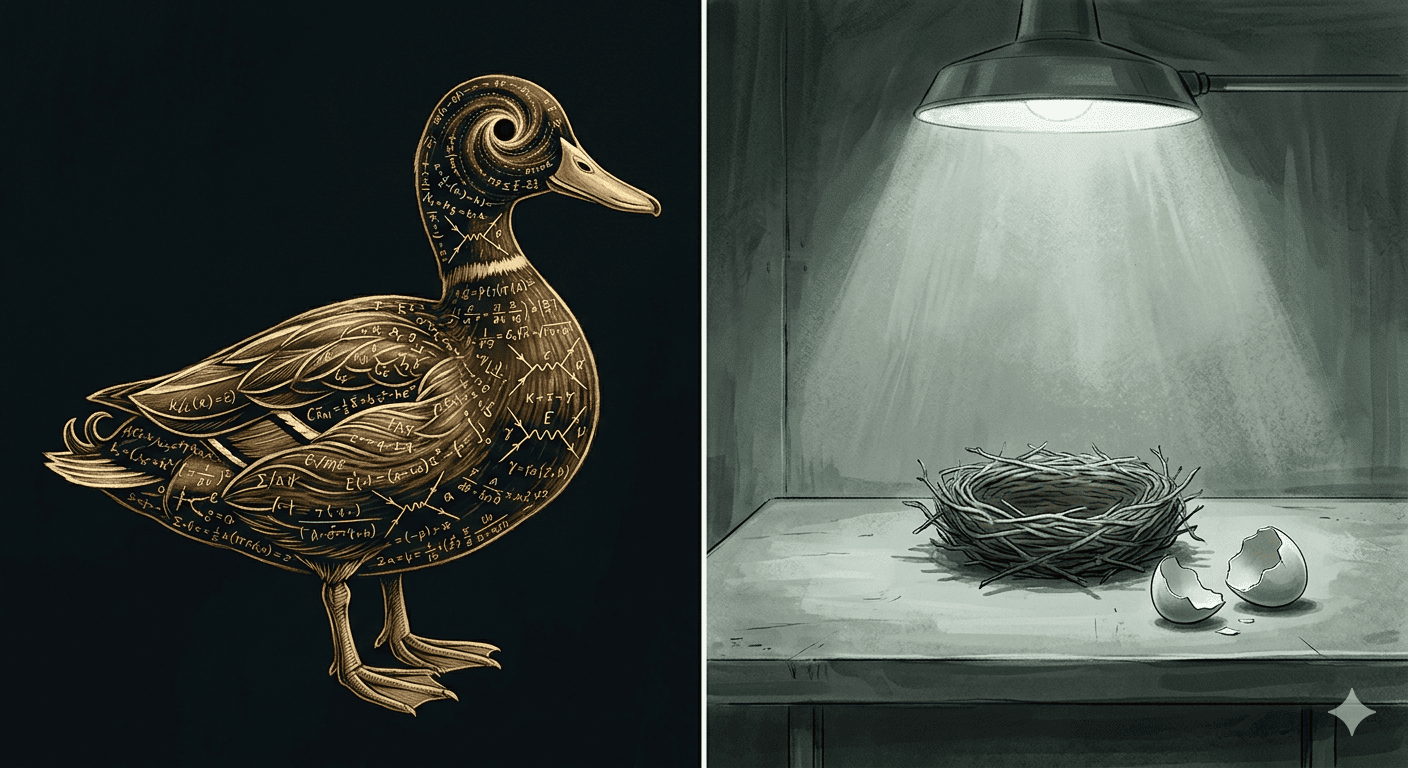
The duck test is one of the cleanest heuristics in the epistemological toolkit: if it walks like a duck and quacks like a duck, treat it as a duck. It works because surface signs are usually entangled with underlying causes. Ducks walk the way they do because of their anatomy; they quack because of the shape of their bill. The surface and the substance are not independent. When you correctly read the surface, you have usually correctly identified the substance underneath.
String theory is the most famous case in modern science of an entity that defeated the heuristic. Not because it failed to look like physics — it looked exactly like physics. It used the vocabulary of physics, the journals of physics, the funding infrastructure of physics, the prizes of physics. Leonard Susskind, Ed Witten, and other figures of genuine brilliance spent decades developing it. By the mid-1990s, not working on string theory was a career risk in theoretical physics. The duck walked. The duck quacked. The duck had an impeccable resume.
And yet no experiment ever confirmed it. No experiment ever could.
I. Why the heuristic usually works.
The duck test functions because observable attributes are normally entangled with the thing they indicate. We trust the heuristic because it has been reliable — surface signals evolved to track, or were designed to reflect, underlying realities. When a doctor diagnoses from symptoms, when a detective infers from evidence, when a scientist identifies a compound from its spectrum, the inference chain holds because the signals are causally downstream of the thing.
Wittgenstein’s notion of family resemblance adds useful nuance here. Categories hold together not through a single shared essence but through overlapping clusters of resemblances — features that criss-cross without any one of them being present in every member. The duck test works not because ducks have a single defining essence but because the cluster of duck-features reliably co-occurs. Which also means: the heuristic fails, predictably, when those features can be produced independently of the underlying reality. When the bill, the gait, and the call can be assembled without the anatomy.
This is the failure mode. And it is more common than we like to think, especially when the thing being imitated is high-status.
II. How string theory passed every surface test.
The genesis itself was a coincidence of exactly the kind physicists had learned to trust. In 1968, Gabriele Veneziano noticed that the Euler beta function — an 18th-century piece of pure mathematics with no business near particle physics — described the scattering amplitudes of the strong force with uncanny accuracy. Within two years, Leonard Susskind, Yoichiro Nambu, and Holger Nielsen had reinterpreted Veneziano’s formula as the behavior of vibrating one-dimensional strings. The duck began life with the strongest possible omen: an old, beautiful piece of mathematics turning out to fit experimental data. Riemann’s geometry had done the same for general relativity. Hilbert spaces had done the same for quantum mechanics. The pattern was real, and so was the prior it created.
The program was soon reframed around a deeper problem: how to reconcile general relativity with quantum mechanics, the two foundational frameworks of modern physics, which contradict each other at the scales where both should apply. The proposal — that fundamental particles are not point-like but tiny vibrating one-dimensional strings — had immediate aesthetic virtues. It unified the known forces in a single mathematical framework. It predicted the existence of the graviton. It connected to deep structures in mathematics that felt, to the people doing it, like they must be tracking something real.
The mathematical elegance was genuine. Ed Witten — perhaps the most formidable mathematical physicist of his generation, Fields Medal and all — worked on strings. When someone of Witten’s caliber works on something, it looks like serious physics, because he is doing it. The institutional markers followed: NSF grants, faculty lines at elite universities, conferences, popular books, breathless coverage in science journalism. An entire generation of talented young physicists built their careers in the landscape.
By the late 1990s, the program had all the surface features of a major scientific breakthrough in progress. The duck walked. The duck quacked. The duck gave keynotes at the most prestigious venues in physics.
III. The egg that never came.
Karl Popper’s criterion for distinguishing science from non-science is falsifiability: a claim is scientific if it specifies conditions under which it would be proven wrong. String theory encountered a problem with a distinctive shape. As the program developed, theorists discovered that the equations permitted approximately 10^500 distinct solutions — 10^500 possible universes, each with different physical constants, different particle masses, different laws. One of those solutions presumably describes our universe. But with 10^500 options, any observation can be accommodated somewhere in the landscape. The theory predicts everything, which means it predicts nothing in particular.
Sabine Hossenfelder’s Lost in Math (2018) diagnosed the disease precisely: physicists had confused mathematical beauty with physical truth. The heuristic — elegant mathematics must be pointing at something real — had served the field for centuries. General relativity is beautiful and true. Quantum mechanics is strange and true. Beauty and truth had been correlated long enough that the correlation itself became trusted. String theory was beautiful. The correlation did not hold.
Lee Smolin’s The Trouble with Physics (2006) and Peter Woit’s Not Even Wrong (also 2006) arrived at the same place from different directions. The program had expanded so far beyond experimental contact that it had stopped being constrained by the world. It had become, in Woit’s phrase, not even wrong — unfalsifiable in principle, and therefore outside the jurisdiction of experiment. The duck had never laid an egg.
IV. What the duck was actually a duck of.
Here is where the story turns, and where it reaches beyond string theory.
String theory was not fundamental physics in the Popperian sense. But it was not nothing. It was a community, a research program, a career structure, a way for very talented people to do genuinely beautiful mathematical work. It produced real results — in mathematics. Mirror symmetry, topological quantum field theory, the AdS/CFT correspondence: these are genuine mathematical discoveries, valuable on their own terms, independent of whether the underlying physical picture is correct. The duck existed. It was just not the duck anyone thought they were funding.
The failure was in the labeling, not in the mathematics. String theory was presented as fundamental physics and staffed and funded accordingly. The duck test was applied at the wrong level. Witten’s brilliance, Susskind’s persistence, the elegance of the mathematics — all of these were real signals, which normally track real physics. The signals were uncoupled from the underlying target without anyone noticing, because the coupling had always been so reliable before.
Thomas Kuhn described how paradigms persist past their use: once a research program has sufficient institutional mass — careers, journals, conferences, graduate students — it becomes very difficult to abandon even when the evidence runs thin. The paradigm produces its own gravity. The duck test gets harder to apply from inside the nest.
This is the generalization worth sitting with. The duck test is the most reliable practical heuristic we have for navigating complex fields we cannot fully understand from the inside. It is also — precisely because it is reliable — the thing that high-status systems learn to spoof. Not through deliberate fraud, usually, but through drift: the institutional markers reproduce themselves after the underlying substance has thinned. Bureaucratic slop that walks like work. Engagement metrics that walk like communication. Optimization functions that walk like intelligence. Performance reviews that walk like feedback.
In each case, the surface signals decoupled from the underlying substance at some point — and the decoupling was invisible for a while because the institutional infrastructure kept regenerating the signals regardless.
Popper’s question was always: what would it look like if this were wrong, and can I even see that shape from where I’m standing? String theory took thirty years to answer it. Most institutional artifacts never do.
(I should note for the record: I have enormous respect for Ed Witten and would prefer not to be in the vicinity when he reads this. I am, as they say, a sitting duck.)
Further reading
- Sabine Hossenfelder — Lost in Math (2018)
- Lee Smolin — The Trouble with Physics (2006)
- Peter Woit — Not Even Wrong (2006)
- Thomas Kuhn — The Structure of Scientific Revolutions (1962)
- Karl Popper — The Logic of Scientific Discovery (1934)