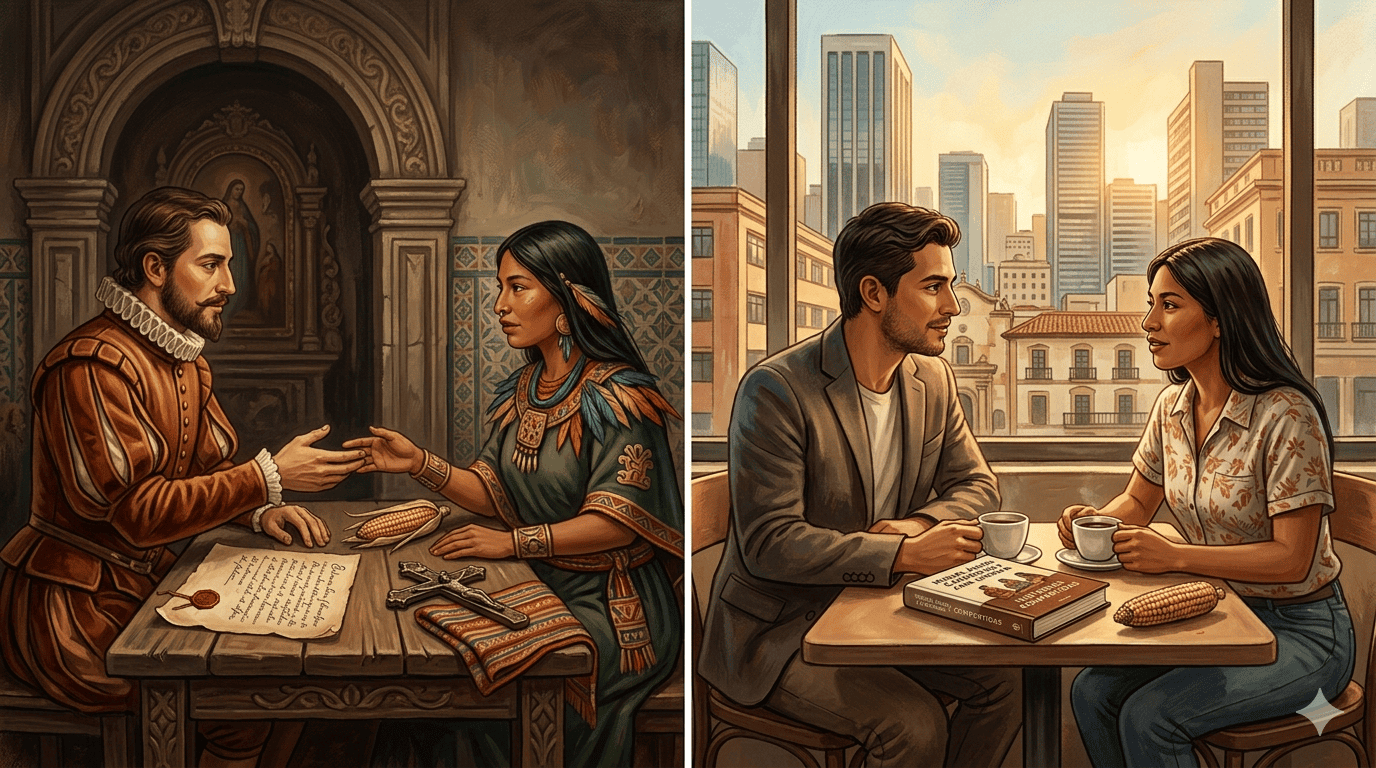
My friend is Spanish. He was born in Toledo in the 1970s. He is not responsible for anything that happened in the Americas in the sixteenth century, and he knows this. What he did, over coffee one afternoon, was offer a symbolic apology — on behalf of something he did not do, on behalf of an institution that no longer exists in the form that did it, acting on orders issued by monarchs dead for four hundred years, which resulted in a catastrophe that reshaped the world I came from.
We almost cried. Not because the apology resolved anything — it cannot resolve anything. Because it named something. Most conversations about colonial history happen at institutional scale: demands, declarations, statues defended or toppled. Those conversations have their place. But in that conversation, there were two people. One of them said: I see it. I see what the side I came from did. I am sorry.
The question the moment raised — the one I have been sitting with since — is what the correct response is. “I accept” is true and not enough. “I don’t hold you responsible” is also true and also not enough. The fuller response, the one that honors both the apology and the complexity of what was inherited, is harder to formulate. That is what this post is for.
I. Emerson’s arithmetic.
Ralph Waldo Emerson’s essay “Compensation” (1841) opens with an observation so structural it reads at first like physics: “Every excess causes a defect; every defect an excess. Every sweet hath its sour; every evil its good.” He is not counseling passivity in the face of injustice. He is describing a structural observation about how reality operates — that enormous losses tend to be accompanied, not canceled or justified, but accompanied, by gains of unexpected kinds.
This is a philosophically delicate instrument to apply to colonial history. Let me be precise about what I am and am not arguing. I am not arguing that the violence was acceptable because of the cultural results. The violence was not acceptable. Conservative estimates put indigenous population loss in the Americas at between fifty and ninety percent in the century following contact — the largest demographic catastrophe in recorded human history. That figure does not become smaller in light of anything.
What I am arguing is different: that the civilization which emerged from the encounter — the language, the syncretic religion, the music, the mestizo body I inhabit — is not a consolation prize. It is the actual reality. I am not a damaged version of something pre-Columbian. I am a new, specific thing that did not exist before the encounter and would not exist without it. That newness deserves to be named — not as an excuse for the violence, but as the honest truth of what was made.
The move has to be made carefully: gratitude for the cultural inheritance is not the same as gratitude for the violence that produced the conditions for that inheritance. Those two things can be separated. They must be.
II. The legend that was never about history.
The Leyenda Negra — the Black Legend — is the narrative framework that portrays Spanish colonialism as uniquely, exceptionally brutal. It is worth knowing where it came from. It was not invented by historians. It was invented by Spain’s Protestant competitors — primarily the Dutch and the English — in the sixteenth and seventeenth centuries, as propaganda to delegitimize Spanish dominion and justify their own expansion. William of Orange funded pamphlets making this argument in the 1580s. The purpose was not historical accuracy. The purpose was market share.
The Argentine historian Marcelo Gullo has argued this at length in Madre Patria: Desmontando la leyenda negra (2021): making Spain the archetype of colonial brutality served Anglo-Saxon imperial interests with remarkable precision, allowing Protestant powers to position their own empires as the civilized corrective. The Belgian Congo. The Irish famines. The Atlantic slave trade under British management. The opium forced on China. None of these generated an equivalent legend in dominant English-language historiography.
Juan Eslava Galán approaches the same material from the opposite direction — less polemical, more archaeological. His popular histories take seriously the full complexity of the encounter: the hospitals, the universities, the missionaries who genuinely defended indigenous populations. Bartolomé de las Casas — a Dominican friar who in 1542 published Brevísima relación de la destrucción de las Indias and spent the rest of his life arguing before the Spanish crown against the encomienda system — is the clearest evidence that the critique of colonial violence came from within the Spanish institutional tradition, not only from outside it.
This is not revisionism in the pejorative sense — erasing crimes. It is revisionism in the original sense: revising a simplified narrative back toward complexity. The ledger does not cancel. Complexity is not exculpation.
III. What was lost. What was built.
The losses are not negotiable. The languages that died — dozens across Colombia alone, hundreds across the continent. The cosmologies, the agricultural knowledge, the astronomical precision of Mesoamerican calendars. The urban planning of Tenochtitlán, which European visitors of the time described as more sophisticated than any city they had seen in Europe, and which was razed. The human cost was not incidental to the project; it was, in large part, the mechanism of it.
What was built from the encounter is a different question. The Spanish language is now the second most spoken native language on Earth, and it belongs as fully to Colombians and Mexicans and Argentines as it does to Castilians. The syncretic religion that emerged — in which the Virgin of Guadalupe is neither the Virgin Mary of Spain nor Tonantzin of the Aztecs, but the figure the encounter itself produced — is a genuine creation, not a copy. The food: chocolate, potatoes, tomatoes moved east; horses, wheat, cattle moved west; two hemispheres fed each other. The music: cumbia, vallenato, son cubano, tango — hybrids that could only have emerged from the collision of specific people in specific places over specific centuries.
José Vasconcelos named the synthesis in La Raza Cósmica (1925): the mestizo is not a diminished version of a pure original. He is the avant-garde human — the embodiment of a synthesis that neither Europe nor pre-Columbian America could have produced alone. Vasconcelos was writing in the triumphalism of post-revolutionary Mexico, which has its own politics and its own blind spots. But the core observation holds: the hybrid is new, not merely mixed, and new is not lesser.
When I look at my Spanish friend across the table, I am not looking at a source-culture. I am looking at one half of a synthesis that produced me. The other half is more various, more lost, and more alive in me than I can always locate. Neither half alone is the full story.
IV. (Coda) The full response.
Here is what I should have said, and what I am saying now:
Your apology is received. It matters because it names something that usually goes unnamed — most conversations about colonial history happen between abstractions, without anyone having to sit across from anyone else. You sat across. That is the gift. I do not hold you responsible for anything that happened before you were born; I hold the acknowledgment itself as what I needed to hear.
And I want to give you something back: gratitude. Not for the violence. For the language I dream in. For the culture that produced García Márquez and Borges and Neruda — which is not a Spanish culture or an indigenous culture, but the thing that happened between them, which would not exist without both. I am what I am because of what happened, including the parts that should never have happened. I cannot be grateful for the violence and I am not. But I can be grateful for the world it produced, which is the only world I have, and which is — despite everything, and partly because of everything — a remarkable one.
Thank you for the apology. Thank you, also, for the language.
This is what Emerson means by Compensation. Not that the sour cancels the sweet or the sweet excuses the sour. That they exist together in the same thing — the same inheritance, the same body, the same words — and that the person who can hold both without collapsing either is closer to the truth than the one who insists on only one.
The grief and the gratitude are not opposites. They are the two hands of the same inheritance. Holding both is not a compromise. It is the only honest position.
Further reading
- Ralph Waldo Emerson — Essays: First Series (1841) — includes “Compensation”
- José Vasconcelos — La Raza Cósmica (1925)
- Marcelo Gullo — Madre Patria (2021)
- Bartolomé de las Casas — A Short Account of the Destruction of the Indies (1542)