There was an eleventh-century Tibetan lama known to his students as Gloomy Face. His given name was Langthangpa Dorje Senge; the nickname came from a vow he had taken never to smile. He was also one of the teachers responsible for transmitting the Lojong mind-training slogans — a collection of pithy instructions whose recurring theme is the danger of taking oneself too seriously. The irony, apparently, was intentional. He lived the joke so completely that he became it.
I think about Langthangpa when I watch A Serious Man (Coen Brothers, 2009), which is the funniest and most remorseless film ever made about the wrong way to carry weight. Larry Gopnik is a physics professor in suburban Minnesota who keeps asking the universe for a rule. His wife is leaving him for a more composed man. His tenure is threatened by an anonymous letter. His brother sleeps on his couch, drains the cyst on his neck, and owes money to someone who wants it now. Each time Larry visits a rabbi for guidance, he gets a parable, a shrug, or weather. He is not asking for much. He is just asking for the rule that explains what is happening to him. That rule never arrives. And the film ends — famously — with a tornado on the horizon and nothing resolved.
The Coens call it A Serious Man because Larry’s problem is not his suffering. His suffering is real. His problem is the posture he brings to it: the certainty that if he can only locate the correct rule, the correct ethical procedure, the correct rabbi, the suffering will resolve into justice. He is hunting for a script in a universe that has never issued one.
I. The four figures.
In the opening scene of Watchmen (2009), the Comedian falls through a glass window at high velocity after a lifetime of moral compromise. His last word, essentially: it was a joke. He had seen the shape of the whole thing from the beginning — the corruption, the futility, the absurdity — and had chosen performance over paralysis. The serious man cannot do that. The joke requires a distance he refuses to allow himself.
Bob Dylan named the antidote in Jokerman (1983, on Infidels). The Jokerman is not a clown. He carries the same weight as everyone else — sin, wilderness, the burden of the world’s categories falling on a single figure. What he has is a lever. He keeps the truth at arm’s length not to avoid it, but because truth at zero distance is incomprehensible. You cannot see the shape of something when your face is pressed against it. The Jokerman steps back far enough to see the whole figure, including himself inside it.
Chögyam Trungpa called this crazy wisdom — not the denial of seriousness but its radical reframing. Trungpa, who was himself a walking demonstration that it is possible to be a serious teacher while simultaneously being extremely suspicious of seriousness, warned his American students against spiritual seriousness specifically: the ego solemnly meditating on the ego, the self gravely working on the self. He called this spiritual materialism — using the tools of liberation to reinforce the very thing they were meant to dissolve. The practitioner who has built a very impressive serious-practice identity has not escaped the trap. He has furnished it.
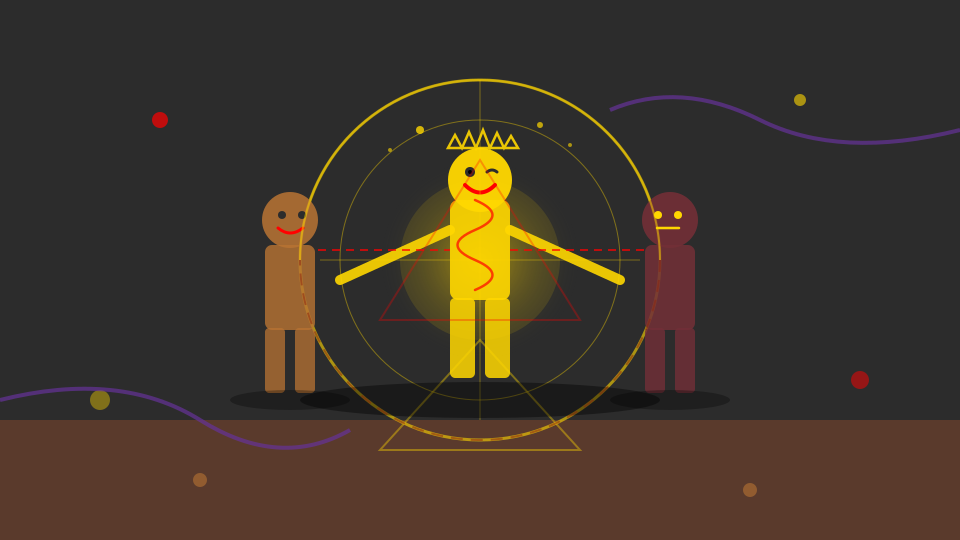
These four figures — Larry the physics professor, the Comedian, the Jokerman, Langthangpa the non-smiling teacher of non-seriousness — are all pointing at the same thing from different angles. They are positions on a single axis: the relationship between the weight of life and the posture we adopt to carry it.
II. The serious man is hunting the wrong animal.
Albert Camus gave this the right name in The Myth of Sisyphus (1942): the absurd is the gap between our demand for meaning and the silence we receive in return. The universe is not hostile. It is simply not responding to the specific question Larry Gopnik keeps asking. What the serious man cannot tolerate is this: that the silence is not a sign of failure, but the baseline condition. The universe has never been in the meaning-delivery business. We are the only species that is surprised by this.
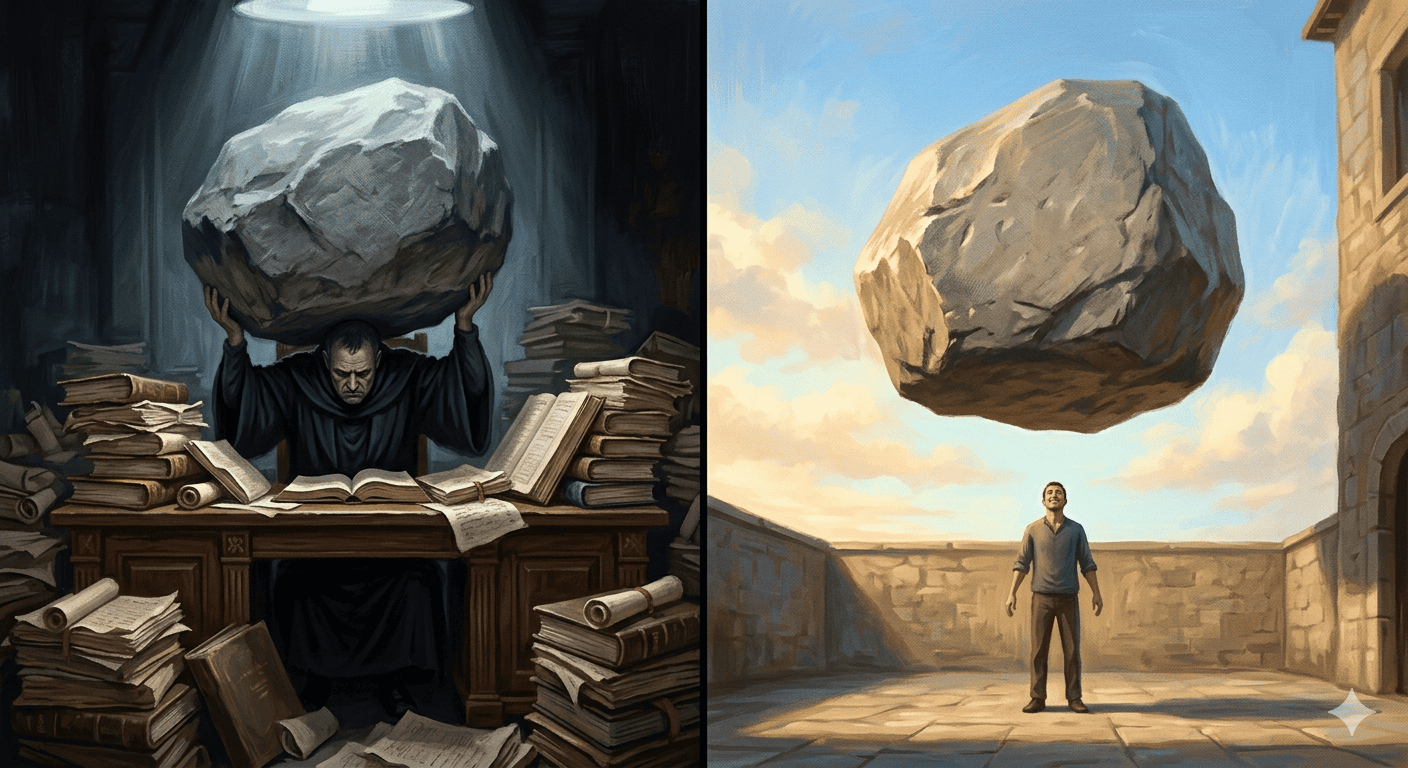
Camus’s fix is the absurd hero — Sisyphus, who knows the boulder will roll back down, who knows the task will never resolve, and who goes back down the hill to pick it up again anyway. He does not do this because he has found a rule. He does it in spite of there being no rule. Camus says we must imagine Sisyphus happy. This is not a comforting lie. It is a technical description of what happens when you stop demanding that the universe answer you and start living in the silence without converting it into an emergency.
Larry cannot do this. He keeps the emergency alive because without it, he would have to live without the promise of a resolution. The serious man needs the crisis to remain legible — it justifies the seriousness. The alternative is not relief. The alternative is the much harder work of existing without a verdict.
III. Seriousness as attachment.
Shunryu Suzuki, in Zen Mind, Beginner’s Mind (1970), introduced the idea of shoshin — the beginner’s mind that encounters each moment without the freight of accumulated positions. In the beginner’s mind there are many possibilities; in the expert’s mind there are few. The Zen take on seriousness is that it is, almost always, attachment to a particular version of the self. I am serious about my reputation. My professional stature. The version of me that lives in other people’s heads. The version I was defending when the argument happened.
This is not a character flaw. It is nearly inevitable. The architecture of the self requires some continuity, some narrative thread. But taken too far — and the serious man always takes it too far — the self becomes a monument to be protected rather than a flow to be inhabited. The monument requires defense. Defense requires seriousness. Seriousness requires emergency. And so it goes.
The Jokerman has noticed that the monument is not quite solid. He has pressed his hand against the impressive stone wall and felt it move slightly. This does not mean the wall is not real. It means it is not what he was told it was. And once you know that, the defensive crouch can relax by a few degrees. Not dissolved — relaxed. That is enough.
IV. Irony as the lever.
The trickster runs through every mythology — Hermes, Loki, Coyote, Anansi, the Fool in Lear. What the trickster does is not mock tragedy. The trickster acknowledges the tragedy and then discloses the angle from which it also looks like a comedy. I see it. I see myself seeing it. I see the gap between the story I am telling and the story that is actually happening. That recursion is the room the joke lives in.
Tragedy and comedy, at their deepest, are the same events told from different positions. The difference is not the events — the suffering is equally real in both — but the proximity of the narrator to the script. The tragic narrator is inside the script, convinced that this scene is the culmination of everything. The comic narrator is one step outside, able to see that every scene believes itself to be the culmination of everything.
When you can see your own tragedy from that second position — without denying the first, without anesthesia — you have arrived at something Kierkegaard would have called irony and Trungpa would have called crazy wisdom and Langthangpa, presumably, would have demonstrated by remaining absolutely expressionless.
V. (Coda) Geological time.
When the weight of being a very serious person is crushing the sternum, there is a practice that helps. Zoom out. Not to nihilism, not to nothing matters — that is the serious man’s escape route dressed up as philosophy. Zoom out to the actual scale. The fourteen billion years it took for atoms to arrange themselves into the brain that is, right now, treating a reputational inconvenience as a civilizational emergency. The Cambrian explosion. The five mass extinctions. The fact that the dinosaurs had no idea.
The point is not that your suffering is small. The point is that the urgency to be relentlessly, performatively serious about it is one of the patterns the universe will dissolve without consulting you. G.K. Chesterton said it better than anyone: angels can fly because they take themselves lightly. The angel does not deny gravity. The angel simply hasn’t bought the seriousness.
Life is heavy. Terminal, frequently unjust, full of real grief that deserves to be named without euphemism. The serious man is right about all of this. He is only wrong about what it requires. Gravity is the correct response to the weight of being alive. Seriousness — the rigid, certainty-demanding, rule-hunting posture — is what we add on top of gravity when we forget that the weight and the posture are two different things.
Live with gravity. Walk with lightness. Langthangpa, apparently, understood this completely.
He just never smiled about it.
Further reading
- Chögyam Trungpa — Cutting Through Spiritual Materialism (1973)
- Shunryu Suzuki — Zen Mind, Beginner’s Mind (1970)
- Albert Camus — The Myth of Sisyphus (1942)
- G.K. Chesterton — Orthodoxy (1908)
- Søren Kierkegaard — The Concept of Irony (1841)