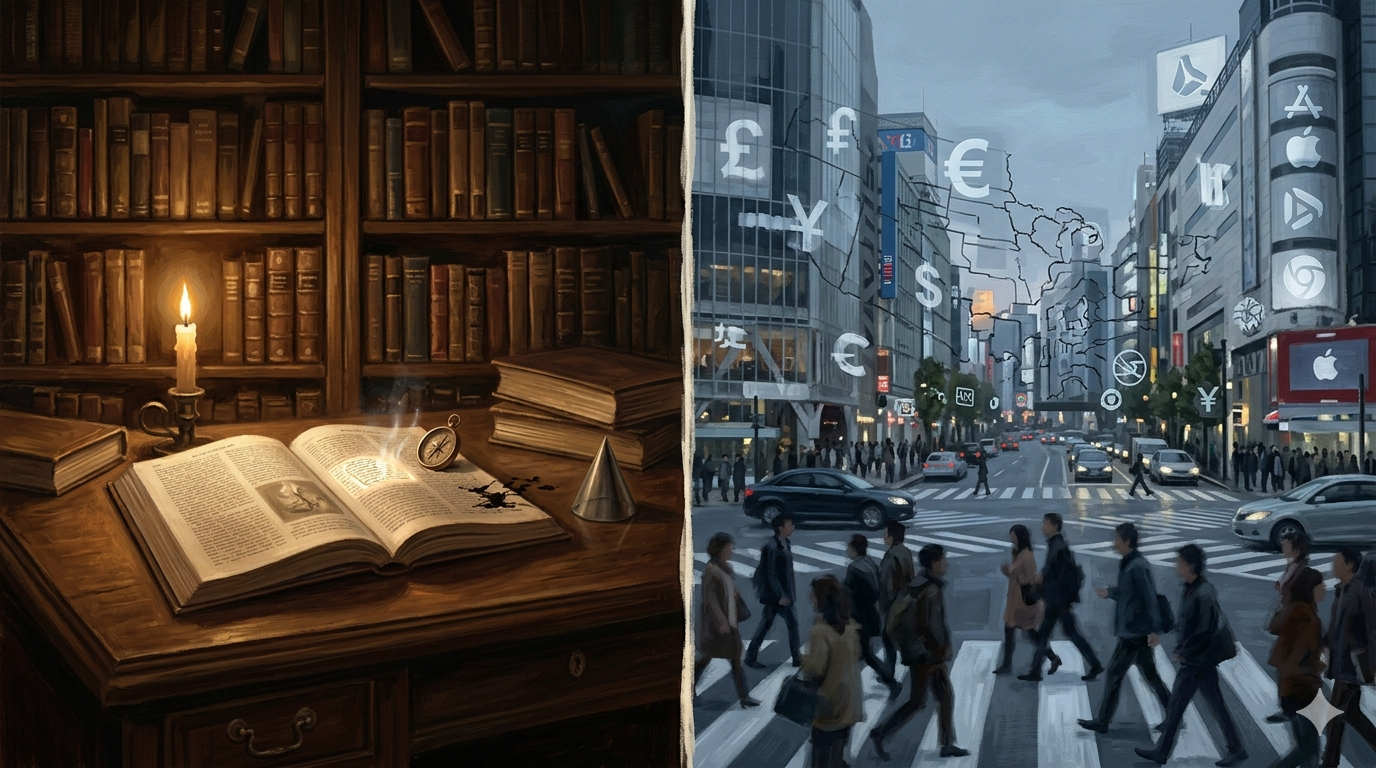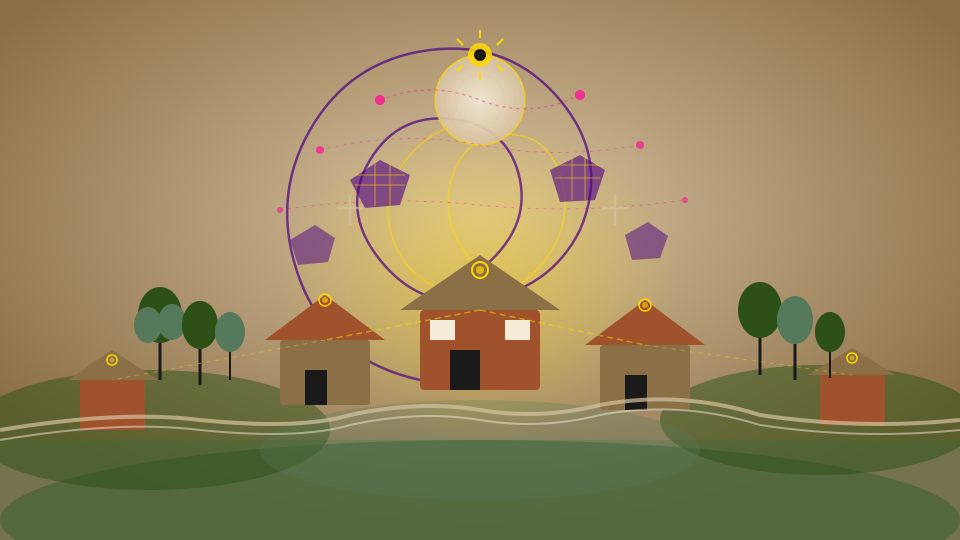
In 1940, Borges published what is not quite a story. “Tlön, Uqbar, Orbis Tertius” — collected four years later in Ficciones — begins with the discovery of a reference to a country, Uqbar, in a slightly variant edition of an encyclopedia. The country does not appear in any other edition. The country, in any verifiable sense, does not exist. This leads, in the usual Borgesian manner, to the discovery of forty volumes describing an entire planet — Tlön — whose existence is similarly unverifiable, but whose philosophers, languages, and physics are described with the patience of something that has had centuries to develop. And then Tlön begins to appear in the physical world. A compass. A metal cone. By the story’s final pages, the fictional world has begun to overwrite the actual one: scholars study Tlönian history, children are taught its geography, a generation arises for whom Tlön is more real than the country they were born in.
Borges in 1940 called this a fantasy. We, in 2026, might call it a Tuesday.
I. The documentary
The mechanism Borges describes is not metaphor. It is the operating system of human civilization. Money is a shared fiction — paper and electrons whose value exists only in the minds of everyone who agrees, simultaneously, to believe in it. Nations are lines on a map that nature does not draw; they exist because enough people act as though they do, which makes them, in every practical sense, real. Corporations are legal persons that no anatomy class will ever dissect. These are not lies in the cynical sense. They are what the historian Yuval Noah Harari, in Sapiens (2011), calls intersubjective realities — things that exist not in the physical world, and not merely in individual minds, but in the shared space between minds, sustained by mutual belief and collapsing the moment that belief is withdrawn. They are, in other words, exactly what Tlön was: fictions that became real because enough people agreed to treat them as such.
The question this raises is not why do we believe in fictions. The question is why would we ever have stopped.
II. Evolution selected for utility, not truth
The baseline answer is biological. Donald Hoffman’s The Case Against Reality (2019) argues that our perceptual systems were not designed — were not selected — to show us the world as it actually is. Quantum fields, probability waves, the void: these are what is actually there, and a creature that perceived them with full accuracy would be paralyzed before it could eat or mate. Evolution selected for the desktop, not the hardware. The solid objects, stable boundaries, and identifiable causes we perceive are interfaces — useful simplifications of an unsurvivable complexity, kept in place not because they are true but because organisms that used them survived and reproduced.
We are, at the most basic level, already living in a model. The narrative animal is not an aberration that developed on top of some pristine reality-perceiving creature. The narrative animal is what the species always was. The question of whether we are full of BS is like asking whether water is full of hydrogen: technically yes, but the answer misses the more interesting structural point.
III. The miracle and the catastrophe
Here is where Harari’s argument sharpens into something almost vertiginous. The decisive event in human prehistory — the development that allowed Homo sapiens to outcompete every other human species — was not better weapons, larger brains, or even language in the general sense. It was the specific capacity to speak fluently about things that do not exist. A chimpanzee can cooperate with chimpanzees it knows personally. A human can cooperate with millions of strangers it will never meet, around resources that do not yet exist, for goals it will not live to see completed — because it can hold, and transmit, and update, and defend a shared story about what the cooperation is for.
The same mechanism built the cathedral and the concentration camp. Both required coordinated fiction at scale — a story about God’s will and a story about racial purity, both precise enough to organize mass behavior and resilient enough to resist correction by immediate experience. The capacity is not good or evil. It is the socket. What gets plugged into it is a separate question.
IV. When the fiction supersedes the territory
The crisis — the specific contemporary crisis this post is circling — arrives at the moment when the narrative layer thickens beyond the point where it can be corrected by the reality it was supposed to model.
Speculative bubbles are the financial version: the representation (price) has decoupled from any underlying production, and the fiction sustains itself not by tracking value but by the shared belief that others will continue to believe it. Post-truth politics is the civic version: a claim is “true” not because it corresponds to events but because it serves the tribe, and the tribe’s continued coherence requires it. The echo chamber is the epistemic version: shared reality fragments into competing fictions, each internally consistent, none correctable by evidence, because evidence itself has become a tribal badge. And generative AI is, among other things, an industrialization of the fiction layer: a machine for producing Tlönian artifacts at scale, whose outputs colonize the information environment exactly as Borges’s hrönirs colonized the physical one.
Jean Baudrillard called this the hyperreal: the simulation preceding and producing the real, rather than the other way around. Hannah Arendt, in Truth and Politics (1967), identified the mechanism by which political narratives override reality without anyone needing to lie outright — you only need to make the truth inconvenient to assert, and inconvenience does the rest. Neither of them was describing a future. Both were describing a tendency that was already fully operational in the institutions around them.
The American idiom full of BS turns out, on inspection, to be the most accurate description we have produced in English of the human condition. We are, individually and collectively, made of stories. The people who understand the mechanism most clearly tend to become novelists, tyrants, or stand-up comedians: the novelists hold the frame up to the light; the tyrants control the projector; the comedians name the machinery out loud, to laughter, which is the only form of exposure the theater will tolerate without shutting down the show.
George Carlin made this his life’s work. His central thesis — sharpened over fifty years into something close to a philosophy — was that language is the primary instrument of social control, and that BS is not a byproduct of the system but its load-bearing wall. Strip the euphemisms, the inflated abstractions, the carefully chosen frames, and you find not hidden truth but the void the BS was always covering. His comedy was an act of naming. The audience laughed because recognition is the only honest response when someone says clearly what everyone already knows but agreed not to say.
The honest position is not to try to escape the theater. Escape is not on offer. The theater is not a prison you were put into; it is the structure of the mind itself, operating normally. What is on offer is the flickering awareness — intermittent, costly, easily lost — that one is inside a theater at all. That the objects in the room might be hrönirs. That the map and the territory have been exchanging identity for a long time now.
Blues Traveler closed the argument in 1994 with a song called Hook. It is a pop song that tells you, explicitly, in its own lyrics, that the hook is manipulating you — and then the hook keeps doing it anyway. The audience knows what is happening. The audience keeps singing along. That is not stupidity. That is the structure of minds that evolved for narrative, operating normally. The theater is very bright. The hook is very good. And somewhere, the lights outside are still on.
Further reading
- Jorge Luis Borges — Ficciones (1944)
- Yuval Noah Harari — Sapiens (2011)
- Donald Hoffman — The Case Against Reality (2019)
- Friedrich Nietzsche — On Truth and Lies in a Nonmoral Sense (1873)
- Hans Vaihinger — The Philosophy of As-If (1911)
- Harry Frankfurt — On Bullshit (2005)
- Jean Baudrillard — Simulacra and Simulation (1981)
- Hannah Arendt — Truth and Politics (1967, essay in Between Past and Future)
- Douglas Hofstadter — I Am a Strange Loop (2007)
- Blues Traveler — Hook (1994, on Four)