The argument that keeps failing is not the argument about which system is better. It is the assumption, buried inside that argument, that the categories are stable — that capitalism, socialism, mercantilism, feudalism refer to four distinct, mutually exclusive arrangements, and that the story of modern history is one of them winning.
They have not been stable for five centuries. What has been stable is something more basic: there is a surplus, and someone claims it. The form the claiming takes has changed. The claiming has not.
I. Power as constant, mechanism as variable
Every era invents a vocabulary for what the surplus is — rent, bullion, wages, planning output, attention — and a vocabulary for who the new lord is: the landholder, the merchant prince, the industrialist, the commissar, the platform. These vocabularies feel definitive when they are coined. They age badly. Nobody in 1600 was thinking in the categories of 1800. Nobody in 1900 predicted the categories of 2000. The categories are snapshots; the underlying relation is the film.
This is what a purely ideological reading of economic history consistently misses. The argument between Smith and Marx is a family argument: both are describing the same surplus-claiming relation, disagreeing about who deserves the surplus and what to do about the inequality. Neither is describing a world without extraction. Neither could: there wasn’t one.
II. Five eras, one impulse
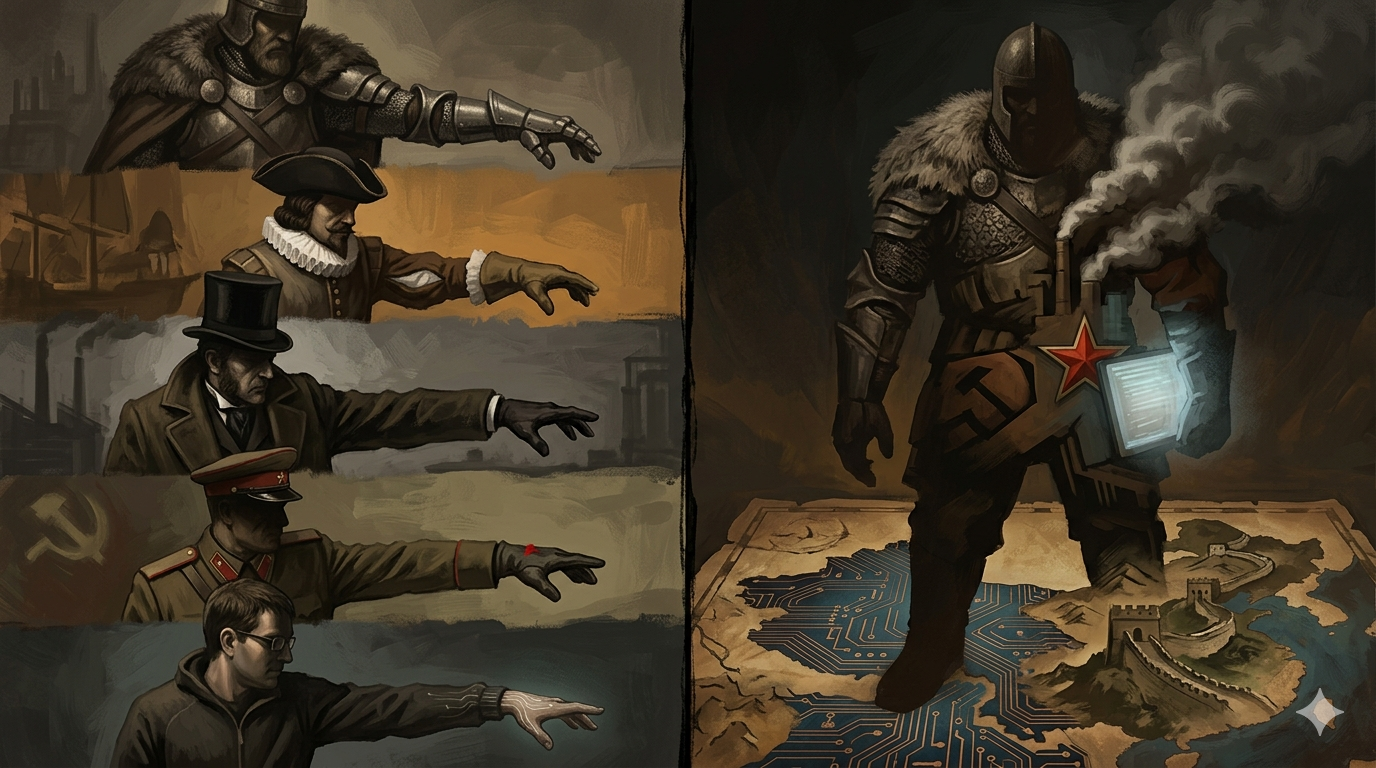
The mechanism has changed shape five times.
Feudalism. Wealth is land, and land is finite. The lord owns it; the serf works it, in exchange for protection and the right to exist. Political power and economic production are the same thing — there is no separation between the crown and the factory because there is no factory. The system is a closed loop, low-velocity, slow to change.
Mercantilism. The nation-state emerges, and with it the idea that trade is war continued by other means. Wealth becomes gold, and gold is zero-sum: what the Spanish crown accumulates, the Dutch crown does not. The merchant class rises, but remains a tool of the state — trading posts as forward operating bases, colonies as resource pools and captive markets. Eric Williams showed in Capitalism and Slavery (1944) how the mercantile extraction of the Atlantic trade was not a precursor to industrial capitalism but its literal foundation. The categories were already nested.
Industrial capitalism. The factory, the joint-stock company, capital itself as a self-expanding value. Wealth becomes liquid and explosive. The social contract shifts from loyalty-to-a-lord to wages-for-labor — a genuine improvement in human dignity, and a genuine innovation in the mechanism of extraction: now the worker is formally free, and the surplus is appropriated through the wage relation rather than through direct coercion. An unprecedented expansion of productive capacity, and an unprecedented expansion of ways to be exploited.
Socialism as state capitalism. The contradictions of industrial capitalism — the inequality, the boom-bust cycles, the class antagonisms — generate the experiment of seizing the means of production. In practice, in the USSR, in Maoist China, in Cuba, this becomes what might be called government capitalism: the state running the economy as a single giant corporation. The mechanism is managerial. The underlying extraction — a planning class appropriating surplus from a working class — does not vanish. It changes uniform, and removes the option to quit.
Techno-feudalism and the new mercantilism. The hybrid present. Yanis Varoufakis’s Technofeudalism (2023) names the first half: the new lords do not own factories. They own the digital infrastructure — the cloud, the marketplace, the algorithm — on which all commerce now occurs, and they collect a rent on every transaction. Amazon does not make the goods sold on Amazon. It charges the people who make goods to access the people who buy them. The surplus flows to the infrastructure owner, not the producer. Meanwhile, states have returned to mercantilism with twenty-first-century instruments: weaponized supply chains, semiconductor export controls, energy dependencies treated as strategic assets. The goal is no longer only profit. It is technological sovereignty. Economic policy is a tool of geopolitical warfare, again.
III. The big lie about China
The lie is not that China is good. The lie is the assumption that China must be on a path the West has already walked — that it will eventually converge to liberal democracy and market capitalism, or eventually collapse under its own contradictions, because those are the two endings the Western template offers.
China is running all five games simultaneously. It uses capitalist mechanisms — the market, the joint-stock company, the profit motive — to drive innovation and growth. It uses state-driven mercantilism — industrial policy, currency management, subsidized national champions, weaponized export dependency — to secure global position. It uses high-technology infrastructure — the surveillance apparatus, the social credit architecture, the platform governance regime — for internal cohesion in a way that resembles a distributed, soft techno-feudalism.
None of these three is novel in isolation. The novel move is running them without the requirement that they cohere into a single ideology.
The West reads this as contradiction. From inside the template, it has to be: a system cannot be capitalist and socialist and feudal at the same time. Branko Milanović’s Capitalism, Alone (2019) breaks this open with the distinction between political and liberal capitalism — China being the clearest instance of the former, organized around state direction and managed hierarchy rather than formal political pluralism. Yuen Yuen Ang’s China’s Gilded Age (2020) shows the synthesis at the institutional level, in granular detail. Neither book defends the system. Both establish that it is a system, not an aberration awaiting correction by history.
The harder Western mistake is not misjudging China. It is believing that the twentieth-century vocabulary still describes the twenty-first-century Western economy. The United States is also running the games simultaneously — platforms collecting rent, states weaponizing technology policy, the financialization of productive assets closely resembling a new form of extraction the old categories cannot name. The synthesis is already here. The categories just have not updated.
IV. Cambalache as the only honest category
In 1934, in the middle of an Argentine decade defined by electoral fraud, economic collapse, and the whiplash between competing ideological certainties, Enrique Santos Discépolo wrote a tango he called Cambalache — the word for a junk shop where incompatible things have been thrown together and labeled as if they all had the same value. The song’s argument is that the modern world has itself become a cambalache: that good and bad, true and false, the honest and the crooked, are no longer sortable, because the machinery that was supposed to sort them has been broken on purpose, and whoever broke it got rich on the debris.
Siglo veinte, cambalache / problemático y febril — Twentieth century, junk shop, problematic and feverish. Que el mundo fue y será una porquería, ya lo sé — That the world was and will be a mess, I already know. En el mismo lodo, todos manoseados — In the same mud, everyone’s been handled.
Discépolo named in 1934 what we are still trying to name. The post-Cold War promise was that history had ended, the categories had won, the right system had been identified. What happened instead is that all the systems merged into a cambalache — a junk shop where feudal rent, mercantile extraction, capitalist accumulation, and state management all operate in the same building under different signs.
The twentieth-century critique of categorical chaos is the twenty-first-century operating environment. The cambalache is not a metaphor anymore. It is the building we live in, and everyone managing it is collecting a fee to let you stay.
Further reading
- Yanis Varoufakis — Technofeudalism: What Killed Capitalism (2023)
- Cédric Durand — Technofeudalism (2020)
- Branko Milanović — Capitalism, Alone (2019)
- Yuen Yuen Ang — China’s Gilded Age (2020)
- Eric Williams — Capitalism and Slavery (1944)
- Enrique Santos Discépolo — Cambalache (1934)