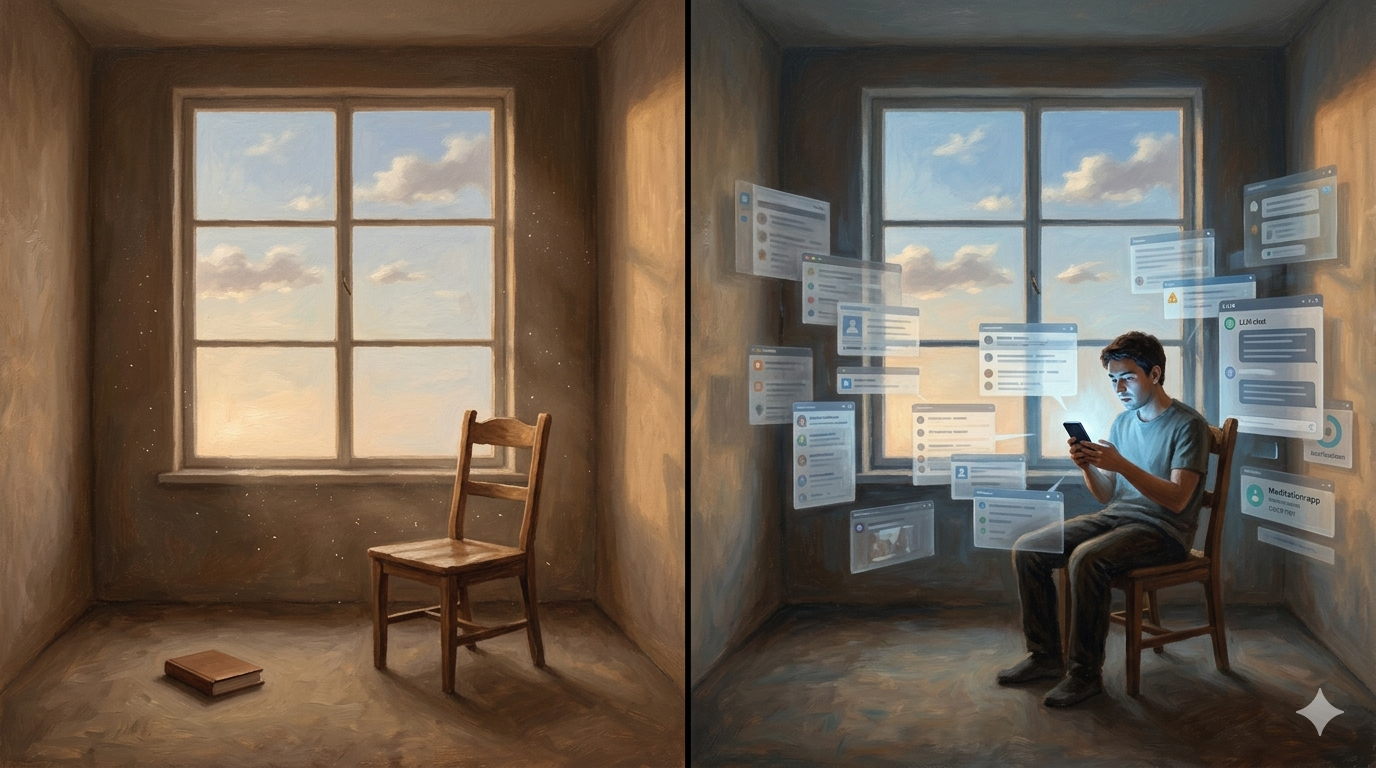
In 1654, in a fragment now numbered 139 of the Pensées, Pascal wrote a sentence that has been quoted so often it has lost most of its weight, and it is worth taking down from the shelf and looking at it again: all of humanity’s misery comes from a single fact, namely, that we are unable to sit quietly, alone, in a room.
Three hundred and seventy years later we have built the most extraordinary device in human history for the express purpose of ensuring no one ever has to.
The smartphone is not the disease. It is the latest and most refined anesthetic in a very long line — radio in the 1920s, television in the 1950s, the always-on cable channel in the 1980s, the social-media feed in the 2000s, the phone in our pocket since 2007 — each one delivering more information, more entertainment, more connection, and, more importantly than any of these, an ever-more-frictionless way to not be alone with ourselves. The phone is the asymptote of a long curve. Pascal saw the shape of this at radio’s resolution. Postman saw it at television’s. Sherry Turkle saw it at the laptop’s. We see it at the phone’s. The question worth holding is what comes next, and whether anything could even be more frictionless than what we have already built.
What we are addicted to, on this reading, is not the device. The device is only the syringe. The addiction is to the avoidance. And the bullet we are dodging is the suspicion, half-formed and half-buried, that reality without the noise might be indifferent, empty, and overwhelming, all at once.
I. The anesthetic, evolving
Each medium kept the promise. Radio brought voices into the kitchen. Television brought the world into the living room. Cable brought a channel for every subculture. The feed brought, eventually, every person you have ever known and a few thousand you have not. Each step delivered exactly the goods it advertised — and, in the same gesture, delivered the hidden good that made it succeed: one more place to put attention that is not the room you are sitting in.
The phone closed the last gaps. It is the medium that follows you to the bathroom and the bedside table. It is the medium that fills the elevator ride, the line at the coffee shop, the sixty seconds before the meeting starts. The slack in a day used to be where the room got quiet. The phone has paved over the slack. We do not have fewer moments alone with ourselves than Pascal did. We have effectively zero moments, by design and by reflex, unless we go out of our way to engineer them.
The medium kept changing. The impulse did not. Pascal saw the impulse without the device. The device only made the impulse easy.
II. What is “reality,” anyway?
There are at least two reals. One is constructed — the stories we tell ourselves about who we are, the social roles we inhabit, the curated feeds, the inherited identities, the LLM-completed sentences, the clean narrative arcs we lay over the messy weeks. This is the territory I have been writing about for most of this season: the Borgesian map of the world, the place we actually live.
The other is primordial. The wordless, immediate, unstoried fact of being. Before interpretation. Before identity. Before language gets its sentence around it. This is what the contemplative traditions point at when they say Buddha-nature, or the uncreated, or simply what is.
The constructed reality is comfortable, because we shape it. The primordial reality is uncomfortable, because it does not bend. Phones, feeds, conversation, projects, ambitions — all of these keep us in the constructed reality. They do not keep us there because the constructed is bad and the primordial is good. The cliché in that direction is wrong, and the post that takes it seriously will mislead anyone it persuades. They are both real. They have different temperatures.
The primordial reality is hot to the touch. It is the temperature of mortality. It is the temperature of being a finite, frightened animal in a universe that is not addressed to it. We don’t avoid it because we have been tricked. We avoid it because, on the encounters we have had with it, it has hurt.
Of course we have built a device that makes the avoidance easier. We were going to build it. Pascal would have ordered one.
III. The paradox of the cure
The natural reaction once you see this is the next move you would expect: all right then. Meditate. Quit the phone. Do the work. And here is the trap.
If meditation is another project of self-improvement, it is just one more layer of the constructed reality — the ego congratulating itself on being the kind of person who works on its ego. Chögyam Trungpa called this spiritual materialism (the term I borrowed in the Chestnut Tree post for a related point). It is the ego’s habit of consuming spiritual experience as another asset class. The wellness routine, the streak, the meditation app with the calendar, the retreat that doubles as content, the “I have been doing the work and it has changed me” posts — these are not, on inspection, very different from the phone. Same anesthetic, different costume.
The harder Trungpa point — the non-dual one, articulated in The Myth of Freedom and elsewhere — is that the structure of “I take the pill to fix me” is itself the mistake. There is no separate user on one side and pill on the other. There is no broken-self being-fixed-by-meditation. There is only the happening, which has been happening the whole time, which the meditation does not produce; it sometimes lets it be visible. We did not, on this reading, take the pill. We have been the pill being taken.
This sounds opaque. It is not, in practice. It is the moment when the person who has been silently grading their meditation session for fifteen minutes notices that they have been grading their meditation session for fifteen minutes, and the noticing is itself the thing the session was supposed to deliver. The noticing was free. The grader was the obstacle.
IV. The clouds and the sky
There is an old contemplative image, one that I think turns out to be one of the cleanest formulations of Buddha-nature I have encountered in any tradition. The phone, the ego, the anxiety, the addiction, the fear of mortality, the to-do list, the running mental arithmetic about how the meditation is going — all clouds, moving through a sky. The clouds are not, on inspection, the problem. The problem is that we have been so absorbed in cataloguing the clouds that we have forgotten we are the sky.
The sky is not afflicted by what passes through it. This is true now. It was true an hour ago, when the day was particularly difficult. It was true at three in the morning when the worst of the catastrophizing was at full volume. It will be true at the end. The cataloguing of clouds happens in the sky. Awakening, in this view, is not the acquisition of something new. It is the noticing that what we already are has not been missing.
This is the synthesis. We use the noise to escape the silence. Meditation is not a way out of the noise. Meditation is sometimes the moment we notice that the noise and the silence are happening in the same place, and that the thing we were trying to reach is the thing we have been standing on the whole time.
A line nobody seems to have actually said
There is a line that gets attributed to Franklin, and to Thoreau, and to half a dozen others who almost certainly did not say it: some people die at twenty-five and are not buried until seventy-five. The attribution does not survive scrutiny. The thing it describes keeps happening, which may be why we keep reaching for someone famous to have said it.
Thoreau did write, in Walden, that the mass of men lead lives of quiet desperation — the verified version of roughly the same idea. The desperation is the half-buried suspicion that the silence the phone has paved over is exactly the place where the rest of one’s life is supposed to start. We pave it over because we do not believe we can survive an encounter with it. We have evidence for that belief. Some of the encounters were genuinely bad.
The honest move is not, I think, to delete the apps. The honest move is to notice, every now and then, the silence we are working so hard to not be in — and to consider that it is not, on inspection, the emergency we have been treating it as. To consider that the bullet we are dodging is the same bullet the chestnut tree was diagnosed for, the same bullet the eternally-busy worker is too busy to register, the same bullet the optimization engine optimizes around. One bullet. Many costumes.
There is a sky behind the clouds. It has not gone anywhere.
Further reading
- Blaise Pascal — Pensées (1670)
- Chögyam Trungpa — Cutting Through Spiritual Materialism (1973) and The Myth of Freedom (1976)
- Shunryu Suzuki — Zen Mind, Beginner’s Mind (1970)
- Pema Chödrön — When Things Fall Apart (1996)
- Marshall McLuhan — Understanding Media (1964)