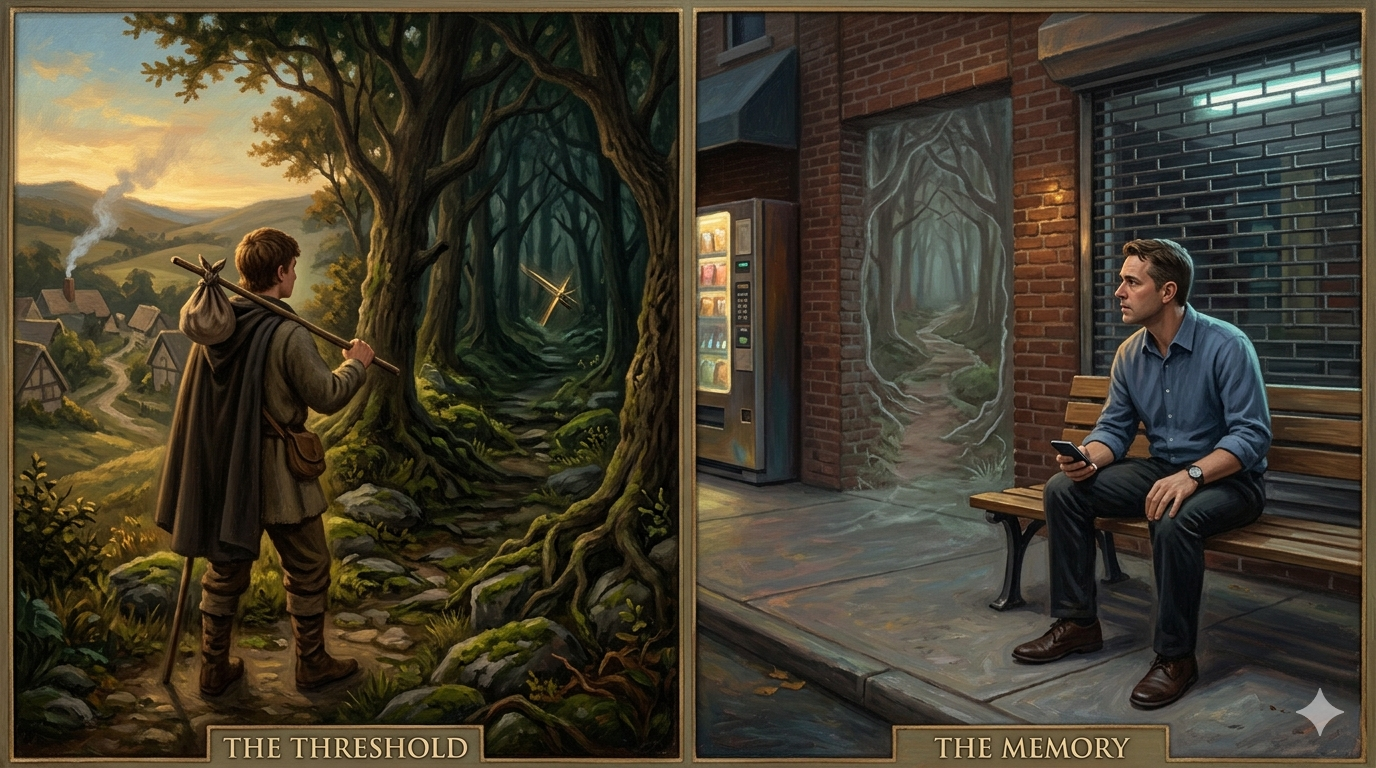
Almost everyone past forty knows the type. The man still operating, in some quiet operative sense, as if he were twenty-four. The woman whose romantic life consists of the same three patterns it consisted of in 2009. The friend whose career has had the right surface motion — promotions, titles, perfectly photographed dinners — but whose inner question, who am I when no one is watching, has not seriously been asked since adolescence. They are not failures. Some of them are extraordinarily successful. They are simply, in the part that matters, not yet adults.
Jung had a name for them. So did Campbell, in a different vocabulary. So did the anthropologists who studied initiation rites in cultures the West tends to dismiss as superstitious. The pattern they all converged on is roughly this: there is a developmental window — call it the late teens through the late twenties, give or take — in which certain psychic tasks are meant to be done. Separation from the parental psyche. The construction of an individuated self. The first acceptance of mortal limit. The shift from what does the world owe me to what do I owe the world.
If those tasks are not completed in the window, they do not simply remain pending. They calcify. The probability of completing them later does not drop to zero, but it drops to miracle — in the technical sense, not the religious one. A miracle here means: requires a crisis large enough to crack the patterns that kept the work from happening in the first place. Most people who miss the window quietly stay missed.
I have wanted to write this post for a long time and have always flinched. It is the most personal of the diagnoses I have been working through on this blog. It is also, I think, the one that most directly explains the others.
I. The window — what is supposed to happen
Joseph Campbell wrote The Hero with a Thousand Faces in 1949, after twenty years of cataloguing initiation myths from every culture he could read. The structure he found is so consistent it feels suspicious. Call to adventure. Departure from the familiar. Crossing the threshold. Trials. The encounter with what was hidden. Return, transformed. The cultures Campbell studied disagreed about almost everything else, but they all agreed that there is a moment when the young person has to leave home — physically, psychically, or both — and pass through something difficult enough that the who who comes back is not the who who left.
Erikson described the same window in clinical-developmental terms — identity vs. role confusion — and Jung described it as the central work of the first half of life: building an ego strong enough to hold an adult life. The vocabularies disagree. The diagnosis does not.
Every traditional culture had ritual containers for this passage. Vision quests. Initiations. The first long absence from the village. Military service before it was a career path. Marriages that were real transitions rather than legal paperwork. The ritual container did two things at once: it forced the work into a defined window, and it gave the community a vocabulary for whether the work had been done. The young man who came back from the woods having seen the bear was a different category of person than the young man who had not gone.
Modern life has very few such containers. The window stays open longer, and is also less protected.
II. What happens when the window is missed
Marie-Louise von Franz’s Puer Aeternus is still the definitive Jungian analysis of what happens when the window closes without the work being done. The puer aeternus — the eternal child — is the archetype, and von Franz’s lectures, originally delivered in 1959 and 1960, name the type with frightening precision.
The puer is not a stupid man, or a lazy one. He is often charming, often gifted, often the most interesting person at the dinner. His fatal feature is that he has not crossed the threshold. His commitments are all provisional. His work is brilliant but unfinished. His relationships are all almost. He is forty-five years old and still re-enacting, in his marriage and his workplace and his relationship to his own children, the unresolved drama of his family of origin. The puella aeterna is the same archetype in another wardrobe.
None of this is a moral failure. It is what a system does when it skips a phase change. Water that has not yet boiled is not bad water. But it is not steam, and pretending it is steam will not get the engine to move.
III. Why later repair is so hard
There are at least three reasons.
The first is neurobiological. The late-teens-through-mid-twenties period of intensive synaptic pruning ends. After that, the brain shifts from building patterns to optimizing existing patterns. New patterns are still possible — the lazy “neuroplasticity ends at twenty-five” line is overstated — but they are markedly more expensive. The cost of becoming someone genuinely different, after a certain age, has been paid by the developing brain in the cohort that did the work earlier.
The second is identity. The longer you have been a particular kind of person, the more sunk costs you have in being that person. Friends who chose you for who you were. Habits of thought that survive because they are recognizable to you. A spouse, perhaps, whose marriage to you presumes you remain who you have been. To do the deferred work after forty is also to ask a great many people, often unfairly, to update their sense of you.
The third is the puer’s specific defense, which is the cleverest of the three. The puer insists that the avoided task wasn’t actually the task. I didn’t fail to commit; commitment is just a bourgeois fiction. I didn’t fail to individuate; individuation is just American self-help. The thing I avoided wasn’t a real thing. This is the move that makes the pattern self-sealing. Each year of avoidance both ossifies the avoidance and produces a more sophisticated argument that the avoided thing was not worth pursuing.
IV. The miracle, and what it usually looks like
When the work does happen late, it almost never happens by an act of will. It happens because something has gone badly wrong.
Illness. Addiction bottoming out. Divorce. The death of a parent — especially the parent whose unlived life was being unconsciously carried. The collapse of every external coping strategy at once. Jung’s hard line was that crisis is the only solvent strong enough to crack a defended ego still wearing the puer’s clothes.
The miracle is not magical. It is the moment the cost of avoiding the task finally exceeds the cost of doing it. That moment is not summonable on demand. It arrives, when it arrives, because life has stopped covering for the avoidance.
Many people simply die unfinished. This is the part of the diagnosis that is hardest to write out plainly. Not every story ends with the late awakening. The literature on the second half of life — James Hollis’s Finding Meaning in the Second Half of Life is the kindest version — is full of accounts of people who did the work in their fifties and sixties and reported, almost uniformly, that it was the only thing they ever did that turned out to matter. It is also full, by implication, of the people who never made it that far.
The expectations that keep the window invisible
There is a final twist, which is partly why I wanted to write this post now and not five years ago.
Modern culture has solved the problem of the missed window by quietly redefining the window out of existence. The vocabulary in circulation is you can change at any age, it’s never too late, the brain is plastic, growth is a lifelong project, success is a matter of mindset. These claims are not quite false. They are also, in the way they are deployed, the puer’s defense at civilizational scale. If development is always available, then the specific window Campbell and Jung were describing was never a real thing, and there is nothing in particular that has been missed by anyone.
The cost of this kindness is that people who have missed the window cannot see they have missed it. They keep applying the morning’s program to the afternoon’s life, in Jung’s image from Modern Man in Search of a Soul. Jung’s line is sharp: We cannot live the afternoon of life according to the program of life’s morning, for what was great in the morning will be little at evening. But the marketing of perpetual youth has made the morning’s program the only one available.
This is the same dynamic, at a different layer, as the medicalization of the chestnut tree and the eternally-busy worker as defense. The clinical-industrial complex names what is often an arrested developmental task as trauma, neurodivergence, anxiety, executive function. Sometimes accurately. Sometimes as a way of avoiding the harder, older Jungian reading: the door was open, you did not go through it, and it costs you everything to go through it now.
The honest question
If the window has closed and the crisis has not come, can it be summoned, or can it only be awaited?
Jung’s books give a model for the work. They do not — and the man himself was clear about this — give a model for making the work happen if the conditions for it have not arrived. That is the part of the diagnosis hardest to live with: the cost has to exceed the avoidance budget, and you cannot, by an act of will, run up the bill.
What you can do, perhaps, is stop helping the avoidance. Notice the place where the morning’s program is no longer matching the afternoon’s life. Stop the small frictionless distractions that keep the bill from arriving. Sit, occasionally, with the silence the puer has spent forty years avoiding. The crisis cannot be summoned. The avoidance can be, slightly, set down.
That is not the miracle. But it is the only honest preparation for one.
Further reading
- Joseph Campbell — The Hero with a Thousand Faces (1949)
- Carl Jung — Modern Man in Search of a Soul (1933)
- Marie-Louise von Franz — The Problem of the Puer Aeternus (1970)
- James Hollis — Finding Meaning in the Second Half of Life (2005)