The public conversation about AI and work is stuck on the wrong question.
“Will my job be replaced?” is the framing everyone reaches for, because it has a clean visual: a robot taking a specific seat. The headlines love it. Goldman: AI to replace 300 million jobs. McKinsey: half of all work activity automatable. The displacement frame promises an event — an announcement, a layoff, a press release — and the policy answers it suggests are familiar: retraining, universal basic income, regulation.
That scenario is not what is actually happening. And it is not what is going to hurt.
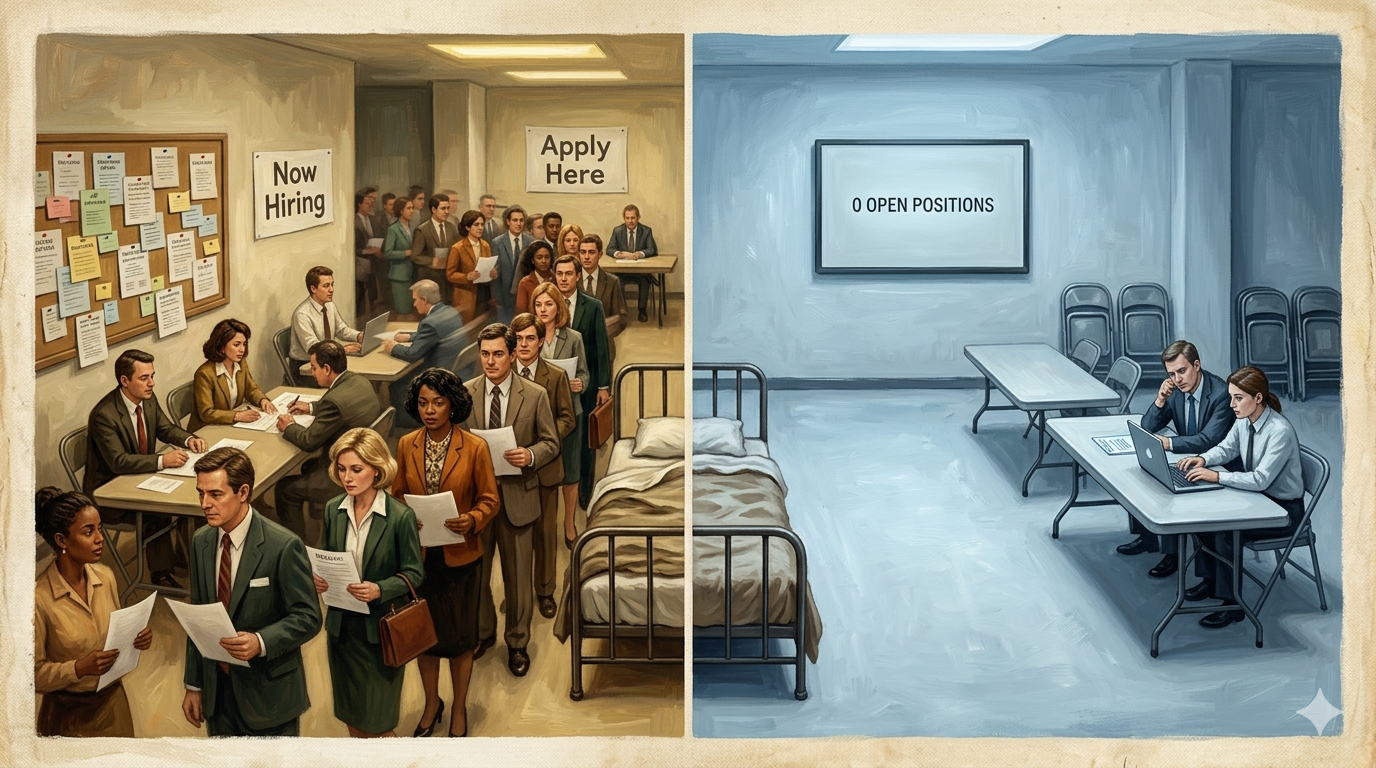
The real mechanism is quieter and harder to see. Companies are not, on the whole, firing humans and replacing them with machines. They are absorbing the new productivity into the people they already have, and then not hiring the next cohort. The work itself remains. The headcount required to do it shrinks. There is no announcement, no story arc, no event — just a hiring freeze that doesn’t end. The crisis is not “a world without jobs.” It is a world with plenty of work to do, and not enough jobs to go around to do it.
I’d like to call the thing by a more honest name. Not job displacement. Labor demand compression.
I. The framing trap
Why does the public debate keep reaching for the displacement frame? Because it has a visual, and a moment, and a verb. X was replaced by Y. The story arc is recognizable: the worker, the announcement, the redundancy package, the Vox explainer about retraining. It fits the way news reporting works.
Compression has none of that. There is no event. There is no replaced person. There is just a job opening that never appears. The new department that doesn’t get spun up. The team that absorbs the new product line without growing. The intern position that quietly dissolves between cohorts. The editor at a magazine that goes from twelve people to four people without anyone being fired — three editors quit over a decade, two retired, three were nudged into other roles, and the four who remain now do the work of all twelve, faster, with worse results, with assistance from tools that didn’t exist when the magazine was at twelve.
You can write a paragraph about that, but you cannot write a headline. The event is the absence of an event. That asymmetry is why the diagnosis keeps getting missed.
It also matters because the policy responses to displacement and to compression are not the same. Displacement asks for retraining and unemployment insurance. Compression asks for something harder: a re-examination of what employment is for, given that productivity and headcount have decoupled.
II. The task-based view of work
The cleanest way to see what is actually happening is to stop treating jobs as atomic units. They are not. A job is a bundle of tasks, and automation acts on the tasks, not the bundle.
Daron Acemoglu and Pascual Restrepo’s task-based modeling formalized this years before the LLM wave, in a long line of NBER papers and now in Power and Progress, the long-form version with Simon Johnson. Their model is simple and empirically careful: each occupation is a vector of tasks; each task has a degree to which it can be automated by a given technology; and what changes when a new technology arrives is not the number of jobs but the labor intensity of each existing job.
Run that through 2026 and you get the picture:
- Traditional displacement: a robot replaces a factory worker. The job is gone. (Visible. Headline-worthy. Already old news.)
- Task automation: an LLM handles a manager’s data entry, scheduling, status decks, summarization, first-draft writing, code review, customer-email triage. The “Manager” job still exists. It now requires sixty to eighty percent less human time. (Invisible until the next hiring round.)
If every job in a company sees a fifty-percent reduction in required labor due to task automation, the company does not fire half its staff. It just stops hiring the next cohort. Growth gets absorbed into existing roles. Senior people, who would normally be supported by junior hires, instead get tools. The job market shrinks even though “jobs” still exist.
The displacement headline misses this because it counts titles. The compression headline can’t be written, because it counts the absence of titles.
III. The productivity-employment gap
The reassurance from economic history is that this has happened before, and it has always been fine. The tractor displaced farmhands; manufacturing absorbed them. Manufacturing automation displaced factory workers; services absorbed them. New categories of work always emerge.
The reassurance has two premises, and the 2026 mechanism breaks both.
The first premise is speed of formation: the new work category appears fast enough relative to the displacement, so the surplus has somewhere to go. The second is labor intensity: the new category demands enough labor to absorb the surplus.
Carl Frey’s The Technology Trap walks through every major automation transition in the modern era and finds that whether the displacement was painful or not depended almost entirely on those two premises. The First Industrial Revolution was painful for sixty to eighty years before the new categories absorbed the surplus. The post-WWII automation wave was relatively benign because demand expanded faster than productivity. The transition we are in now resembles the First Industrial Revolution more than the post-WWII one, except faster.
What’s different now is that the new categories are themselves immediately compressed by the same automation that created them. A new industry forms — say, data labeling — and within months its labor intensity is being attacked by the next generation of the technology. The recursive automation makes the historical comfort story stop applying.
David Autor’s polarization work on the hollowing-out of middle-skill jobs documented the structure of this gap before the LLM wave. The middle of the labor market thins. The high-skill end and the low-wage service end thicken. There is no middle category to receive the displaced middle. The shape of the labor market becomes a barbell.
Daniel Susskind’s A World Without Work is the book this argument is, in some sense, arguing against the title of. Susskind’s actual analysis is closer to compression than to total displacement — what he calls frictional technological unemployment is essentially this argument — but the title points readers toward the wrong mental model. There will not be a world without work. There will be a world where the work that exists requires far fewer humans to do it.
Thomas Piketty’s Capital in the Twenty-First Century gave us the macro version of the same fact a decade ago: when the rate of return on capital exceeds the growth rate of the economy, the labor share of national income shrinks, and the capital share grows. Compression is what that macro fact looks like at the level of an individual hiring decision.
IV. The hollowed-out shape
When automation handles the task and the process, what is left for the human is usually framed in interview-blog vocabulary as strategic oversight, emotional intelligence, judgment, taste. All real categories. None of them scalable to the size of the existing workforce.
A thousand-person company cannot have a thousand strategic directors. It can have five. The middle layer — the project managers, the senior contributors, the analysts, the editors who actually moved work through the company — was the connective tissue. That tissue was made of a thousand small acts of judgment, none of which individually justifies a “strategic director” title, but which collectively constituted the company’s actual operating intelligence.
Compress the middle and you do not get a company of strategists. You get a company with five strategists, a thin band of low-paid task operators (who are themselves under compression pressure from the next generation of tools), and an automated middle. Everyone else has to find work somewhere else — in an economy where every other company has done the same thing.
There is a generational fairness corollary nobody is talking about clearly enough. Compression lands asymmetrically on the people who would have been hired into the now-collapsed middle. Senior workers are largely retained because they are useful for the strategist layer that survives. The displacement is silent and falls on people who were never employed in the first place — the un-hired generation. They will not be visible in unemployment statistics, because unemployment statistics count people who had jobs. They will be visible, twenty years from now, as the demographic cohort that never accumulated the career capital that the cohort before them accumulated by being hired into the middle of an organization that no longer exists.
The honest question
I am deliberately not closing this with a policy recommendation. UBI, retraining, anti-automation regulation, sovereign-AI industrial policy — there are arguments for and against all of them, and the post that takes a side on any of them is a different post.
The argument here is more modest, and harder to dismiss: we cannot fix what we cannot name. The displacement frame is the wrong frame. It produces wrong policies because it predicts a wrong event. The compression frame — jobs not being created, not jobs disappearing — is what is actually happening, and it has to be the starting point of any honest conversation about labor and AI in 2026.
The headlines will keep counting layoffs. The compression will keep happening between the headlines. The cohort that is never hired will not write the obituary of its own missing career.
Someone has to. We could start with the right name for the thing.
There is an old salsa from El Gran Combo de Puerto Rico whose chorus, written in 1972, puts this more honestly than any economics paper: No hay cama pa’ tanta gente. There is no bed for so many people. The work is plentiful. The places to do it from are not. We have known this, danced to it, sung along with it, for fifty-four years. We are only now realizing it was an economic forecast.
Further reading
- Daron Acemoglu & Simon Johnson — Power and Progress (2023)
- Carl Benedikt Frey — The Technology Trap (2019)
- Daniel Susskind — A World Without Work (2020)
- Thomas Piketty — Capital in the Twenty-First Century (2013)
- Cory Doctorow — “Tiktok’s Enshittification” (2023) — for the platform-scale version of the same value-capture dynamic