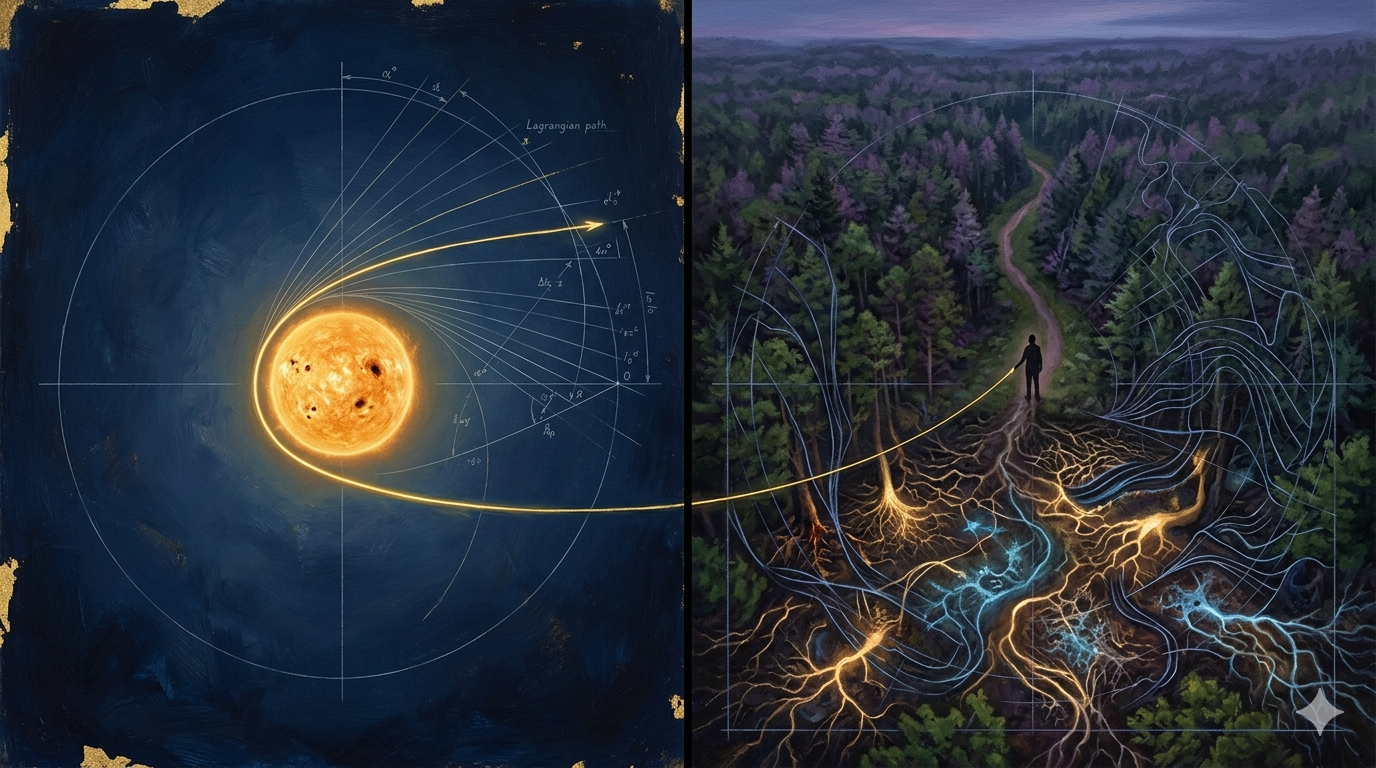
Watch a photon leave the surface of the sun and arrive at your retina. Eight minutes earlier it was inside a star; now it is inside an eye. Of all the paths it could have taken — and physics, in some literal interpretations, says it did take all of them — the one that resolves into your day was the one that minimized a quantity called action. Light finds the cheap route.
That is the most boring sentence you can write about a star. It is also the most honest, because the cheap route — the principle of least action — is the deepest pattern we know. Every clean equation in physics turns out, on inspection, to describe a system that doesn’t waste effort. Equilibria are basins. Orbits are minima. Gravity is a way of cleaning up.
If we follow the pattern up — from photons to bacteria, to brains, to civilizations — something strange happens. The pattern keeps holding. But it stops being clean. By the end, it stops being efficient at all. And that, I think, is the most interesting thing about us.
I. The constraint: physics as the rules of the game
At the lowest layer, the universe is an optimizer in a very flat sense. It minimizes. Light bends to find the fastest path. Soap films find the smallest area that spans a wire frame. Planets settle into stable orbits. The Lagrangian formulation of mechanics — written down by Lagrange after Euler after Maupertuis after Fermat — shows that almost everything in classical physics can be derived from one statement: nature picks the path along which a quantity called action is stationary.
This is the constraint layer. It is the rules of the game, written into the fabric. Whatever else happens on top has to respect this floor. You cannot break least action; you can only build on it.
The naive version of “the universe optimizes” stops here. And if it stopped here, we would live in a clean, dead world: pure equilibria, gradual heat death, no surprises. The universe would be a closed accounting system, and the books would balance.
They do not balance. Something else is going on.
II. The player: life as iterated optimization
When you go up one floor — from physics to biology — optimization stops being passive. It becomes a strategy.
Evolution is the cleanest example. Life is not a thing; it is an algorithm running on chemistry. Each organism is a guess at how to capture energy and reproduce in a particular niche. Most guesses fail. The survivors carry information about what worked, and the next generation guesses again. Daniel Dennett called this the substrate-neutral algorithm at the heart of biology — an iterative optimization process that doesn’t care whether it runs on DNA, on memes, or eventually on silicon. The fitness landscape is the cost function. The species is the search.
Cognition is the same trick performed at the speed of one organism’s lifetime. The brain is a high-energy organ — twenty percent of your basal metabolism — facing a flood of data it cannot process in full. Its solution is to compress: build a predictive model of the world, run reality through the model, and only attend to what surprises the model. Karl Friston’s free-energy principle makes the strongest current case for cognition-as-optimization: the brain, on this view, is a machine minimizing the long-run prediction error — the surprise — between its model and the world.
This second layer is about resource management. Doing more with less. Heuristics over exhaustive search. The map is cheaper than the territory, so the brain runs the map and bills you the difference.
If we stopped here, we would have a tidier story: physics constrains, biology economizes, cognition compresses. A whole tower of efficiency, all the way up.
But efficiency, taken alone, is also a trap.
III. The pivot: efficiency is fragility
A perfectly efficient system is a specialist. It is built for one set of conditions, with no slack, no redundancy, no spare capacity. Move the conditions and the specialist breaks. We have a name for organisms like this: extinct.
The honest universe is a noisy place. Entropy is real. Environments shift. Black swans land. In a world with surprise, pure efficiency is suicide — not on average, but at the margins, where the rare event lives. Nassim Taleb’s Antifragile is the longest book-length argument that what looks like waste in good times is the only reason a system survives the bad ones.
So real, durable optimizers do something subtler than minimize. They keep slack. They overprovision. They hold options. A liver carries reserve capacity it does not normally need. A forest carries seed banks for fires it cannot predict. A city carries idle infrastructure that turns out to be priceless the day something breaks. Slack is not laziness; slack is intelligence with a longer time horizon.
There is a deeper version of this argument, which is that complexity itself only exists because the universe is opportunistic. Ilya Prigogine’s Order Out of Chaos showed that life and similar dissipative structures arise precisely where a system finds an energy gradient and exploits it — building local order by accelerating global disorder. Stuart Kauffman’s At Home in the Universe makes the related case that self-organization happens at the edge of chaos: not in the regimes of perfect order or perfect noise, but in the messy strip between them. Geoffrey West’s Scale traces the same signature across organisms, cities, and companies: efficiency drives growth, but only opportunism — the willingness to break the curve, to invent something new — keeps the curve from collapsing.
The pivot, in other words: the universe runs on least action, but life runs on least regret.
IV. Synthesis: intelligence is the universe optimizing for complexity
Stack the layers and a picture forms.
- Physics uses efficiency to build structure.
- Biology uses efficiency to capture and store energy.
- Cognition uses efficiency to model the world.
- Intelligence uses opportunism to break out of any one model when the model fails.
We are not just inhabitants of an optimization engine. We are the part of the engine that has noticed itself optimizing — and that has begun, sometimes, to choose what to optimize for. We are how the universe holds slack on purpose. We are how a thing made of dust starts hedging.
That sentence is not poetic; it is structural. Every act of human imagination — a new metaphor, a new business model, a poem nobody asked for, a child’s question that derails the lesson plan — is the universe spending efficiency to buy back optionality. We are opportunistic engines. The opportunism is the point.
The tempering
If the post stopped at the synthesis it would be a celebration. I think it ends somewhere quieter.
When we read the universe as an optimization engine, the deepest mistake we can make is to assume the engine is trying — that the cosmos has an opinion, that intelligence is the goal, that order is a project the universe is signed up to deliver. None of that holds. The order we see is the residue of countless opportunistic exploitations of conditions that did not have to obtain. The slack we depend on is not a gift; it is a statistical accident running through a brittle medium that is mostly empty.
This has a personal corollary. The expectation that everything in our lives should be structured, intelligent, organized — that the right answer exists, that the path should be legible, that the bad seasons should not have happened — is not a small mistake. It is, I think, a recipe for great pain, because it asks of finite, opportunistic creatures the kind of perfection only a closed equation could exhibit. We are not closed equations.
The universe optimizes, but it optimizes the way a forest does, not the way a spreadsheet does. Most of the moves are wasted. Most of what survives survived by accident. The intelligence at the top of the stack is the residue that got lucky enough to ask why.
To live well inside that fact may be the only optimization that matters.
Further reading
- Ilya Prigogine — Order Out of Chaos (1984)
- Daniel Dennett — Darwin’s Dangerous Idea (1995)
- Stuart Kauffman — At Home in the Universe (1995)
- Nassim Nicholas Taleb — Antifragile (2012)
- Geoffrey West — Scale (2017)