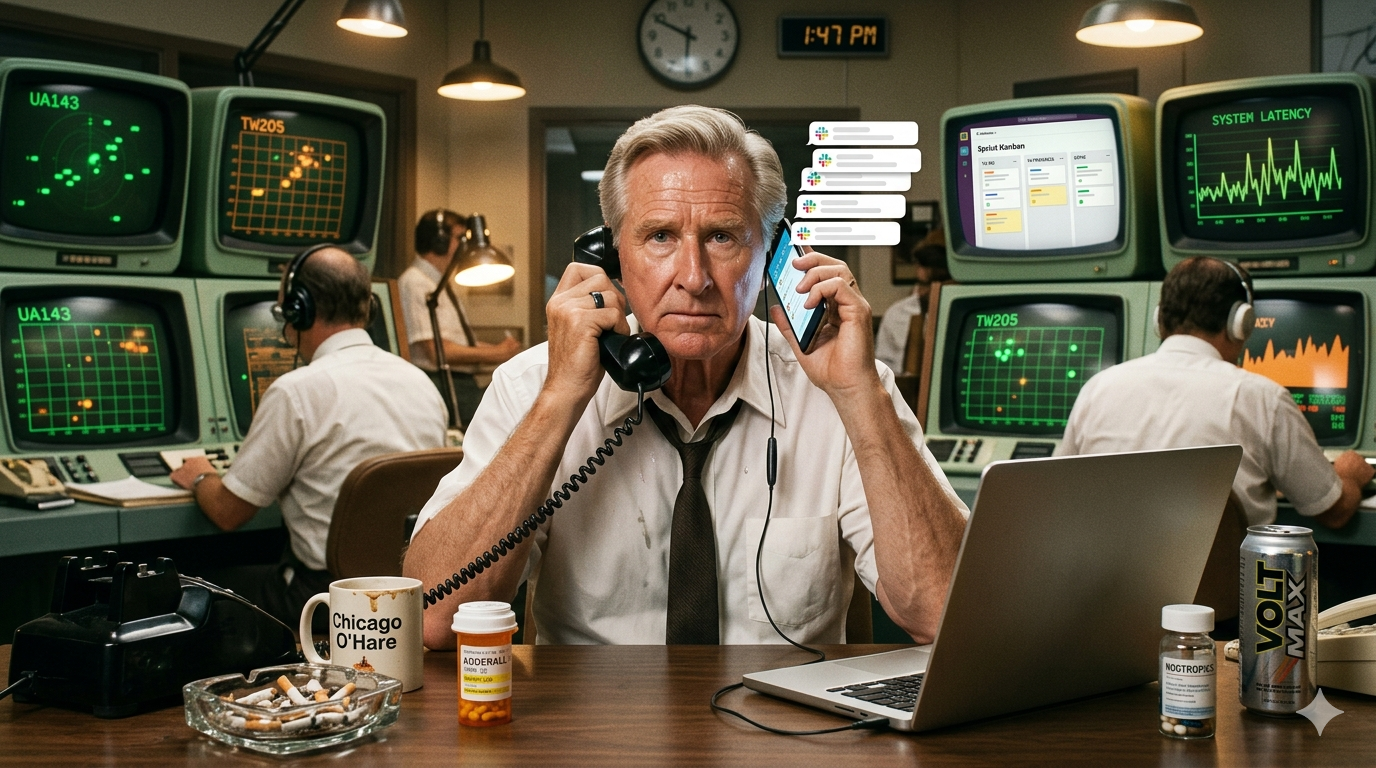
In Airplane! (1980), Lloyd Bridges plays Steve McCroskey, an air-traffic controller running a disaster on the ground while a single pilot with food poisoning tries not to kill everyone on the plane above. McCroskey is on two phones at once. He’s barking at his wife. He’s pivoting to a subordinate mid-sentence. He’s drinking coffee, then cigarettes, then amphetamines, then glue, in that order.
Every fifteen minutes or so, the camera cuts back to him and he delivers the same line with a slightly different noun:
“Looks like I picked the wrong week to quit smoking.” “Looks like I picked the wrong week to quit drinking.” “Looks like I picked the wrong week to quit amphetamines.” “Looks like I picked the wrong week to quit sniffing glue.”
It’s one of the great running gags in American comedy. And it’s not an accident that it works. The audience in 1980 recognized the type immediately — the indispensable middle manager held together by caffeine, nicotine, and the adrenaline of a problem he’s the only one who can solve. The joke is the recognition.
What’s strange, watching it forty-five years later, is that the joke got absorbed. The hero of Airplane! has become the job description.
The 10x engineer is McCroskey with a laptop
Somewhere between McCroskey’s debut and the first Steve Jobs biography, the tech industry decided that the indispensable man wasn’t the punchline anymore — he was the goal. We invented a whole theology around him.
The 10x engineer. The A-player. The founder who sleeps at the office. The rockstar. The person on whom an entire system quietly depends, who does the work of ten others, whose keyboard is wet with Red Bull, and whose calendar is a Jackson Pollock. If McCroskey looked like a breakdown waiting to happen in 1980, the 2010s decided he looked like equity.
Silicon Valley doesn’t tell this story as self-destruction. It tells it as virtue. You are not burning out; you are shipping. You are not context-switching; you are high-agency. You are not dependent on stimulants; you are optimizing. The actor is the same. Only the lighting changed.
Context-switching as workplace culture
The comedy of McCroskey rests on a simple visual: a man doing too many things at once, each with a life-or-death deadline. Modern knowledge work has normalized this to the point that we no longer find it funny. Slack is McCroskey’s second phone. The calendar is McCroskey’s subordinate interrupting him mid-sentence. The 3 p.m. incident review is the pilot in the cockpit throwing up into a paper bag.
The “always-on” performance isn’t neutral. Every published measurement we have — from Cal Newport’s Deep Work to the decades of cognitive research it draws on — says the same thing: sustained attention is where good work comes from, and context-switching is where it goes to die. McCroskey is funny because he’s landing the plane by miracle. Your sprint ships by the same miracle, and we’ve built a culture that treats the miracle as reproducible.
Worse, we’ve moralized it. A developer who declines a 4 p.m. meeting because they’re in the middle of a hard problem is “not a team player.” A senior engineer who wants one afternoon a week uninterrupted is “hard to work with.” Personal boundaries have quietly been reclassified as technical debt.
Performance by vice
McCroskey’s gag works on escalation: smoking, drinking, amphetamines, glue. The joke is that each vice is more desperate than the last, and he never notices because the job is too loud.
The modern version is subtler but not very. Caffeine is basically compulsory. Modafinil and Adderall have quietly entered the knowledge-work diet. Microdosing has moved from Burning Man to the Monday standup. The supplement stack has replaced the cigarette. The cold plunge has replaced the three-martini lunch. Each of these has legitimate uses and plausible advocates. Taken together, they describe a workforce that cannot deliver the performance it has been promised to deliver without pharmacology.
Noticing this is not the same as condemning it. But when the gag from a 1980 comedy maps this cleanly onto 2026 working life, something has gone quietly wrong with what we think “high performance” means.
Vibe coding and the tool-for-process swap
The 2026 version of the gag has its own vocabulary. Vibe coding is the name someone gave — half in earnest, half as a meme — to letting an LLM write the code while you steer with intent, taste, and whatever falls out. It works, often enough. The problem isn’t the tool; the tool is real. The problem is the category error that the word vibe quietly endorses: mistaking a faster tool for a better process.
A tool that halves the typing time does not give you, as a free byproduct, the architectural taste that tells you whether what was typed was worth typing. A tool that removes the friction of producing code does not give you, as a free byproduct, the review practice that catches the thinking mistake the friction would have surfaced. Tools and processes are two different things. One of them ships this quarter. The other is what keeps the thing you shipped from quietly rotting for the next five years.
This is the same category error McCroskey has always embodied, now with a laptop and an API key. He would have loved vibe coding. He would have had three windows open, two autocompletes fighting each other, a Cursor tab generating the PR description for the code he hasn’t read yet, and his wife on hold. Looks like I picked the wrong week to quit reviewing my own pull requests.
The single point of failure is also a person
The economics of the 10x engineer sound great until you remember that a single point of failure is a system-design antipattern and a human being. We love the engineer who knows everything — until she gets pregnant. Or takes a vacation. Or has a breakdown. Or quits. Then we discover that the “high performer” was also a bottleneck nobody built around, and the team that glorified her is the team that couldn’t function without her.
The McCroskey company doesn’t survive McCroskey quitting. Neither does the McCroskey engineer.
This is where Anne Helen Petersen’s Can’t Even and Oliver Burkeman’s Four Thousand Weeks meet in an uncomfortable handshake. Petersen shows the cohort of workers who were told heroic effort would be rewarded and got precarity instead. Burkeman shows that even the rewarded version — the successful, high-agency life fully optimized for productivity — doesn’t actually deliver the good the productivity was supposed to buy. Both books arrive at the same place from different doors. The 10x life is not a good life even when it works.
The opposite direction of self-awareness
There’s one more thread I want to pull, because it connects this to the last two posts in this series.
In Enlightenment and Madness I wrote about Remedios la Bella and José Arcadio Buendía — the two faces of transcendence that modernity no longer makes room for. In The Chestnut Tree as Modern Diagnosis I wrote about the quieter face of the same erasure: what happens when cultures without a category for mystical experience medicate it into a chart.
McCroskey is the third face, and maybe the one we’ve most completely surrendered to. Every contemplative tradition on earth — Zen, Vipassana, Stoicism, Christian contemplatio, Sufi dhikr — begins from the same insight: you cannot see yourself while you are running. Self-awareness requires the slow second, the pause, the moment where the breath is no longer instrumentally allocated to the next task.
The 10x performance is the engineered opposite of this. It is a full-body commitment to the proposition that you do not need to know yourself in order to be maximally useful — and, increasingly, that knowing yourself is a form of slack the quarterly plan cannot afford. Meditation says stop. Productivity says stop costs money. The two metaphysics cannot coexist in the same nervous system for very long.
We have collectively picked the second one, and we are already paying. The mental health numbers are the receipt. Nobody reading this needs the citation.
Looks like we picked the wrong week to quit noticing
Airplane! ends with the plane landing safely, because it’s a comedy, and McCroskey is still at his desk, because he’s made of adamantium and script requirements. Real McCroskeys land differently. Sometimes they land fine. More often they don’t, and the team around them lands on top of them.
I don’t have a neat prescription. Cal Newport’s Deep Work is a useful technical book. Burkeman’s Four Thousand Weeks is a useful metaphysical one. Petersen’s Can’t Even is a useful political one. None of them repeals the 10x theology. That takes a change of taste, which is slower.
The first move, though, is the one the audience made in 1980 and forgot how to make by 2026: watch McCroskey juggle three crises and a pack of cigarettes and notice that he’s the punchline, not the hero.
Looks like we picked the wrong week to quit noticing.
Further reading
- Cal Newport — Deep Work: Rules for Focused Success in a Distracted World (2016)
- Oliver Burkeman — Four Thousand Weeks: Time Management for Mortals (2021)
- Anne Helen Petersen — Can’t Even: How Millennials Became the Burnout Generation (2020)