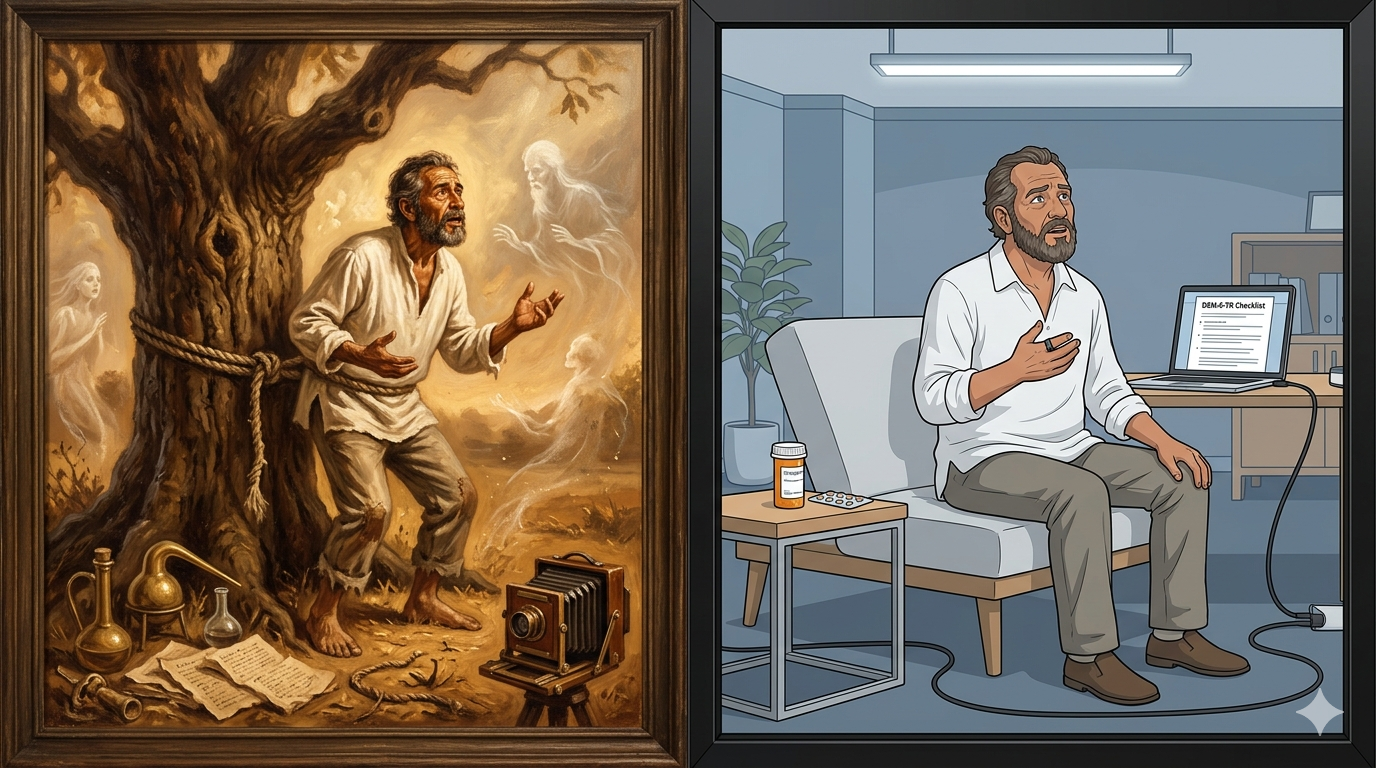
In Enlightenment and Madness I argued that José Arcadio Buendía wasn’t mad in the way Macondo thought he was — that the patriarch tied to the chestnut tree was another face of the same transcendence that lifts Remedios la Bella into the sky. Two exits from ordinary consciousness, one serene, one savage.
A reader — my mother, actually — pushed back on that with a sharp question. If he had lived today, she asked, would you still call it wisdom, or would you just put him on a medication and send him home?
I think that is the right question, and it deserves its own post.
The rope and the prescription
Imagine José Arcadio Buendía walks into a clinic today. The intake nurse hears the Latin monologues, the fixations on alchemy and magnetism, the grandiose certainty that the daguerreotype will one day photograph God. She looks up, concerned, and starts checking boxes.
- Pressured speech, flight of ideas → hypomania.
- Fixated, obsessive research rabbit holes → OCD or the attentional profile now called ADHD.
- Visions of invisible interlocutors → schizotypy, perhaps schizophrenia if sustained.
- Grandiose transformative projects → bipolar I in its expansive phase.
- Latin lectures to nobody → a psychotic break.
By the time the chart is done, José Arcadio has a small pharmacy to pick up on the way out. The chestnut tree is replaced by lithium, risperidone, an SSRI for whatever depression trails the expansive episodes, and a standing appointment with a case worker.
The medication replaces the rope. The DSM replaces Macondo.
Whether that is progress is not, I think, a settled question. It certainly looks like progress — no one wants to be tied to a tree. But we should notice what has happened under the hood. We’ve taken a person who, in 1910, would have been read as a visionary, a madman, a prophet, or a lost alchemist — depending on the village — and replaced that entire semantic field with a single word: patient. And the price of admission to that word is agreeing that what was happening inside José Arcadio was a malfunction, not a vision.
Foucault’s move
Michel Foucault spent a career arguing that “madness” is less a discovery than a construction. In Madness and Civilization he traces how, over the course of a few centuries, Western societies stopped treating the mad as an uncomfortable but sacred part of the social fabric and began locking them up — first in the old leper houses after the lepers were gone, then in increasingly clinical institutions, until finally the category called “mental illness” crystallized into the shape we inherited.
The point is not that nobody ever suffered before the DSM. People suffered, and a lot of what we now medicate really is suffering and deserves relief. The point is that the boundary — where ordinary ends and pathological begins — is not a natural fact. It is a line we redraw every generation, and where we draw it tells us more about what a given society can tolerate than about the people on either side of the line.
José Arcadio Buendía is on the wrong side of our line. He would have been on the wrong side of almost any line. But the ease with which we would now translate his entire being into a treatment plan should at least give us pause.
Trungpa’s inverse
Here is where it gets uncomfortable. Chögyam Trungpa — the Tibetan teacher whose yeshe chölwa, “wisdom gone wild,” I leaned on in the previous post — would read the clinic scene above in the exact opposite direction. Not “here is a sick man being generously helped,” but “here is a man being gently, efficiently stripped of the one thing that made him real.”
In the Vajrayāna frame, the states modernity classifies as disorders are also the raw material of awakening. The manic over-coupling of pattern and meaning is how the mystic actually sees. The dissolving ego-boundary we call dissociation is also the ground of non-duality. The obsessive rabbit hole is also the samaya of a serious practitioner. The DSM entries are not simply wrong, but they are descriptions written from outside a territory where the interior experience looks radically different.
If you take Trungpa seriously, then our therapeutic apparatus is sometimes curing people of enlightenment.
Neither reading is comfortable
The honest problem is that both readings are real, and neither gives a clean answer.
Yes: a lot of what gets medicated is genuine suffering, and the relief matters. People in psychotic episodes are terrified. People with untreated bipolar destroy their lives. Depression kills. Nobody who has sat with a friend in the wrong kind of episode romanticizes any of this. The rope was not a good solution.
Also yes: the category has quietly grown to swallow too much. The edges of “normal” keep shrinking — a grief that lasts too long is now a disorder, a child who can’t sit still for seven hours is now a disorder, a spiritual opening is now a disorder, a prophetic streak is now a disorder. The semantic field that once held saint, prophet, fool, visionary, crank, eccentric, mystic has collapsed into treated and untreated.
Trungpa’s own warning cuts both ways. He called it spiritual materialism — the ego’s habit of collecting enlightenment as an achievement. Romanticizing José Arcadio’s chestnut tree from the safety of a modern desk is itself a kind of spiritual materialism. I cannot credibly ask anyone to trade real relief for mythic imagery.
But I also cannot pretend the imagery has nothing to teach us.
The wellness industry as alchemy without the metaphysics
Modern life didn’t lose the hunger that drove José Arcadio to the laboratory. It only stripped the metaphysics out of it.
Look at where the alchemical impulse reappears today. Optimization. Biohacking. Microdosing. “The work.” The Oura ring. Continuous glucose monitors for people with no diabetes. The cold plunge. The sauna protocol. The supplement stack. The therapy hour, the coach, the retreat. This is the same obsession José Arcadio had — we can transform ourselves, we can see through the veil, we can make gold out of lead — translated into the dialect of a managerial civilization that does not believe in souls.
What’s missing is the metaphysics. José Arcadio thought he was assaulting the divine order. Today we think we are optimizing a meat suit. The ambition survives. The horizon has collapsed.
Ivan Illich saw this half a century ago. In Medical Nemesis he argued that medicine, past a certain point, stops healing and starts producing the sickness it then claims to treat — iatrogenesis as an industry. I think the wellness complex is Illich’s argument at a higher octave. The modern subject is invited, for a monthly subscription, to become their own José Arcadio: forever tinkering, forever optimizing, forever one tweak short of the breakthrough. The chestnut tree has become the therapy couch, the ketamine clinic, the Oura ring, the Slack channel for the cohort of your current program.
This is not a cheap dunk on wellness. A lot of it genuinely helps people. I sleep better in a dark room than a bright one; I am not above the ring. The question is subtler: once the metaphysics is gone, is the remaining practice still protecting us from the ego-trap Trungpa warned about, or is it the ego-trap itself, now wearing a Whoop strap?
Two honest questions
I promised at the beginning of this series to end on real questions rather than false resolutions. Two keep returning.
- When we convert José Arcadio Buendía into a chart and a prescription, we relieve him, and we also erase him. Is the trade worth it — and do we even have standing to ask, from outside the consciousness we would be erasing?
- Modern wellness has kept the alchemical drive and dropped the metaphysics. Is that honesty — we finally admit the lead was never going to become gold — or is it the deepest form of spiritual materialism, alchemy without a god to answer to?
García Márquez ended Cien Años with Macondo erased by wind. Foucault ended Madness and Civilization with the suspicion that our asylums were just leper houses with better plumbing. Trungpa ended most of his talks with a joke nobody was sure how to take.
I don’t have a better ending than any of those. The chestnut tree is still standing, somewhere, in every one of us. What we tie to it, and what we call that thing once we’ve tied it, is an open question a society as medicated as ours owes itself the courage to keep asking.
Further reading
- Michel Foucault — Madness and Civilization (1961)
- Chögyam Trungpa — Cutting Through Spiritual Materialism (1973)
- Ivan Illich — Medical Nemesis / Limits to Medicine (1974)
- Gabriel García Márquez — One Hundred Years of Solitude (1967)