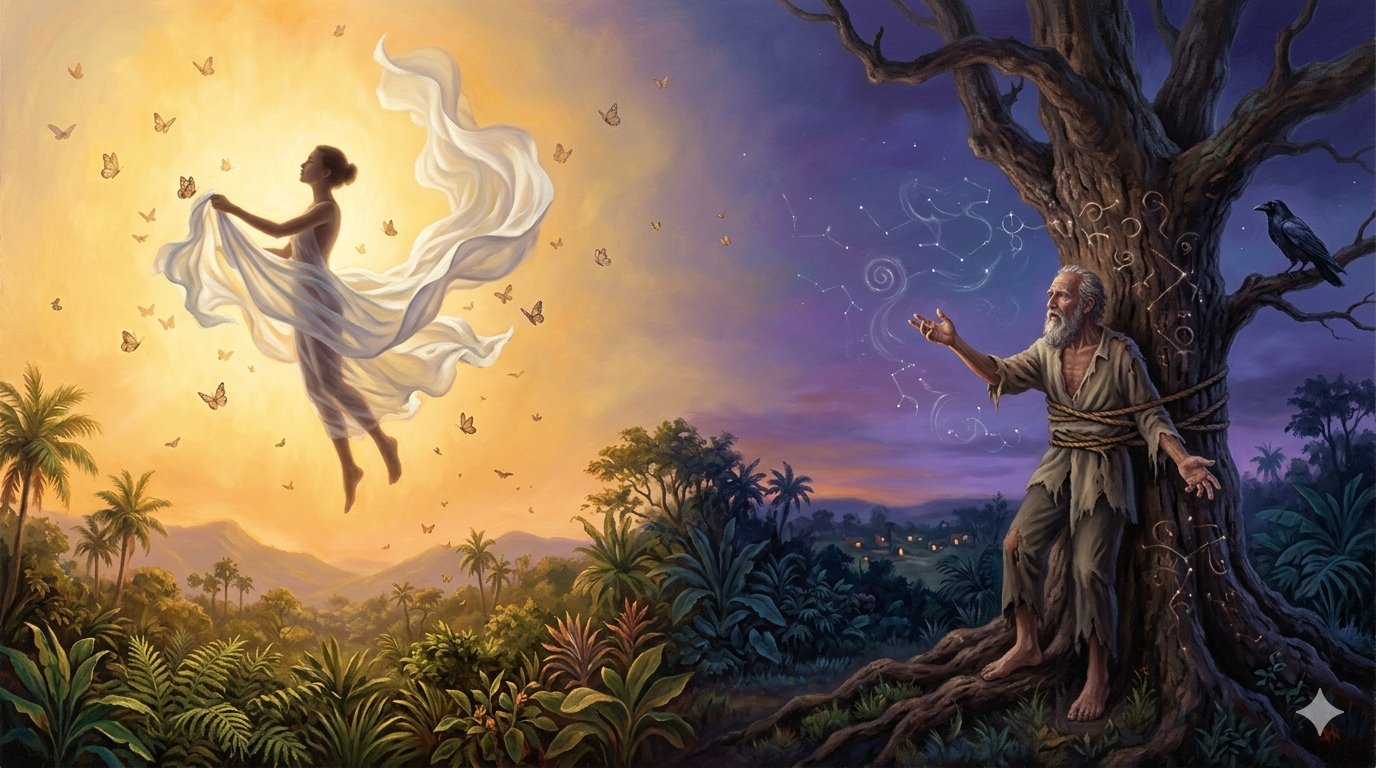
Rereading Cien años de soledad after many years, I found myself less drawn to the Buendía dynasty’s epic sweep than to two characters at opposite poles of the novel: Remedios la Bella, who ascends bodily into the sky while folding sheets, and José Arcadio Buendía, the patriarch who dies tied to a chestnut tree, speaking Latin to the ghosts only he can see.
Both escape Macondo. Both leave ordinary reality behind. But they do so from diametrically opposite directions — one upward into serenity, the other downward into madness. The more I thought about it, the more this looked like a question Buddhism has wrestled with for centuries: what separates enlightenment from craziness, and are they really opposites at all?
Remedios la Bella: The Buddha of Macondo
Remedios la Bella is pure presence. She wanders naked around the house because clothes have nothing to do with her. She doesn’t grasp social convention. She kills men — not through seduction, but through the unbearable fact of her detachment. Her beauty is not beauty in the ordinary sense; it is the beauty that comes from not wanting anything, not clinging to anything, not seeing the world the way most of us see it.
When she ascends into the sky — matter-of-factly, while folding sheets — García Márquez gives us one of literature’s most perfect images of enlightenment. Not the laborious monk-after-decades-in-a-cave enlightenment. The other kind. The kind that was always already there. Remedios does not attain liberation; she was never trapped.
This is Buddha-nature in its most radical form: the mind that does not adhere. Remedios is what the Zen masters pointed to when they said the ordinary mind is the way — if you could only stop interfering with it.
José Arcadio Buendía: Crazy Wisdom at the Chestnut Tree
At the other end of the novel sits the founder of Macondo. José Arcadio Buendía obsessed over alchemy, magnetism, magnifying glasses as weapons, the daguerreotype as proof of God or His absence. He speaks in prophecies nobody else understands. Eventually he becomes violent. His family ties him to a chestnut tree, where he dies speaking Latin to visions.
Everyone in Macondo agrees: he went mad.
But there is another way to read him. Chögyam Trungpa, the Tibetan Buddhist teacher who brought tantric practice to the West, wrote about crazy wisdom — yeshe chölwa, “wisdom gone wild” — in the lectures collected as Cutting Through Spiritual Materialism and elsewhere. It is the enlightened mind that refuses to be domesticated by convention, that acts outside every expected frame, that looks to ordinary observers exactly like madness.
José Arcadio Buendía looks a lot like that. His obsessions weren’t only obsessions; they were attempts to see through the veil. The chestnut tree wasn’t a cage. It was a cushion.
The difference between Remedios and José Arcadio isn’t the destination. It’s the route. She floats up through transparency. He burrows through the wall with his forehead.
Two Paths, One Door
Buddhism, mythologized in the West as a path of calm, actually contains both modes. There is the Theravāda path of purification, mindfulness, insight — the monk’s slow lamp-lighting of consciousness. And there is the Vajrayana path of tantric rupture, the razor held to convention, the teacher who slaps you because you asked a polite question.
- Remedios is the first path at its extreme: so pure she never needed to walk it.
- José Arcadio Buendía is the second path at its extreme: so wild the path burned out beneath him.
Both are exits from ordinary consciousness. Both terrify the societies that contain them.
Modern Times
We believe in neither now. Modern life is a dense middle: productive, measurable, medicated when it drifts too far from the mean. Remedios today would be diagnosed. José Arcadio would be committed.
This is not a new observation. Foucault spent a career on it — how the boundaries of “madness” tighten as societies industrialize, how the visionary, the mystic, and the fool become clinical categories once we decide consciousness is a machine with correct settings.
But something older is at work. Every traditional culture preserved, in some form, a space for the transcendent and a space for the sacred madman. Shamans. Prophets. Saints of both the ascetic and the Dionysian varieties. Modernity has few such spaces left. The ordinary has metastasized.
And when modern life does reach for something beyond the ordinary, it tends to trap it inside the same acquisitive frame — what Trungpa called spiritual materialism: the ego’s habit of collecting teachings, teachers, and experiences as if enlightenment were another asset class. Remedios is beyond that frame. José Arcadio Buendía burns through it. Neither fate is one we would wish on ourselves, which may be the point.
Zarathustra in the Marketplace
Nietzsche understood this, which is why his philosopher-prophet descends from the mountain to deliver a message the crowd treats as either scandalous or insane. Zarathustra is not mad. Zarathustra speaks from somewhere no one else currently lives. But the structure of his reception — the scornful crowd in the marketplace, the indifference, the eventual disciples who misunderstand him almost as completely as the crowd — is the structure of how any transcendent knowledge lands in ordinary time.
The Übermensch that Zarathustra teaches is neither Remedios nor José Arcadio exactly, but he shares their geometry. He stands outside the moral and cognitive average. He is, by the lights of any given village, either a saint or a lunatic.
Nietzsche himself collapsed into actual madness in his final years. Whether that was cost or confirmation of his own teaching is a question his biographers have never stopped arguing about.
Two Questions to Close
Reading Cien Años with this lens, two questions keep returning:
- If Remedios and José Arcadio Buendía are two faces of the same transcendence — one serene, one savage — how would we know which one we had encountered in a saint or a madman we met today?
- What does it mean to live in a time whose default stance is that both are symptoms of the same disorder?
García Márquez didn’t answer either question. Good novelists don’t. But he left Macondo on the page knowing that Remedios ascended and José Arcadio Buendía was tied to a tree — and that at least one of them, maybe both, had seen something the rest of us are still looking for.
Further reading
- Gabriel García Márquez — One Hundred Years of Solitude (1967)
- Chögyam Trungpa — Cutting Through Spiritual Materialism (1973)
- Friedrich Nietzsche — Thus Spoke Zarathustra (1883)